
 By
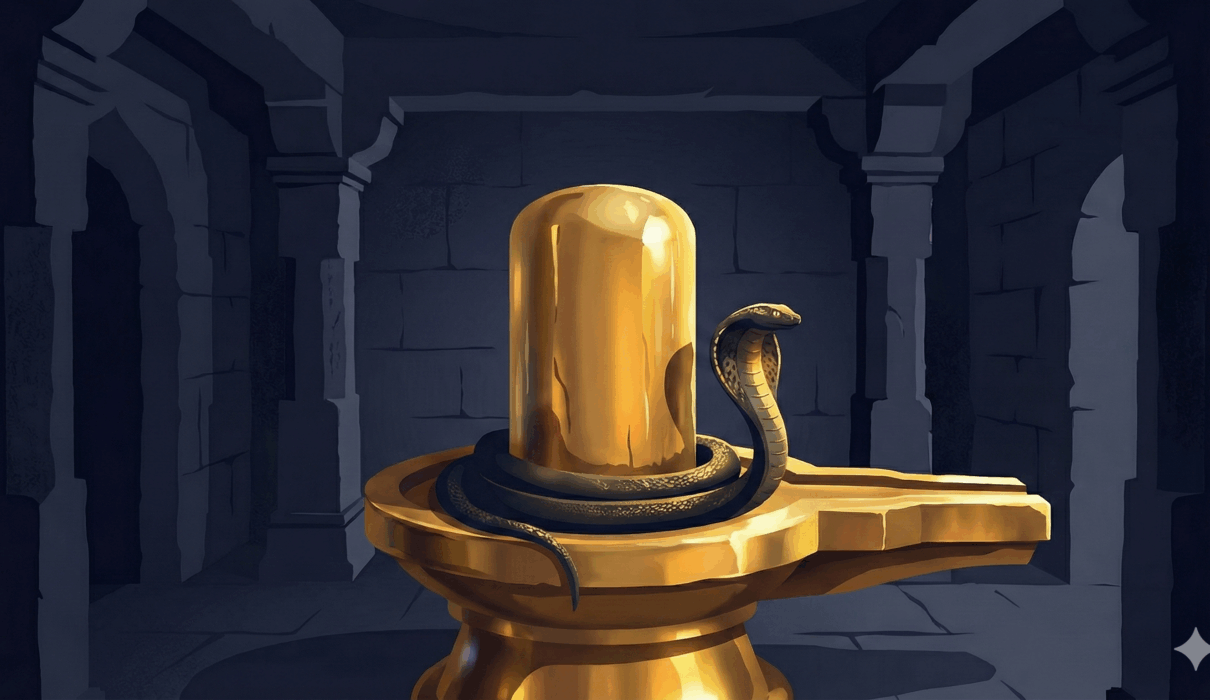
By The small temple of Maa Ganga stood high on a hill overlooking the village of Dhampur. Its stone walls were worn smooth by the rain and sun, but inside, a beautiful, small idol of a goddess, believed to be made of pure gold, shimmered faintly in the lamplight.
For years, an old priest named Devan served the temple. He was a man of simple needs and deep faith. He polished the idol daily, not for its wealth, but for the light it brought to the faces of the humble villagers who came to pray.
One evening, as the sun dipped behind the western hills, a snake, long and dark, slid quietly into the shrine. It coiled itself neatly beneath the golden idol, seemingly taking up residence.
Devan was not frightened. He knew the creature was a part of nature, and the temple was its home too. He continued his duties, leaving a small bowl of milk near the snake each day.
The snake grew accustomed to the priest. It never harmed him, and the villagers saw the sight as a blessing—a sign that the Goddess protected her treasures.
Word of the Golden Idol and its serpentine guardian reached the ears of a wealthy merchant named Kiran in the city. Kiran was a man whose heart was ruled by a thirst for more. He was rich, but his greed was boundless.
Kiran traveled to Dhampur. He saw the shimmering idol and his eyes widened with lust. He ignored the beauty of the mountain and the peace of the temple; he saw only the weight of the gold.
He observed Devan and the snake. “What is this foolishness?” he muttered. “A snake guarding a fortune, fed by a man who could easily take the gold for himself.”
Kiran approached the old priest. “Devan-ji,” he said with a false smile, “that gold belongs to the Goddess, yes? But you, a man of simple virtue, could use some worldly reward. I will give you ten thousand silver coins if you simply remove the snake for one hour so I may take the idol and replace it with a silver one.”
Devan looked at the gold idol, then at the coiled snake, and finally at the eager, hungry eyes of the merchant.
“Sir,” Devan replied, “the gold is not mine to give. And the snake is not a guardian; it is a fellow resident. It asks for nothing but a sip of milk each day.”
Kiran was furious but hid his anger. He believed the old priest was merely holding out for a better offer.
The next day, Kiran returned with a large, heavy box filled with gold coins. “Take this, old man,” he commanded, placing the box at Devan’s feet. “This is more money than your village has seen in a year. Remove the snake and go in peace.”
Devan sighed. He knew that the sight of the gold was blinding Kiran.
“Kiran-ji,” Devan said gently, “I have lived here long. The snake comes, eats its meal, and departs. It seeks only trust, not gold.”
Kiran laughed, a dry, rasping sound. “Trust? It wants only milk because it doesn’t know the value of the gold it guards! Greed is a language everyone understands.“
He pushed past Devan and approached the golden idol. The snake, sensing the merchant’s sudden, violent intent, uncoiled slightly but remained still.
Kiran, seeing his chance, swung a heavy stick, intending to strike the snake and drive it away.
But as the stick swung down, the snake, quick as lightning, did not strike Kiran. Instead, it moved its head and struck the heavy box of gold coins that Kiran had brought, knocking it over.
The box tumbled open, spilling the shiny coins across the stone floor. The coins scattered and rolled, their sound a mockery in the silent temple.
Kiran looked in shock at his scattered fortune, then back at the snake. The creature looked at the merchant, then at the old priest, and slowly, deliberately, slithered away, disappearing into a crack in the wall.
Kiran finally understood. The snake had never been the obstacle; his own greed was. The creature had only protected its home and, in a strange way, the pure heart of the priest. The snake wanted nothing, while Kiran, with his chest full of gold, still wanted more. His greed had been exposed and had cost him the peace of the temple.
He gathered his scattered coins, the metal suddenly feeling cold and heavy with shame. He left the temple that day, richer in gold but poorer in spirit. Devan continued his service, knowing that the greatest treasures are often those that cannot be bought or stolen.
If this story about the danger of greed resonated with you, you may also enjoy reading about the importance of perspective in The Secret of the Two Gardens.
The Moral
True wealth is measured not by what you possess, but by the peace you find in what you do not need. When greed enters the heart, it blinds a person to the value of trust and contentment.
Glossary and Vocabulary for Learners
| Word | Part of Speech | Meaning for the Story | Example Sentence |
| Shimmered | Verb | Shone with a soft, flickering light. | The golden idol shimmered faintly in the dark. |
| Worn | Adjective | Damaged or made thinner by continuous use over time. | The temple walls were worn smooth by the weather. |
| Serpentine | Adjective | Resembling a snake; coiled or winding. | The merchant ignored the serpentine guardian. |
| Guardian | Noun | A person or thing that protects something. | The snake acted as a silent guardian of the temple. |
| Boundless | Adjective | Unlimited or immense. | Kiran was wealthy, but his greed was boundless. |
| Vague | Adjective | Not clearly stated or defined. | He gave a vague reason for wanting the gold. |
| Unwavering | Adjective | Steady and resolute; not changing. | The priest’s faith was unwavering. |
| Ingenuity | Noun | The quality of being clever, original, and inventive. | The man’s ingenuity saved the day. |
| Sank | Verb (Past Tense) | Gradually settled or dropped to a lower level (used figuratively here). | His spirits sank as he realized his mistake. |