
 By
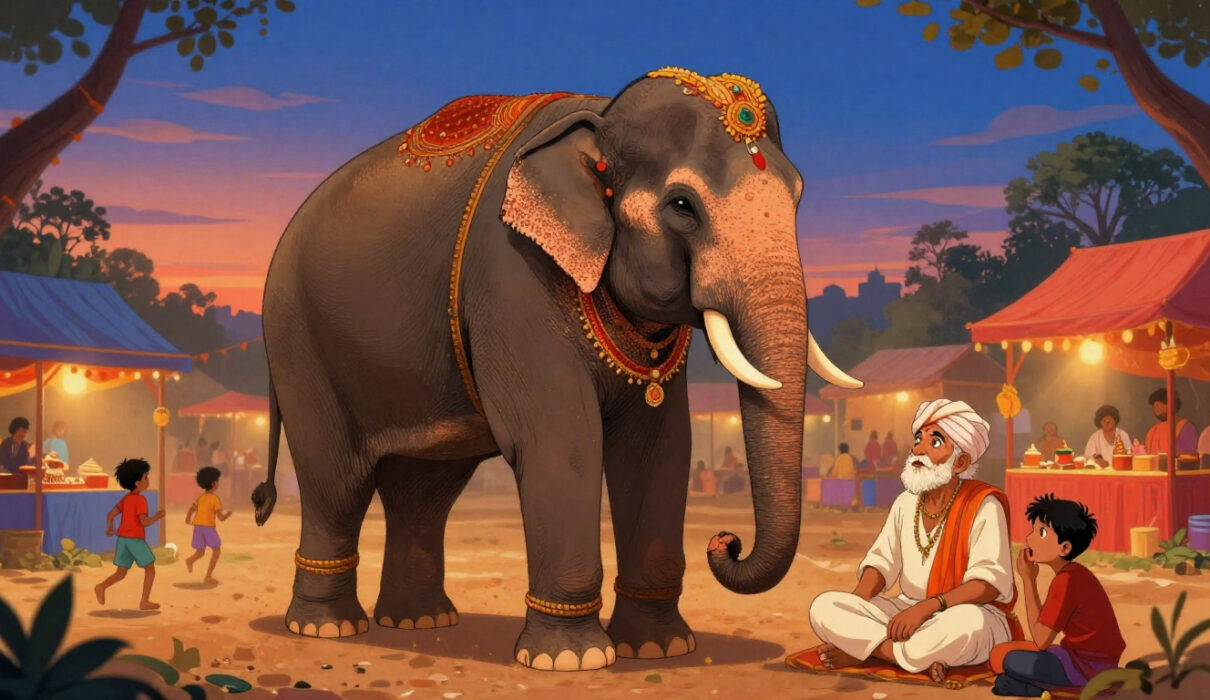
By The late afternoon sun hung low above the dusty grounds of a small village mela. Stalls lined the open field—colorful bangles, sweets dripping with syrup, toys that spun in the wind. Children ran past, laughing, while elders bargained over spices and cloth. At one corner of the fair, a group of elephants stood calmly, their grey bodies shining faintly with dust and sunlight.
Arun, a young schoolteacher visiting from the city, found himself drawn to them. He had always admired elephants for their strength and gentle eyes. As he approached, he stopped suddenly, frowning with confusion.
Each massive elephant—powerful enough to uproot a tree—was tied with nothing but a thin rope looped around one front leg. No iron chains. No heavy posts. The rope looked like something used to tie a goat, not a giant creature of the jungle.
“How is this even possible?” he murmured.
Any one of these elephants could snap the rope like a piece of old thread. They could run free into the fields or walk across the mela without anyone being able to stop them. Yet they stood quietly, swaying slightly, waiting for their mahouts to return.
The scene puzzled him so much that he walked to the nearest trainer, an older man wearing a faded turban and a warm smile. The man sat polishing a brass bell used during performances.
“Baba,” Arun asked, “why are the elephants tied with such a small rope? They could break it in a second. Why don’t they run away?”
The trainer chuckled softly, his eyes wrinkling with kindness.
“Beta,” he said, “when these elephants were very young—no bigger than a calf—we used the same rope to tie them. At that age, it was strong enough to hold them back.”
He paused, watching one elephant flap its ears lazily as a fly buzzed past.
“In those early days,” the trainer continued, “they tried many times to break free. They pulled, tugged, struggled… but the rope always won. After many failures, they accepted that they cannot break free. That belief has stayed with them.”
He lifted the rope gently. “Even now, when they are strong enough to crush a tree trunk, they never question the rope.”
Arun stared at the elephant nearest to him. It lifted its trunk and dusted its own head, completely unaware of its own strength.
“So you’re saying,” Arun asked slowly, “that the only thing holding them is their belief?”
“Yes,” the trainer replied. “Not the rope. The belief.”
The words sank into Arun like a stone sinking into a calm river. He looked again at the elephants—majestic, powerful beings accepting a life of limitation because of an old memory.
As he stood there, something shifted inside him. Arun thought about his own life—dreams he had abandoned, talents he had buried, opportunities he had believed were “not for people like him.” He remembered the time he had wanted to write a book but stopped after two rejections from publishers. He remembered how he avoided applying for better jobs, afraid he wasn’t “good enough.”
How many ropes had he tied around himself?
He watched a little boy offer a banana to one of the elephants. The elephant reached out gently, curling its trunk with surprising delicacy. Arun realized that if someone cut the rope right now, the elephant would probably still stand in the same place—simply because it believed it couldn’t move.
A belief could be stronger than any chain.
As the sun dipped lower, softening the sky with an orange glow, Arun walked slowly through the mela. The sounds around him—drums, laughter, vendors calling out offers—felt faint, as if he had stepped into another world inside his mind.
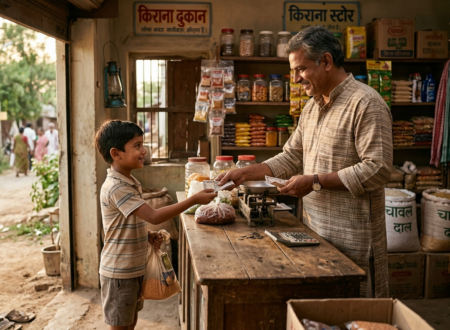
He passed a stall selling clay lamps. The shopkeeper lit one and placed it near the edge of the counter. “Light helps us see what we forgot,” the man said casually, speaking to no one in particular.
Arun felt the words echo the same lesson the elephants had taught him.
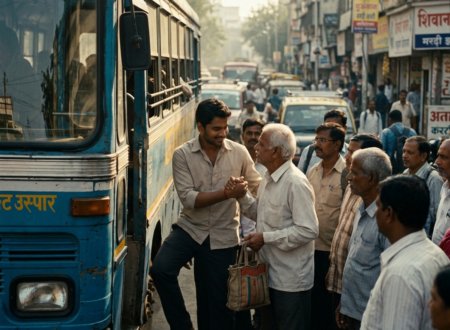
Later that evening, while returning home on a crowded bus, he kept thinking about the rope. Not the elephant’s rope—but his own invisible ropes. Memories of old failures that held him back. Judgments he had accepted from others. Limits he had never tested again.
When he reached his small rented room, he sat at his desk and opened an empty notebook. He wrote only one line:
“The rope is not real anymore.”
The next day, he woke early, filled with a quiet confidence. He started his week by submitting his old manuscript again to two publishers. He applied for an advanced teaching position he had always avoided. He even joined a local writing circle at the community center.
Every time doubt entered his mind, he remembered the elephants standing under the evening sky—giants held by nothing but a belief.
Weeks passed, and small changes began to bloom. His manuscript received encouraging feedback. Students praised his new teaching ideas. Arun slowly felt a part of himself growing stronger—something he had forgotten existed.
One evening, while walking by the riverside, he smiled at the memory of the mela. “We break our ropes the moment we stop believing in them,” he whispered.
And in that simple truth, he felt something inside finally set free.
Moral
Many of our limitations exist only in our minds—once we challenge them, we become free.
Glossary
- Mela — An Indian fair or festival.
- Mahout — A person who trains and cares for elephants.
- Tethered — Tied or fastened.
- Conditioned — Trained to think or behave in a certain way.
- Uproot — To pull something out of the ground.
- Delicacy — Gentle, careful action.
- Manuscript — A writer’s draft or book before publishing.
- Echo — To repeat or reflect an idea.
- Limitations — Things that restrict ability or growth.
- Belief — Something one accepts as true.
- Confidence — Trust in oneself.
- Failure — Not succeeding at something.
- Rope (metaphorical) — A mental barrier or limiting belief.
- Encouraging — Giving support or hope.
- Bloom — To grow or develop.
Vocabulary List
- Belief — Conviction, assumption
- Strength — Power, force
- Gentle — Soft, mild
- Conditioned — Trained, shaped
- Tug — Pull, yank
- Abandon — Give up, quit
- Opportunity — Chance, possibility
- Memory — Recall, remembrance
- Struggle — Challenge, effort
- Discover — Realize, find
- Transform — Change, evolve
- Encourage — Support, motivate
- Break free — Escape, liberate
- Limitation — Restriction, barrier
- Reflect — Think, contemplate
- Tame — Calm, control
- Journey — Path, voyage
- Growth — Improvement, progress
- Resolve — Determination, purpose
- Whisper — Murmur, breathe softly