
 By
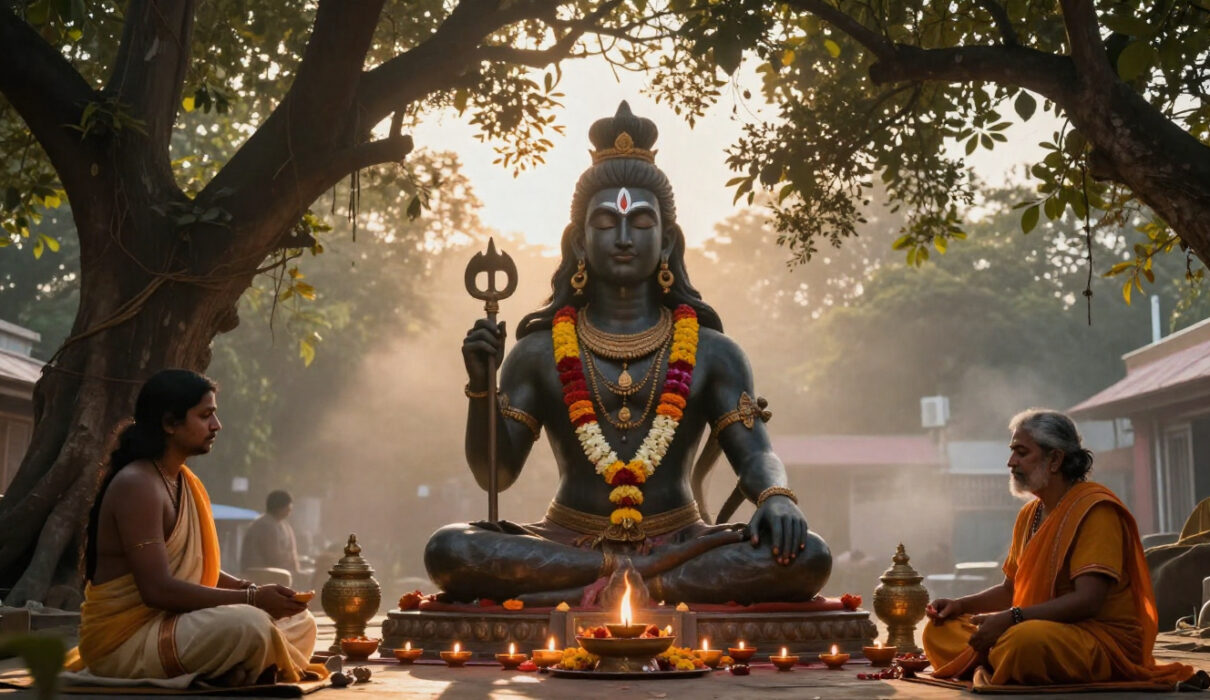
By The air in the village of Amarnathpur was thick and heavy. It smelled of crushed marigold flowers, stinging camphor, and that damp, metallic scent the river leaves behind after the sun sets. It was Maha Shivaratri—the Great Night of Shiva. Up on the hill, the temple bells were ringing non-stop. The sound didn’t just hang in the air; it rolled down the stone steps like a wave, vibrating through the rooftops of every house in the valley.
Anant had heard those bells every year of his life. But tonight, they felt different. To him, they sounded like a question he couldn’t answer.
He sat on the cool, packed dirt, his back resting against the twisted trunk of a massive Bilva tree. Its three-pronged leaves rustled above him, making a sound like a constant, dry whisper. In his lap, he held a single twig of those leaves. That was it. He had no brass pot of milk for the abhishekam, no new clothes, and not even a single coin to buy a coconut.
A year ago, Anant’s life was a straight, happy path. He had a small shop and a family that was his whole world. Then the river flooded. In one night, the water took his shop, his home, and the two people he loved most. Now, he was just a man with a torn kurta and a heart that felt like it was full of lead.
The Heavy Heart
Inside the temple, the jagran was loud. “Om Namah Shivaya… Om Namah Shivaya…” The chant rose and fell like the breathing of a giant. He could hear the rich men from the city giving orders, busy organising a grand ritual. He closed his eyes and could almost see it: the priests pouring liters of milk and honey over the cold, black stone of the Lingam. He imagined the bright oil lamps and the pride in the eyes of the people who could afford such things.
Anant looked down at his wilted leaves. A beggar’s gift, a bitter voice inside him hissed. It was his pain talking. Why are you even here? the voice whispered. Where was God when the river took your daughter’s hand?
The thought was a dark stone in his chest. Tonight wasn’t just a prayer; it was a battle. On one side was his weak, tired faith. On the other was a sadness that had a thousand sharp teeth.
The Moment of Surrender
Tears, hot and quiet, finally spilled over. They ran through the dust on his cheeks and dripped onto the dry roots of the Bilva tree. He didn’t wipe them away.
“I’m empty, Mahadev,” he whispered into the dark. “I have nothing left. No milk, no money, and no peace. I only have these leaves and a soul that is broken.”
He wasn’t trying to be fancy. He was just tired. He gave up—not because he was holy, but because he had no strength left to fight. And right then, in that moment of total silence, something shifted.
The temple noise didn’t stop, but it felt miles away. The darkness behind his eyelids changed. It wasn’t “empty” anymore; it felt vast and cool, like the air on a high mountain. He felt a presence. It wasn’t a ghost or a magic trick. It was a sudden, deep feeling of being held.
The Light Within
It felt like a steady hand on his shoulder. No words were spoken, but the message was clear: I am here. I was in the water. I was in the grief. I am the one crying these tears with you.
A strange stillness settled over Anant. His life wasn’t fixed—his family wasn’t coming back—but the “hole” in his chest had changed. It wasn’t a void anymore; it was a space filled with a quiet, blue light.
He looked at the Bilva leaves in his hands. They weren’t just “offerings” anymore. They were alive. They were him.
Slowly, his knees aching, Anant stood up. He walked past the chanting crowds and the piles of expensive fruit. He didn’t wait for a priest. He simply leaned forward and placed his small twig of leaves at the base of the Lingam.
At that exact second, the main oil lamp flickered and flared bright gold. For one heartbeat, the light caught the tears on Anant’s face. In the polished stone, he saw his own reflection—but he didn’t see a victim. He saw a man who was at peace.
The Dawn of Peace
The priest nearby gasped, seeing the flame jump for such a tiny gift. The crowd began to whisper about “miracles.” But Anant didn’t care about the flame. He just smiled—a real smile that finally reached his eyes.
As the first grey light of morning touched the village, Anant walked back to his tree. He realised that the “Great Night” wasn’t about staying awake; it was about finally waking up. He hadn’t found God in the gold or the milk. He had found Him in his own brokenness, under a tree, in the quiet heart of a man who had finally let go.
Moral of the Story
True devotion isn’t about how much we give, but how much of ourselves we offer. Lord Shiva doesn’t look for expensive gifts; He looks for the honest heart that turns to Him with sincerity and surrender.
Vocabulary Words
- Metallic: A smell or taste like metal (like the river air).
- Gnarled: Twisted and lumpy, like the bark of an old tree.
- Wilted: Droopy or limp (like a leaf losing water).
- Vibrating: Shaking slightly and quickly.
- Kurta: A traditional Indian tunic or shirt.
- Surrender: To stop fighting and let go.
- Presence: The feeling that someone or something is nearby.
- Void: A completely empty space.
- Reflection: The image you see in a mirror or shiny stone.
- Sincerity: The quality of being honest and genuine.
Glossary Words
- Maha Shivaratri: The most important night of the year for devotees of Shiva.
- Bilva: A sacred tree whose leaves are used to worship Lord Shiva.
- Abhishekam: A ritual where milk or water is poured over a deity.
- Jagran: Staying awake all night to pray or sing.
- Om Namah Shivaya: A powerful mantra of devotion to Shiva.
- Lingam: The symbol used to represent Lord Shiva in temples.
- Mahadev: A name for Shiva meaning “The Great God.”
- Bells: Used in temples to wake up the senses and focus the mind.
- Camphor: A substance burned in Indian rituals for its strong scent.
- Atma-Jagran: The awakening of the soul or inner self.
FAQs
1. Why are Bilva leaves offered to Lord Shiva? The Bilva leaf is believed to be Shiva’s favourite. Its three leaflets represent the three eyes of Shiva and symbolise the removal of three types of sins: physical, mental, and verbal.
2. What is the spiritual lesson of Maha Shivaratri? It teaches us to overcome darkness and ignorance. By staying awake and meditating, we try to “awaken” our inner consciousness and find the peace that exists within us.
3. Does Shiva only accept grand offerings? No. As shown in the story, Lord Shiva is known as “Ashutosh,” which means he is easily pleased by a simple, honest heart rather than expensive gifts.