
 By
By Have you ever said something in anger and wondered if the friendship could survive? This story shows that even our worst moments can become growth opportunities—if we dare to face our mistakes and have the wisdom to forgive. Rohan and Arjun’s journey proves that real friendship isn’t about never fighting; it’s about how you come back from it.
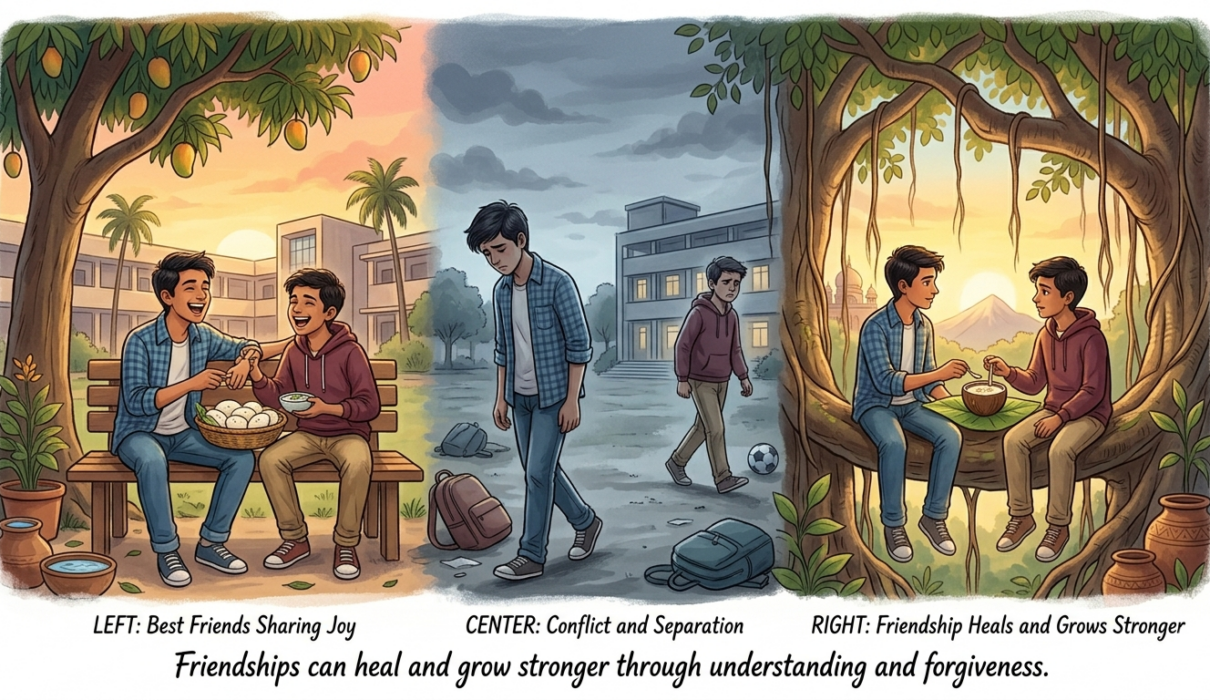
Rohan and Arjun had been best friends since Class 6. In their small town of Dehradun, everyone knew them as “the inseparable duo.” Rohan was studious and serious; Arjun was athletic and easygoing. Despite their differences, they balanced each other perfectly.
What made their friendship special wasn’t that they never disagreed—it was that they always found their way back to each other. Until the day Rohan let his stress take control of his words.
It was the week before board exams. Rohan was stressed beyond measure—studying 12 hours a day, barely sleeping, living on chai and the paranthe his mother forced him to eat. His parents expected him to get into IIT, and the pressure was crushing him.
Arjun seemed relaxed in comparison. He’d study for a few hours, then head to the cricket ground. “Don’t stress so much, yaar,” he’d tell Rohan. “You’ll ace it anyway.”
But this only frustrated Rohan more. “Easy for you to say,” he thought bitterly. “You don’t have the same expectations.”
One evening in the library, Rohan was buried in his physics textbook when Arjun walked in with their classmate Priya, laughing about something from cricket practice.
“Rohan!” Arjun called cheerfully. “Come to the canteen with us! You’ve been studying for hours.”
Rohan looked up, exhausted and irritated. “Some of us actually have to work hard, Arjun. We can’t just coast through life on cricket.”
The smile faded from Arjun’s face. “What’s that supposed to mean?”
“It means not everyone has it as easy as you!” Rohan snapped. “Your parents don’t pressure you. You just float through everything while I’m drowning!”
Arjun’s jaw tightened. “You have no idea what my life is like.”
“Oh, please!” Rohan’s anger erupted. All his stress and pressure came pouring out. “You’re just average, Arjun! Average student, average person. The only reason you’re even relevant is because you can hit a ball. At least I have a brain!”
The words hung in the air like poison.
Arjun’s face went pale. “Is that what you really think? After eight years of friendship?”
Rohan’s anger deflated instantly. “Arjun, wait, I didn’t mean—”
“No,” Arjun’s voice shook. “You meant every word. People say what they really think when they’re angry.”
He walked out. Rohan sat there replaying his words: “Average.” “Only relevant because of cricket.” “At least I have a brain.”
He felt sick.
For two weeks, Arjun completely avoided Rohan. Changed his seat. Ignored his texts. Walked past him in the hallways like he didn’t exist.
Rohan tried everything. “I’m sorry, bro. Please talk to me.” No response.
The exams came and went, but Rohan couldn’t focus. His words kept echoing in his mind. He’d wounded his best friend with weapons he could never retrieve.
Three weeks later, Rohan’s mother called him over with sad eyes.
“Did you know Arjun’s father lost his job six months ago?”
Rohan’s heart stopped. “What?”
“They’ve been struggling financially. His mother works double shifts as a nurse. Arjun coaches cricket to younger kids every evening to earn money for his family. That’s why he couldn’t study as much.”
Rohan felt like he’d been punched.
“He never told anyone because he was ashamed,” his mother continued. “He was trying to stay positive. And you called him average. You said he was only relevant because of cricket.”
Rohan’s eyes filled with tears.
“That’s the problem, beta. You spoke without knowing. Words are like nails hammered into wood—you can remove them, but the holes remain forever.”
That night, Rohan wrote a three-page letter. He apologised for every hurtful word. He wrote about all the times Arjun had been there for him.
“You were never average, Arjun. You were extraordinary. You handled problems I can’t imagine with grace. You worked two jobs—student and provider—while I complained about studying. You are one of the strongest people I know. I was too blind with anger to see it. I don’t deserve your friendship, but I’m asking for forgiveness anyway.”
He slipped it under Arjun’s door.
A week later, Rohan sat alone on the school steps when a shadow fell over him.
Arjun.
Neither spoke. Then Arjun sat down, pulling out his tiffin box.
“My mom packed extra aloo parathas. Want some?”
Rohan’s eyes welled up. “Arjun, I—”
“I know. I read your letter. Multiple times.”
“I wish I could take back what I said.”
Arjun looked at him steadily. “You can’t. Those words hurt, Rohan. It took weeks to stop hearing them.”
“I’m so sorry.”
“I know you didn’t mean them,” Arjun sighed. “You were drowning and lashed out. I just wish you’d talked to me instead of attacking me.”
They sat in silence, sharing parathas.
“My dad says, ‘Anger is like drinking poison and expecting the other person to die,'” Arjun said. “You hurt me, but you’ve been hurting yourself too.”
Rohan nodded, grateful that Arjun could see beyond the angry words to the struggling friend beneath.
“We’re still friends,” Arjun said firmly. “But we both need to do better. You—learn to control your anger. Me—learn to share my struggles instead of hiding them. Deal?”
“Deal,” Rohan said, feeling hope for the first time in weeks.
This wasn’t just forgiveness. This was both of them choosing to grow.
From that day, Rohan transformed his approach to anger. When frustration rose, he’d count to ten. Take deep breaths. Walk away until he could think clearly. He started journaling his feelings instead of bottling them up—and it helped more than he’d imagined.
But the biggest change? He learned that admitting you’re wrong takes more courage than staying angry. And that real strength isn’t about never losing your temper—it’s about what you do after you’ve cooled down.
The friendship healed and grew stronger. The fight became a turning point that taught both boys valuable lessons. Rohan learned to manage his stress before it hurt the people he loved. Arjun learned that forgiveness doesn’t mean forgetting—it means choosing to move forward together.
Years later in college, Arjun said, “That fight was the worst and best thing that happened to our friendship. Worst because it hurt like hell. Best because it proved we could survive anything if we were both willing to grow.”
Rohan smiled. “I’m still sorry it happened.”
“I know,” Arjun grinned. “But I’m glad we fought our way back to each other. That’s what real friends do.”
They laughed, grateful for a friendship that was now stronger because it had been tested. The experience became their reminder—not of what anger destroys, but of what courage, honesty, and forgiveness can build.
MORAL
True strength lies not in never making mistakes, but in having the courage to own them and the wisdom to grow from them. Words spoken in anger can hurt, but sincere apologies, genuine forgiveness, and the willingness to change can heal even the deepest wounds. Real friendship survives not because it’s perfect, but because both people choose growth over grudges.
GLOSSARY
- Inseparable — So close that they cannot be separated; always together
- Duo — A pair of people who work together or are closely associated
- Studious — Spending a lot of time studying; dedicated to learning
- Athletic — Physically strong, fit, and good at sports
- Anxious — Feeling worried, nervous, or uneasy about something
- Paranthe — Indian flatbread, usually stuffed with vegetables or potatoes
- Ace — To do extremely well; to succeed perfectly
- IIT — Indian Institutes of Technology, prestigious engineering colleges in India
- Coast — To proceed easily without much effort
- Erupted — Burst out suddenly and violently
- Deflated — Lost energy or confidence suddenly; felt defeated
- Wounded — Hurt deeply, either physically or emotionally
- Retrieve — Get back; take back something that was given
- Financially — Related to money matters
- Lashed out — Attacked verbally or physically in anger
- Sincerely — In a genuine, honest, and heartfelt way
- Board exams — Important final examinations in Indian schools (Class 10 and 12)
- Tiffin — Lunch box; packed meal in Indian context
- Yaar — Hindi/Urdu word meaning “friend” or “buddy”
- Beta — Hindi word meaning “child” or “son/daughter” (term of endearment)
VOCABULARY LIST
- Inseparable — Extremely close, bonded, united
- Balanced — Complemented, offset, harmonized
- Anxious — Worried, nervous, stressed
- Frustrated — Annoyed, irritated, exasperated
- Exhausted — Tired, drained, worn out
- Irritated — Annoyed, bothered, agitated
- Erupted — Exploded, burst out, blew up
- Poison — Toxin, venom, something harmful
- Deflated — Discouraged, disheartened, defeated
- Torture — Extreme suffering, agony, torment
- Avoided — Stayed away from, evaded, shunned
- Wounded — Injured, hurt, damaged
- Retrieve — Recover, reclaim, get back
- Struggling — Having difficulty, fighting, battling
- Ashamed — Embarrassed, humiliated, guilty
- Extraordinary — Remarkable, exceptional, amazing
- Grace — Elegance, dignity, composure
- Lashed out — Attacked verbally, struck out, hit back
- Healed — Recovered, mended, repaired
- Consequences — Results, outcomes, effects
KEY PHRASES
- “inseparable duo” — Two people who are always together and very close
- “breaking point” — The moment when someone can no longer handle stress and loses control
- “words hung in the air like poison” — Hurtful words that created a toxic atmosphere
- “his anger deflated instantly” — Suddenly lost all his angry energy when he realized his mistake
- “lashed out” — Attacked someone verbally because of built-up anger or frustration
- “words are like nails hammered into wood” — Once you say something hurtful, you can apologize but the damage remains
- “drinking poison and expecting the other person to die” — Holding onto anger hurts you more than the person you’re angry at
USAGE EXAMPLES
- The twins were inseparable since birth and did everything together.
- She felt anxious about the job interview and couldn’t sleep the night before.
- After working 16 hours straight, he was completely exhausted.
- When she’s stressed, she tends to lash out at people who try to help her.
- His apology seemed sincere, and she decided to forgive him.