
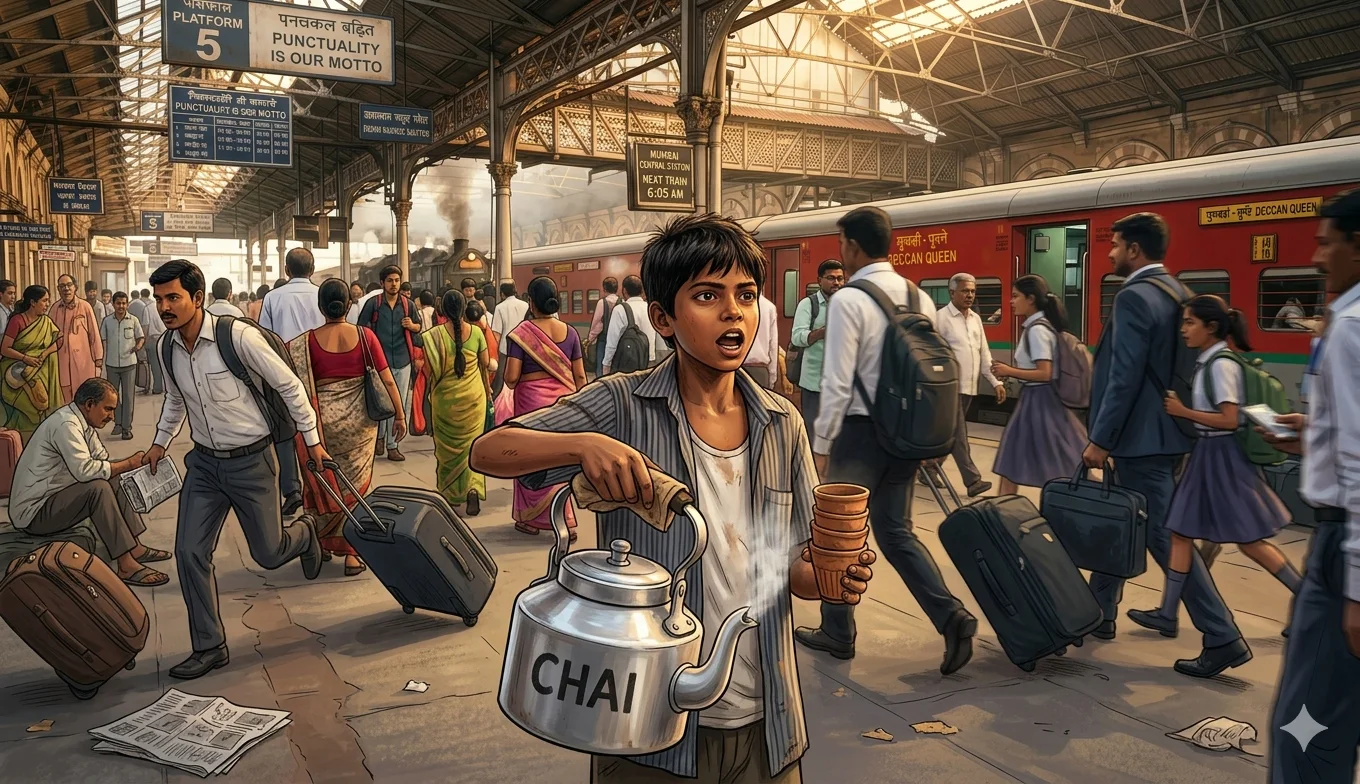
Can a boy who sells tea at a railway station become a successful restaurant owner? Everyone said it was impossible. But Raju knew that every big dream starts with one small step—and he was willing to take thousands of them.
Every morning at 5 AM, twelve-year-old Raju walked to Dadar Railway Station in Mumbai. He carried a large steel kettle filled with hot, sweet chai and a basket of small clay cups.
“Chai! Garam chai!” he would call out to the rushing crowd. “Hot tea!”
Most people ignored him. Some stopped to buy chai for five rupees. But Raju didn’t mind. He had a dream.
His father had died two years ago. His mother washed dishes in people’s homes. They needed money. So Raju became a chai wallah—a tea seller.
But he wasn’t just selling tea. He was building his future.
In his pocket, Raju always carried a small notebook. Every day, he wrote:
Earn: 200 rupees
Spend on supplies: 100 rupees
Give to mother: 50 rupees
Save: 50 rupees
“What are you saving for?” his friend Arif asked.
Raju’s eyes shined. “I’m going to open a restaurant someday.”
Arif laughed. “You? You can barely afford new clothes!”
“Small steps,” Raju said quietly. “Every big thing starts small.”
Raju didn’t just sell chai. He learned.
He asked businessmen about success. He asked chefs about cooking. He watched other vendors work.
He learned that good service makes customers happy. He learned which spices make the best tea. He learned that a smile costs nothing but means everything.
The railway platform became his classroom.
After two years, Raju had saved 36,000 rupees. He bought a small wooden cart painted yellow and red. Now he could sell chai AND vada pav. His earnings doubled.
At sixteen, He had 100,000 rupees. He rented a tiny 10×10 space near the station. Four plastic chairs. Two tables. A simple sign: “RAJU’S CHAI CORNER.”
He served chai, vada pav, and samosas. Everything clean. Everything fresh. He always smiled and remembered customers’ names.
Word spread. His small corner became popular.
At twenty, Raju opened a real restaurant with ten tables and a proper kitchen. He hired helpers. He expanded his menu—dosa, idli, parathas, thalis.
The restaurant became famous for good food and great service. “That chai wallah kid owns a restaurant now!” people said, amazed.
Today, Raju is thirty and owns three restaurants in Mumbai. But every morning at 6 AM, he goes to Dadar Station—not to sell chai, but to give it away free.
He stands at the same spot where he used to work and gives free chai to railway workers and cleaners.
“Why do you do this?” a reporter asked.
Raju smiled. “Someone once laughed at my dream. I want these workers to know—if a chai wallah can own restaurants, anyone can achieve their dreams.”
He still keeps his old notebook in his office. It reminds him that big success comes from small, consistent steps.
Now Raju speaks at schools. He shows students his worn notebook.
“Look,” he says. “This is how dreams start. Not with huge money. Not with perfect conditions. But with small, daily actions. Fifty rupees a day became 36,000. Then 100,000. Then a cart. Then a corner. Then three restaurants.”
“You might be studying English,” he tells them. “Maybe learning a new skill. Maybe working a job you don’t love. But every day you show up, you’re building something. Small steps. Consistent effort. That’s the secret.”
Today, Raju’s mother manages one of his restaurants. And every morning when Raju gives free chai at the station, he sees himself in the young vendors.
He hopes they see their future in him.
✨ Words Worth Keeping
🌱 Phrases to Remember
📚 Quick Glossary
🎬 See It in Action
Success requires consistent effort, not just occasional hard work.
She barely had enough money to pay rent, but she saved a little every month.
The company expanded from one small shop to twenty stores in five years.
His persistence paid off when he finally got the job after ten interviews.
Word spread quickly about the new restaurant, and soon it was always full.





