
Ananya Rao stood at the service line, shuttle balanced on her racket, and did the math again. Three points from qualifying. One clean smash and she was through to the state list.
She missed it long.
Her coach, Meena ma’am, didn’t shout. She wrote something on her clipboard and called the next player forward. Ananya sat on the bench and watched the number blink on the scoreboard, the number that would decide whether four years of 5 a.m. practice meant anything.
“You’re playing the scoreboard, not the shuttle,” Meena ma’am said afterward, zipping her bag. “Every rally, your eyes go there first.”
Ananya didn’t answer, because it was true. For weeks she had practiced the same smash a hundred times an evening, and in the empty hall it never once missed the line. But the moment a scoreboard existed, her wrist tightened half a second early, and the shuttle sailed wide.
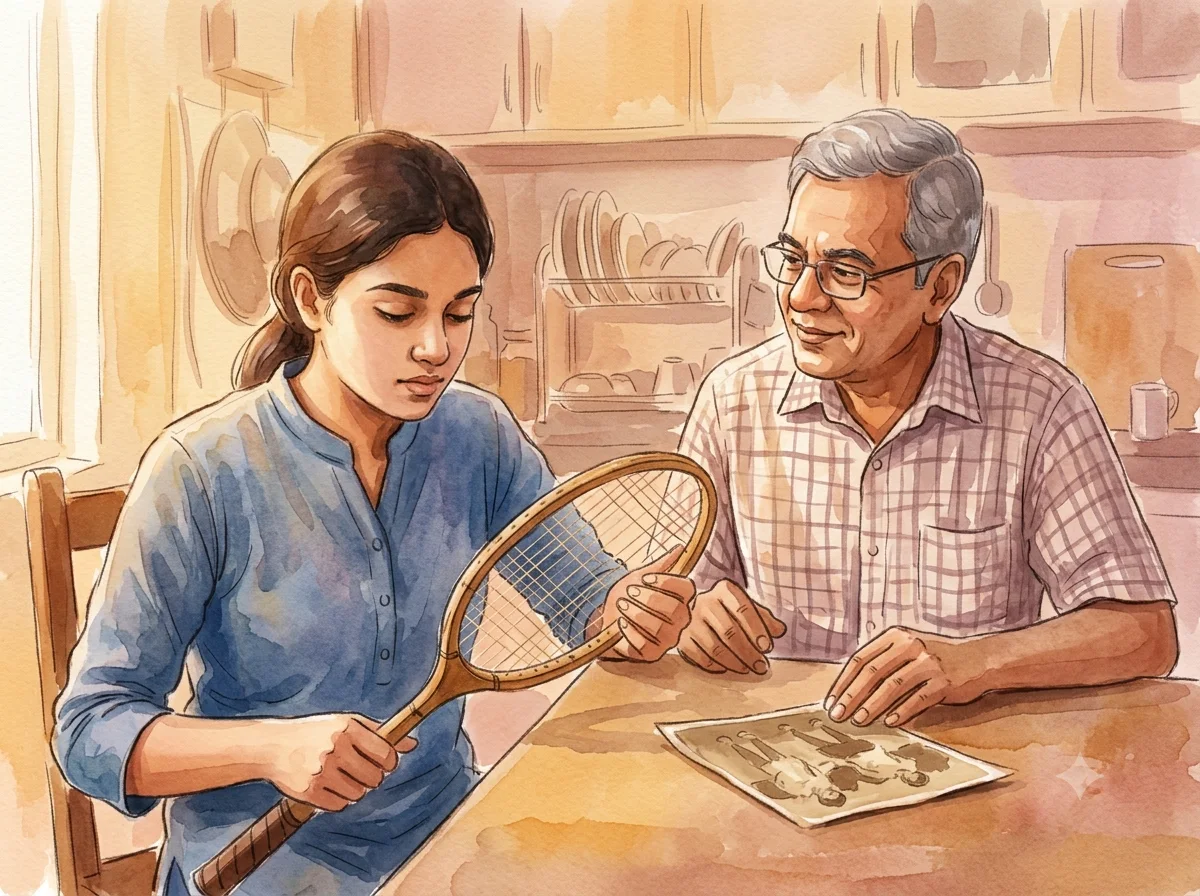
That night, home was ordinary in the way it always was — her mother reheating dal, the television murmuring from the next room. Ananya went to the garage looking for spare grip tape and found, instead, her father’s old racket.
It hung on a nail behind the scooter, strings gone slack and yellowed, the handle worn down to bare wood where his palm used to sit. She hadn’t touched it in years. When she lifted it down, a photograph slid out of the half-zipped case and landed face-up on the concrete.
Her father, maybe twenty, mid-smash, both feet off the ground, on a court she didn’t recognize. On the back, in handwriting she knew from every birthday card: State trials, 1994. Lost in the second round. Played the best rally of my life anyway — 14th point, third game.
She turned the photo over twice, as if a second look might change what it said. He had lost the match. And he’d written it down like it was the part worth keeping.
She found him at the kitchen table, still in his office clothes, and set the photograph down instead of asking her question out loud.
He looked at it for a moment before he spoke. “Nineteen ninety-four,” he said. “I choked on match point in the first game. After that I stopped trying to win the trial and just tried to hit the shuttle exactly the way I’d practiced it. Point after point. Didn’t matter anymore if I won or lost.” He tapped the edge of the photo. “Beta, this was the point right after I stopped keeping score in my head. Best smash of my life. Lost the match ten minutes later.”
“You kept a photo of the match you lost.”
“I kept a photo of the ten minutes I actually played the way I meant to.” He slid the racket case toward her across the table. “Strings are shot. Handle’s still good, if you want the wood.”
Ananya carried the old racket to her room and set it on the desk where she’d see it while packing her kit for the next morning. She didn’t restring it. She wasn’t going to play with it. She needed to look, one more time before she slept, at a boy mid-air who had already lost and hadn’t stopped swinging.
The second qualifier ran two days later. Same hall, same scoreboard, same three points between her and the state list. When the shuttle rose for the smash point, Ananya didn’t check the number. She watched the shuttle the way she watched it in the empty hall at 5 a.m. — the seam, the drop, the exact half-second to strike.
Her wrist came through clean.
She didn’t know, in that instant, whether the shuttle had landed in or out. For the first time in weeks, she found she didn’t need to know before she swung.
Scripture/Source: Bhagavad Gita, Chapter 2, Verse 47 — “You have a right to your actions, but never to the fruits of those actions.”
✨ Words Worth Keeping
🌱 Phrases to Remember
📚 Quick Glossary
🎬 See It in Action
The team has a qualifier next month, and everyone's training twice as hard.
The old swing set has gone slack after years in the rain.
She choked during her driving test even though she'd practiced the route ten times.
The wooden spoon handle is worn down smooth from decades of Sunday cooking.
He made one clean cut through the fabric, no fraying at the edge.


