
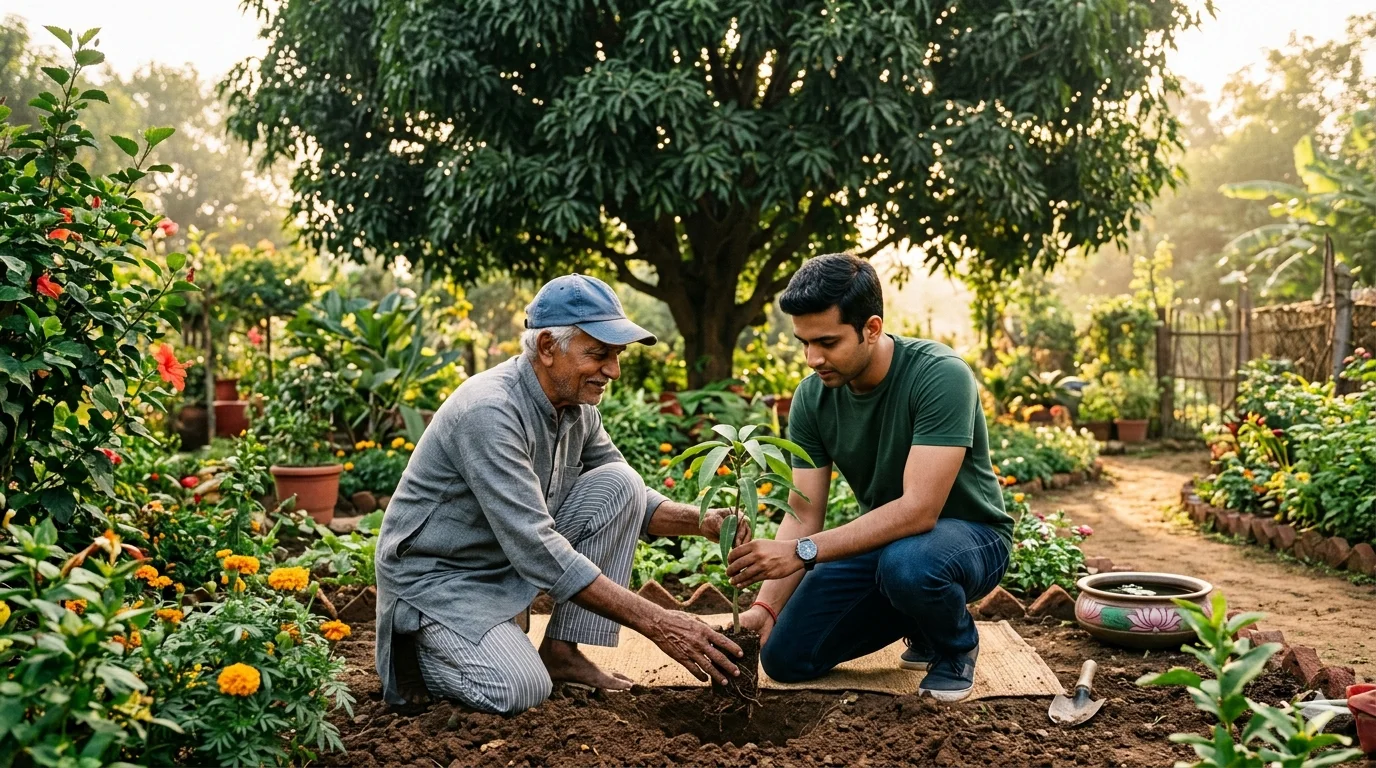
Why do some people succeed while others give up too soon? This story about an old gardener and an impatient young man teaches us that the most valuable things in life cannot be rushed—they must be nurtured with time and care.
In a quiet neighbourhood in Pune, there lived an old gardener named Mohan Kaka. His small house had the most beautiful garden in the entire area—roses of every colour, fragrant jasmine vines climbing the walls, and a magnificent mango tree that gave sweet fruit every summer. People often stopped outside his gate just to admire the flowers and breathe in the peaceful atmosphere.
Mohan Kaka was in his seventies, with weathered hands that told the story of decades spent in the soil. He wore simple cotton clothes and a faded blue cap to protect himself from the sun. Every morning at six o’clock, he would be in his garden—watering, pruning, talking gently to his plants as if they were old friends.
One day, a young software engineer named Vikram moved into the house next door. Vikram was ambitious, always in a hurry, and used to getting quick results. Everything in his life ran on deadlines and instant gratification—fast food, fast internet, fast career growth.
One morning, Vikram saw Mohan Kaka carefully planting something in a small terracotta pot. Curious, he walked over.
“What are you planting, Kaka?” Vikram asked.
“A sandalwood sapling,” Mohan Kaka replied with a gentle smile. “It will grow into a beautiful tree one day.”
Vikram looked at the tiny plant—barely four inches tall, with just a few delicate leaves. “How long will it take to grow?”
“About twenty to thirty years for it to mature fully,” Mohan Kaka said calmly, patting the soil around the sapling.
Vikram laughed. “Twenty years? Kaka, you’re already seventy! You won’t even be alive to see it grown. Why waste your time?”
Mohan Kaka looked up at Vikram, his eyes twinkling with wisdom. “Perhaps you’re right. But that’s not why I plant it.”
Vikram didn’t understand. “Then why?”
The old man stood up slowly, brushing the soil from his hands. “Come, let me show you something.”
He led Vikram to the magnificent mango tree at the corner of his garden. Its thick trunk was covered in rough bark, and its branches spread wide, creating a cool, shaded area beneath. A wooden bench sat under the tree, worn smooth by years of use.
“My grandfather planted this tree when I was five years old,” Mohan Kaka said, running his hand along the trunk. “He never lived to taste its fruit. My father watered it faithfully for years before he passed away. And now I sit under its shade, eat its mangoes, and think of them both. They didn’t plant it for themselves—they planted it for me, for you, for everyone who comes after.”
Vikram fell silent.
“That sandalwood tree I just planted?” Mohan Kaka continued. “I may never see it fully grown. But maybe your children will. Maybe they will sit under its shade and thank an old gardener they never met. That’s enough for me.”
The old man paused, then added, “You know, Vikram, in your work, you get results in months. You build something, and within a year, you see success. That’s wonderful. But life is not just about what we achieve quickly. Some things—the most important things—take time. Relationships, character, legacy, wisdom. These cannot be rushed.”
Vikram felt something shift inside him. He thought about his own life—constantly chasing the next promotion, the next salary hike, the next achievement. He never stopped to think about what he was building that would last beyond his own lifetime.
From that day on, Vikram started spending his mornings with Mohan Kaka in the garden. The old man taught him how to plant, how to wait, how to care for something without expecting immediate results.
Six months later, Vikram planted his own sapling—a neem tree—in a pot on his balcony. It was small, fragile, and would take years to grow.
His friends laughed. “Why are you wasting time on this? You’ll probably move cities for your job in a year!”
Vikram smiled, remembering Mohan Kaka’s words. “Maybe. But wherever I go, someone will water this tree. And one day, someone will sit under its shade and feel grateful. That’s enough.”
Years passed. Vikram did move cities, then countries. But he never forgot the lesson. In every place he lived, he planted a tree. He invested in things that took time—friendships, skills, health, kindness. He stopped measuring success only in quarterly results and started thinking in decades.
When Mohan Kaka passed away at the age of eighty-two, Vikram flew back to Pune for the funeral. After the ceremony, he walked into the old garden one last time.
The sandalwood sapling was now five feet tall, its leaves dark green and healthy. It had many years to go before reaching full maturity. But it was growing, steadily and silently, just as Mohan Kaka had known it would.
Vikram knelt beside it and whispered, “Thank you, Kaka. You taught me that the best things in life are not instant—they are earned through patience, nurtured through care, and measured not in months, but in lifetimes.”
✨ Words Worth Keeping
🌱 Phrases to Remember
📚 Quick Glossary
🎬 See It in Action
The fragrant flowers filled the room with a sweet smell.
She remained calm even when everyone else was panicking.
His grandfather's wisdom helped him make the right decision.
They worked steadily every day until the project was complete.
I feel grateful for all the support my family has given me.





