
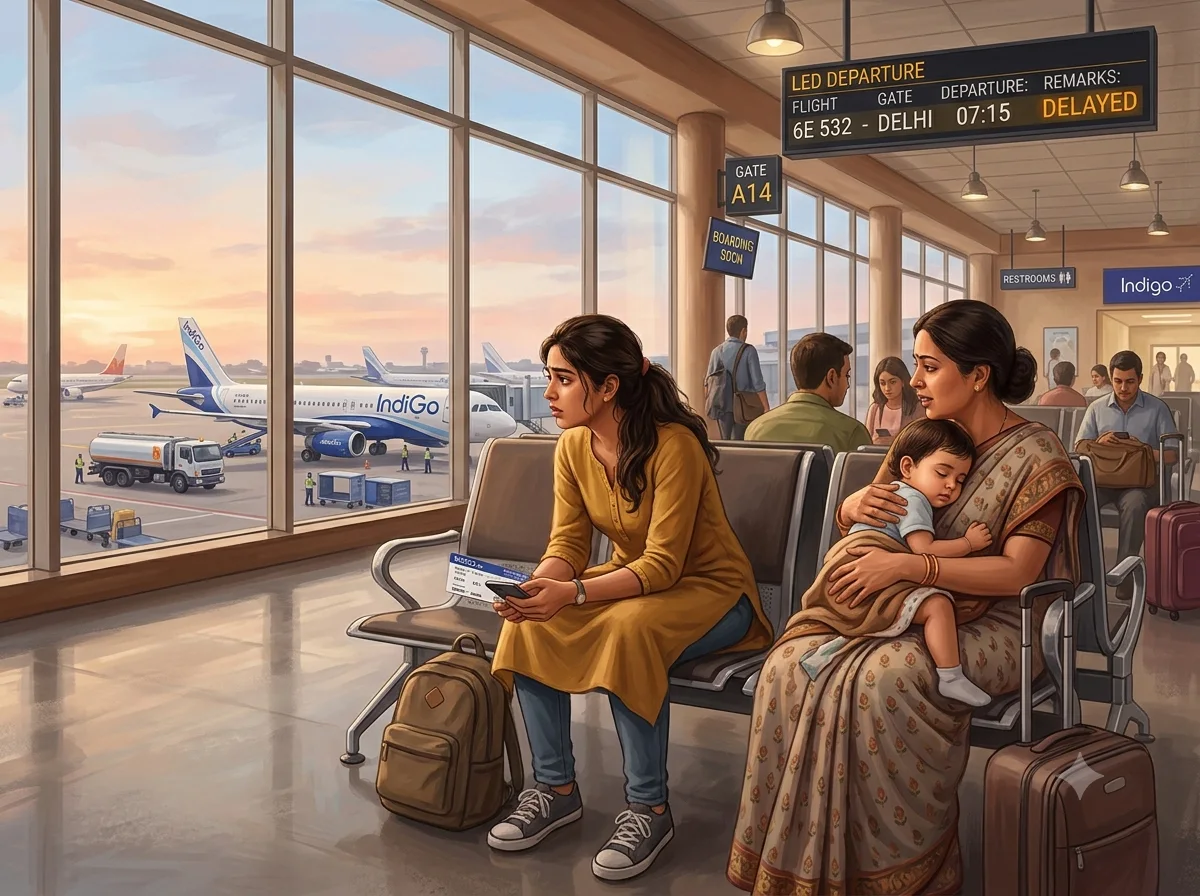
Your phone buzzes at 5:47 am, and the moment you see your sister’s name on the screen, your stomach tightens. Some messages you know are bad before you’ve even read a word.
Papa’s surgery moved up. Doctor says come today if you can. — Aparna
You’re still in the security line at Gate 18 when you text back boarding soon, even though boarding is still forty minutes away. Saying it makes you feel like you’re already moving, even though you’re standing still.
You find a seat by the window and watch the plane outside, as if watching hard enough could make it move faster.
7:10 AM — DELAYED.
The announcement is calm, almost bored, the way these announcements always are. But your chest drops anyway, the way it does in a lift between floors.
You call your sister. “It’s delayed.”
“How long?”
“They don’t know yet.” Your voice breaks a little on the last word, and you’re embarrassed, sitting here with strangers all around you.
“He’s asking for you, Meera,” Aparna says softly. “I told him you were already on your way.”
You hang up and pull your knees up to your chest, the way you used to sit as a child. You start doing what you always do when something feels out of your hands — you try to fix it anyway. You calculate. If the flight leaves by eight, if traffic isn’t bad, if the doctor waits just a little longer. None of the numbers change the one fact that matters: nobody knows when this plane will leave.
A woman sits down beside you, a sleeping toddler on her shoulder. She notices your face — the kind of face people usually try not to look at directly.
“Bad news?” she asks gently.
“My father’s surgery. I need to be there, and I can’t do anything from here except wait.”
She nods, as she understands exactly. “I sat like this once, in an airport in Pune. My mother was in the hospital, and I was stuck for three hours, and I spent every minute of it thinking that if I worried hard enough, somehow it would help her. It never once did.”
“So what did you do instead?”
“I remembered something my father used to say — that the mind likes to believe it’s in control, even when it isn’t. He’d tell me: your job was never to control the outcome. It was only ever to show up, fully, for the part that’s actually yours. The rest was never yours to carry in the first place.”
You sit with that for a moment. “That sounds like giving up.”
“I thought so too, at first.” She shifts the sleeping child gently. “But giving up would mean not going at all. I still got on that flight. I still went straight to the hospital the moment I landed. I just stopped trying to control the part of it I never could — the waiting, the delay, the traffic. I only carried what was mine.”
GATE 18 — NOW BOARDING.
You’re on your feet before the announcement even finishes. And walking down the jet bridge, you notice your hands have stopped shaking — not because the delay is fixed, but because somewhere in that conversation, you’d quietly put down the part of the worry that was never yours to hold.
Scripture/Source: Inspired by the Bhagavad Gita, Chapter 2, Verse 14 and Chapter 18, Verse 66 — Krishna’s teaching that our duty is to act fully in what is ours to do, while releasing the outcome, which was never within our control.
Continue Reading
The Waiting Room — a different kind of waiting, the same medical urgency, and the same quiet lesson that surrender isn’t giving up.
Beyond the Target — a different kind of fear, and the same discovery that worry never actually changes the outcome.
📄 Free printable worksheet available below.
Complete the learning activities and download it at the end of this lesson.
✨ Words Worth Keeping
🌱 Phrases to Remember
🎬 See It in Action
Calculate — /KAL-kyoo-late/
Release — /ri-LEESS/


