Sulochana Kaku came every afternoon at four, when the chakli were still warm, and Meera’s hands were busy.
She never came empty-handed. Some days it was a bunch of curry leaves from her own pot. Some days it was a small remark, wrapped in the same concern.
“You’re such a good girl, Meera,” she said, settling on the kitchen stool. “Cooking for twenty people before Diwali. But anyone else in your place would ask where all the shop money goes.”
Meera laughed and pressed another spiral of dough into the hot oil. She changed the subject to the weather.
But the sentence stayed behind after Kaku left, like the smell of frying.
Meera’s husband Suresh and his elder brother Ravi ran Kulkarni Sweets together, in the same lane in Nashik where their father had started it. Ravi kept the shop keys. Ravi kept the cash box. Ravi had always kept them, and until this Diwali, Meera had never once thought about it.
“Ravi dada never lets Suresh touch the cash, have you noticed?” Kaku said on Monday, over tea. “Elder sons. They think the shop is theirs.”
On Tuesday: “Pihu’s new frock was lovely. Silk, no? Very nice, on a shop’s income.”
On Wednesday, Kaku only sighed, and said nothing at all, and Meera found she was the one who finished the sentence.
By Thursday she had started noticing things. Ravi’s tea went to him last, not first. She counted the sweet boxes stacked by the door and wrote the number on the back of her hand. At dinner, when Ravi made his usual joke about her over-salted dal, she didn’t laugh. She just passed him the bowl without looking up.
Ravi stopped joking after that. Suresh looked from his wife to his brother and said nothing, and ate faster than usual.
That night Meera took Suresh’s old shop ledger from the cupboard and sat with it under the bedroom lamp. Page after page of numbers. One line, three weeks back, was circled in Ravi’s handwriting: Cash withdrawn: Rs. 40,000. Own use.
Own use. She read it again and again until the numbers swam.
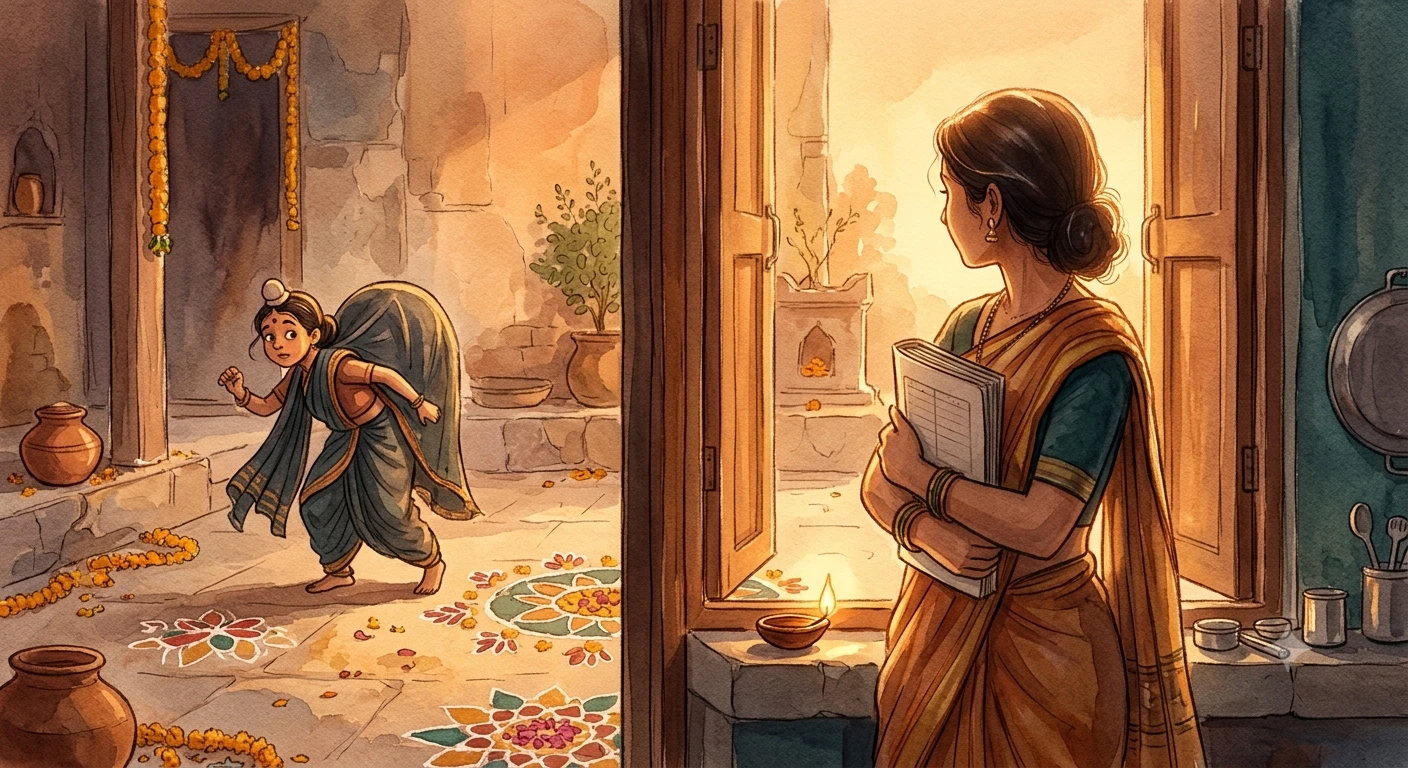
On Friday, the day before Lakshmi Pujan, the courtyard was full of noise. Pihu, Ravi’s nine-year-old, was rehearsing for the school Ramleela, and she had been given the part she wanted most: Manthara.
She had tied a dupatta around her shoulders to make a hunch. She carried a stick. She crept across the rangoli, narrowly missing the marigold petals, and hissed at an imaginary queen.
“Rani Kaikeyi! How can you sleep so calmly? Do you not see what is being taken from your Bharat?”
Meera stood in the kitchen doorway with the ledger against her chest.
“Kaki, am I scary enough?” Pihu called.
“Very,” Meera said. Her voice came out smaller than she meant.
“Teacher says that’s the clever part.” Pihu straightened up, forgetting her hunch. “Manthara never did anything. She never touched the throne or the arrows. She only talked, every day, till Kaikeyi couldn’t hear her own thoughts anymore. Then Kaikeyi did all the bad things herself.”
She hunched again and went creeping off, muttering her lines.
Meera did not move. She was hearing, one after another, the sentences of the last four days. Such a good girl you are. Anyone else would ask. Always the compliment first, like a spoonful of sugar. Always the doubt after.
Not one of them had been a fact. Not one of them had been Kaku’s own.
She looked down at the ledger in her arms. She had not asked a single question in four days, and she had answered all of them herself.
The shop was closing. The shutters were half down, and Ravi was alone at the counter with a steel tin, counting notes under a bare bulb.
Meera put the ledger on the counter and opened it to the circled line.
“Dada. What is this?”
Ravi looked at the page. Then he looked at her, for what felt like a long time. He wasn’t angry, and that was worse.
He pulled the steel tin toward her and lifted the lid. Inside lay small envelopes, each with a name in his careful handwriting: Babu, Shantaram, Lata, the three workers who had been with the shop for twenty years. Under them was one more, thicker than the rest.
Meera – Diwali.
“The shop had a thin month,” Ravi said. “I couldn’t give the bonuses from the till without short-changing the suppliers. So I took it from my own savings and wrote ‘own use,’ because it was my own.” He rubbed the back of his neck. “Yours was going to be a surprise. Aai said you’ve wanted a Paithani since your wedding.”
Meera looked at the thick envelope. She thought of his tea, going last. She thought of the dal bowl, passed without a word.
“You could have asked me in March, Meera,” Ravi said, not unkindly. “I’d have shown you the whole book.”
“I know,” she said. It was all she could say.
On Saturday morning, Sulochana Kaku appeared at the kitchen door at four o’clock, with curry leaves
“Meera, beta, I was thinking about what Ravi’s wife said last week…”
Meera was ready. She had a box of faral in her hands: chakli, ladoo, shankarpale, tied with a ribbon. She handed it across the threshold.
“Happy Diwali, Kaku. Thank you for always thinking of us.” She smiled and did not step aside. “If I have any questions about my family, I’ll ask them myself.”
Kaku’s mouth opened, then closed. She looked at the box, then at the door, and went home slowly down the lane.
Meera latched the door. She didn’t slam it. She just latched it, the way you do on a house that has a full evening ahead.
In the courtyard, Pihu’s stick leaned against the wall beside her hunched dupatta. Meera lit the first diya of the evening, set it on the kitchen windowsill, and went to find Ravi to ask him which side he liked his tea with the extra sugar.
Source/Inspiration (for the Scripture line later): Valmiki Ramayana, Ayodhya Kanda: Manthara’s whispering to Queen Kaikeyi.
📄 Free printable worksheet available below.
Complete the learning activities and download it at the end of this lesson.