English Short Stories

The Knot

The Knot

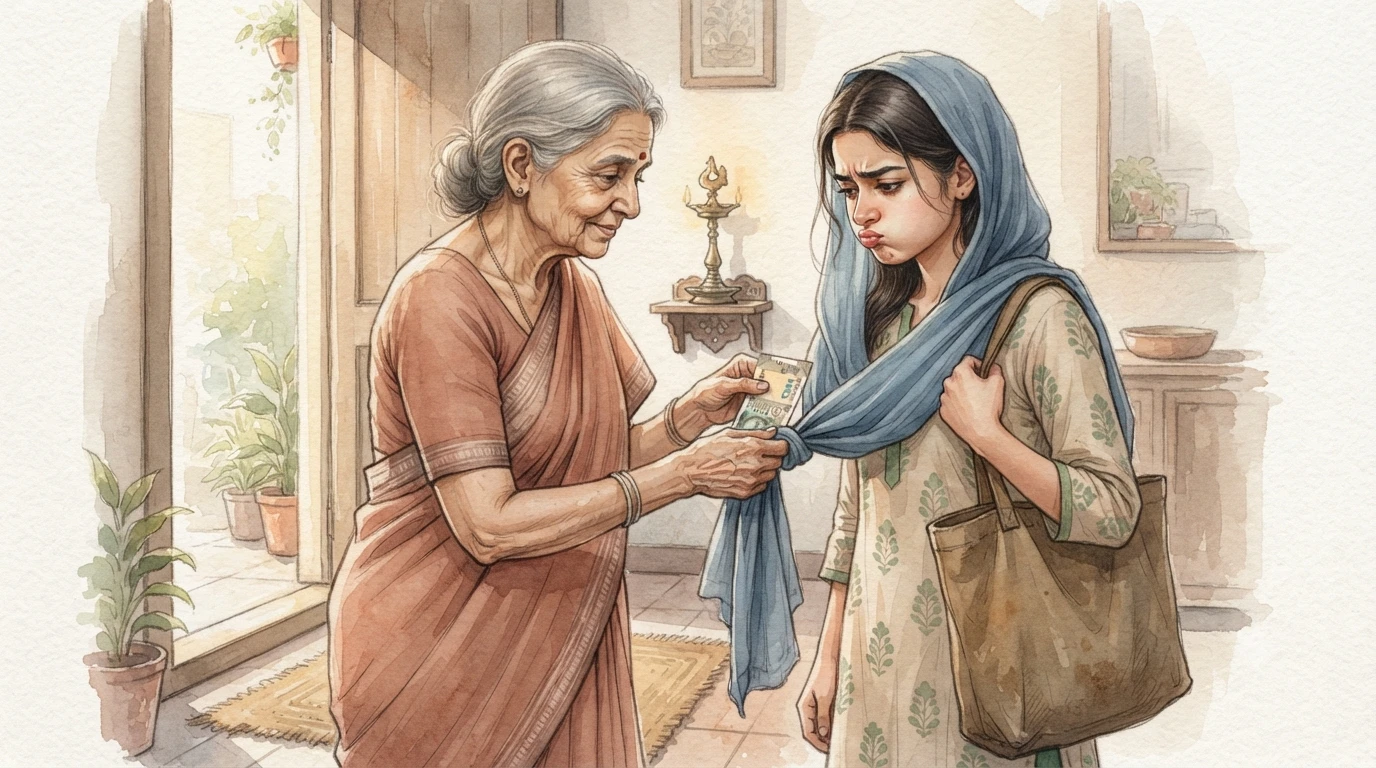
An Indian grandmother tying a folded rupee note into her granddaughter's dupatta.
Reading Time: 4 minutes

Aaji was at the door before Sanika had found her second shoe.

“Aaji, no. Please.”

“Ek minute.”

Sanika held up her phone like a shield. “Everything is on UPI. Nobody carries cash.”

“Then nobody will mind if I tie it.”

Aaji pressed a five-hundred-rupee note to her forehead, the way she did with every note before it went anywhere. She folded it small, then smaller, until it was the size of a postage stamp. Two pulls of her thumbs, and it sat knotted in the corner of Sanika’s dupatta.

“It looks like something from a Doordarshan serial.”

“Those serials had sensible women.”

Sanika went down four flights of stairs with her eyes rolled all the way up. Three months of articleship at a CA firm near Malad station, and she was still trying to look like someone who belonged there. Nobody who belonged there wore money in her dupatta.

She always untied it before she reached the station. Today a senior kept her till half past eight, and she forgot.

It was July, and the rain had been falling since afternoon.

The foot overbridge at Malad was one long, slow body. Everyone moved at the same speed, and nobody could stop or turn or lift an arm. At the top of the stairs Sanika reached into her tote for her phone, to see how late she was.

The zip was open two fingers’ width. Her hand found the lining and nothing else.

Phone. Wallet. Debit card. The ID card with her photo, taken on a bad day.

An announcement crackled overhead. Water on the tracks near Goregaon, all trains held. A thousand people sighed at once.

Sanika stood still while the crowd broke around her. She had no one’s number in her head. Not her mother’s, not her friends’. Only one, the landline at home, which Aaji had made her recite on her palm in Class 5 until she cried.

A woman with a green umbrella dialled it for her without being asked.

Aaji answered on the first ring.

“Aaji, it’s me. My bag was… I have nothing. No phone, no…”

“Kuthe aahes?”

“Malad station.”

“Auto kar. Tyala paise de. Mi gate var ubhi aahe.”

Take an auto. Pay him. I’m standing at the gate.

The auto stand outside the station was a wall of umbrellas and shouting.

“Goregaon?” the first driver said, already shaking his head. “Nahi jaana.”

The second didn’t even look up. The third said, “Barish mein koi nahi jayega, madam,” and drove off with an empty seat.

Sanika’s fingers were cold and wet. She stepped under a shop’s awning and worked at the knot with her nails. Two thumbs had pulled it tight that morning, thumbs that had tied a few thousand of them.

When it finally opened, the note was soft as cloth. It smelled of Aaji’s cupboard, of naphthalene and agarbatti.

The fourth driver looked at her wet dupatta, then at the sky.

“Goregaon kahan?”

She told him.

He thought about it for a moment. “Baitho.”

The meter clicked down as they pulled out. It climbed slowly through the traffic. A bus stood in a pool of brown water for ten minutes, and the driver cursed it in Marathi and then in Hindi. At the gate it read one hundred and ninety.

She held out the five hundred, and he sighed the way every auto driver in Mumbai sighs at a five hundred.

“Chhutta nahi hai?”

“Nahi.”

He dug through his shirt pocket and a tin box under the seat, and counted three hundred and ten into her hand, mostly in tens, with one dirty fifty folded in the middle.

Sanika tied three hundred of it into the corner of her dupatta, in the dark, before she had decided to. The last ten went into her pocket.

Aaji was at the gate under the black steel umbrella she had owned since before Sanika was born. She asked nothing. Her hand went to the corner of the dupatta, found the lump of the knot, and let go.

On Sunday Dilip Mama came from Nashik, and over lunch he told the story.

“Your Aaji, nineteen years old. Manmad station, 1975. I was eleven and completely useless. We were going to Aurangabad to our uncle’s house, and the connection was delayed until nearly morning.”

“Dilip, jevan kar,” Aaji said. Eat your food.

“She fell asleep on the bench for five minutes. Five! And the bag was gone. Tickets, food, everything.” He was laughing, but he was also holding his thali very still. “Only the knot in her padar. Ten rupees. Aai had tied it that morning and said nothing.”

“Dilip.”

“Four hours she sat there with her hand like this.” He showed them, fingers closed over a corner of his shirt. “Afraid to open it. I cried for water. Finally she bought one chai and two puris, and the change went back into the knot.”

Sanika looked at her grandmother.

Aaji was looking at her rice. But her left hand had gone up to the end of her saree and closed over it, tightly, and she didn’t seem to know it was there.

Sanika said nothing. She reached for the pickle.


On Monday morning she was dressed before Aaji was up.

When Aaji came to the door, Sanika was already holding out the corner of her dupatta. The knot was loose and lopsided, shaped like a modak someone had sat on. Three hundred rupees, folded badly.

Aaji looked at it for a long moment.

Her thumbs twitched once, wanting to fix it.

She tucked her hands into her padar instead. “Dabba ghetlas ka?”

“Ho, Aaji.”

📄 Free printable worksheet available below.
Complete the learning activities and download it at the end of this lesson.

📖 Story in Brief
In a Marathi family in Mumbai, a nineteen-year-old articled assistant is embarrassed by her Aaji's habit of knotting a ₹500 note into her dupatta. When her purse and phone are stolen at Malad station on a rainy evening, that knot is all she has, and a family story from Manmad in 1975 shows why it exists. This heartwarming Indian life story about a grandmother and granddaughter shows that an elder's old-fashioned habit can be love that has already been tested.
💡 The Lesson Inside
Some advice sounds old because it has been carried a long way. Aaji never explained the knot, because explaining it would have meant sitting down on that bench at Manmad all over again. Sanika didn't need the explanation. She needed one wet night, and then she understood that what looks like fuss from an elder is often love someone once paid for. The phone and the knot can share one dupatta.
✨ Words Worth Keeping
Articleship
the training period a CA student spends working at a firm, learning the job while still studying.
Example:Her articleship starts in July, so she is already practising how to sound calm in front of clients.
Lopsided
leaning or uneven, like a tray carried badly by one hand.
Example:The cake came out lopsided, but nobody at the party complained.
Awning
a sloping cover of cloth or tin over a shop front that keeps off the rain.
Example:We waited under the tea stall's awning until the downpour thinned.
Twitch
to make a small quick movement you didn't plan, usually because your body wants to do something your mind has decided against.
Example:His fingers twitched towards the remote, but he let his sister finish her show.
Connection
a second train, bus or flight you must catch to continue your trip.
Example:We missed our connection in Pune and spent the afternoon on a station bench.
🌱 Phrases to Remember
Held up like a shield
used to protect yourself or block an argument, often in a half-joking way.
Example:He held up his folder like a shield when his boss asked about the missing report.
Eyes rolled all the way up
showing, without words, that you find something silly or embarrassing.
Example:She went out of the house with her eyes rolled all the way up after her mother fussed over her jacket.
Before she had decided to
doing something automatically, as if your hands knew before your mind did.
Example:He stood up before he had decided to when his teacher walked in.
Broke around her
said of a crowd that flows past one still person, like water around a stone.
Example:The commuters broke around him as he stopped to read the sign.
Without being asked
doing a helpful thing before anybody requests it.
Example:A stranger carried her bag up the stairs without being asked.
📚 Quick Glossary
Aaji
Marathi for grandmother, usually your father's or mother's mother, said with warmth and a little teasing.
Padar
the loose end of a sari that falls over the shoulder, and the traditional place where many women of Aaji's generation tied a small note or coin.
Modak
a sweet dumpling of rice flour with a coconut and jaggery filling, loved in Maharashtra and special to Ganesh Chaturthi.
Agarbatti
incense sticks burned at home shrines, so cupboards and clothes often carry that smell for years.
🎬 See It in Action
1

Articleship — After her articleship ended, Neha was offered a full-time job at the firm.

2

Lopsided — He gave a lopsided smile and shrugged, as if the whole thing didn't matter.

3

Awning — The vegetable seller pulled the awning down when the first drops fell.

4

Twitch — A twitch of her eyebrow told him that she didn't agree.

5

Connection — The bus connection was late, so everyone ended up sharing one auto.

🗣️ Say It Right
Articleship
/say it like: AR-tik-ul-ship/
Lopsided
/say it like: lop-SY-did/
Padar
/say it like: PAH-dur/
💬 Reflection Corner
Have you ever dismissed a family tradition without understanding the love or experience behind it? What is one small habit of your grandparents that you understand better today? How can we preserve meaningful family traditions while living in a modern world?

🎯 Complete the Story Challenges

🧩 Vocabulary Explorer ✏️ Context Architect ⏳ Timeline Master ✍️ Creative Novelist
Game 1: Word Match ✨ Reward: +10 XP

Vocabulary Matcher

Match the vocabulary word on the left with its correct meaning on the right.

Articleship
Awning
Twitch
Lopsided
leaning or uneven, like a tray carried badly by one hand.
the training period a CA student spends working at a firm, learning the job while still studying.
a sloping cover of cloth or tin over a shop front that keeps off the rain.
to make a small quick movement you didn't plan, usually because your body wants to do something your mind has decided against.
Free Reading Comprehension Worksheet

Strengthen your English skills with a printable worksheet based on this story.

Vocabulary Practice Reading Comprehension Critical Thinking Writing Skills
Download & Print Worksheet

Free for students, parents, teachers and ESL learners.

One more story before you go...

A young Indian goalkeeper sitting alone on a bench, story about quiet strength and family worry

The Goalkeeper Who Never Smiled

Reading Time: 2 minutesDhruv hadn’t smiled in three weeks. Not once. Not even when his team won. “He’s not rude,” his captain told the new boy, Aryan, after practice. “He’s just… like that

Read More »
Little cloud afraid to let go of rain, girl waiting in doorway below. Bedtime story for kids about letting go and trusting.

The Cloud Who Kept the Rain

Reading Time: < 1 minuteHigh above the Sahyadri hills, a small cloud named Megh was holding its rain. He had been holding it all day. The other clouds had already let go — their

Read More »

Stories you may like...

Watercolor illustration of a young Indian man leaning on a Mumbai apartment balcony railing at dusk while his elderly grandfather sits in a cane chair holding a mug, discussing brutal honesty versus kindness.

Reading Time: 3 minutesThe ceiling fan in the Deshmukh dining room clicked with every rotation, the only sound left after Aarav’s brutal honesty.

Read More »
Watercolor illustration of an Indian schoolgirl receiving a small green sapling from an elderly gardener kneeling in a sunny school garden

Reading Time: 3 minutesKavya was twelve and believed she was the cleverest student in her school. She always had an answer, corrected her

Read More »
Girl studying at a table in a Kurla chawl as her father&apos;s watch marks the hour (discipline story for students)

Reading Time: 3 minutesEvery evening at seven, Anjali’s father took off his wristwatch and laid it face-up on the table, next to her

Read More »

Readers Also Enjoyed

📖 Finding your next story...

Learn something new

[ess_learning_sidebar]
English Short Stories logo

Straight to Your Inbox