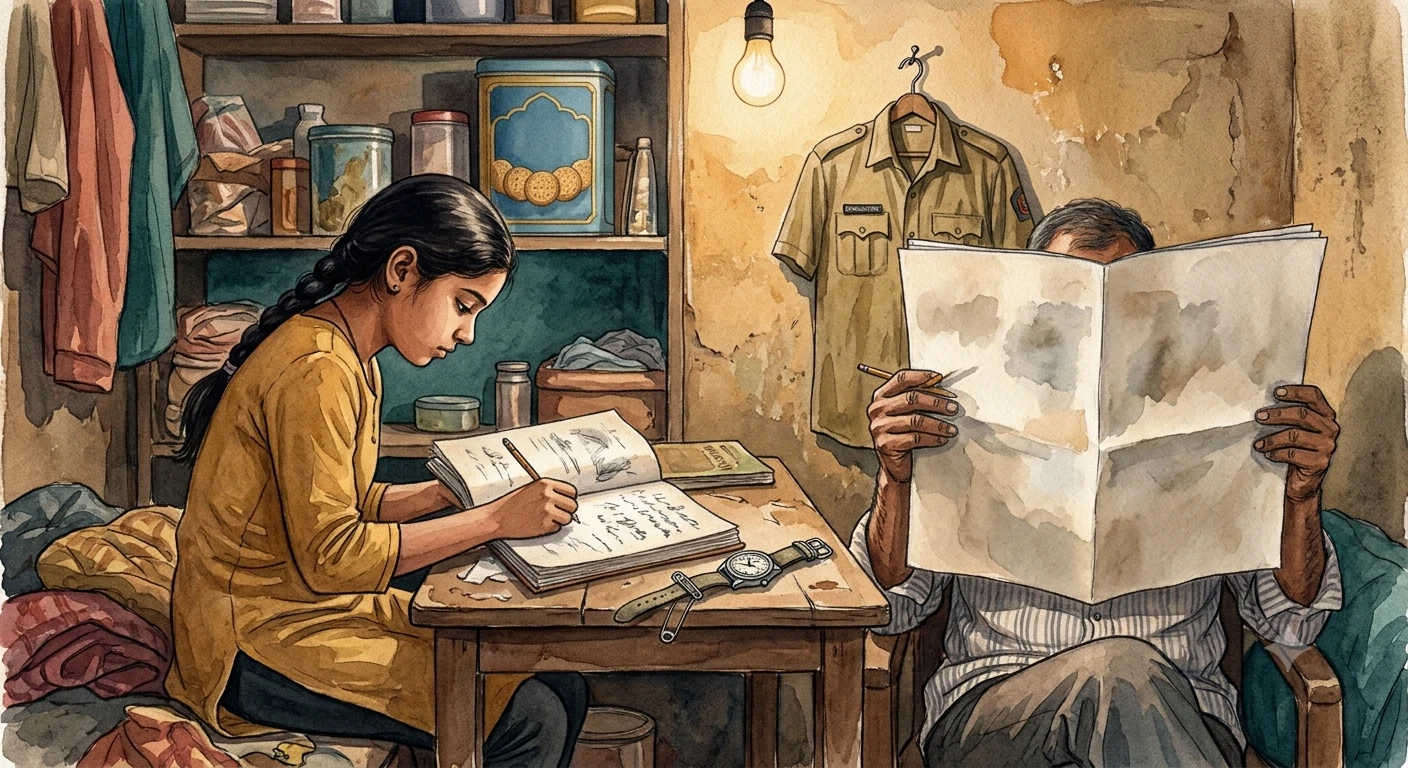
Every evening at seven, Anjali’s father took off his wristwatch and laid it face-up on the table, next to her books.
It was an old HMT with a cracked strap, held together by a safety pin. He had worn it on Mumbai bus routes for twenty-two years. When it came off his wrist, the hour began.
“One hour,” Dinkar said. “After that, do what you like.”
That was the whole rule. No ranks, no speeches. Only the watch and Anjali at the table in their one-room home in a Kurla chawl, where the table was also where they ate.
She was thirteen, and by November, she hated it.
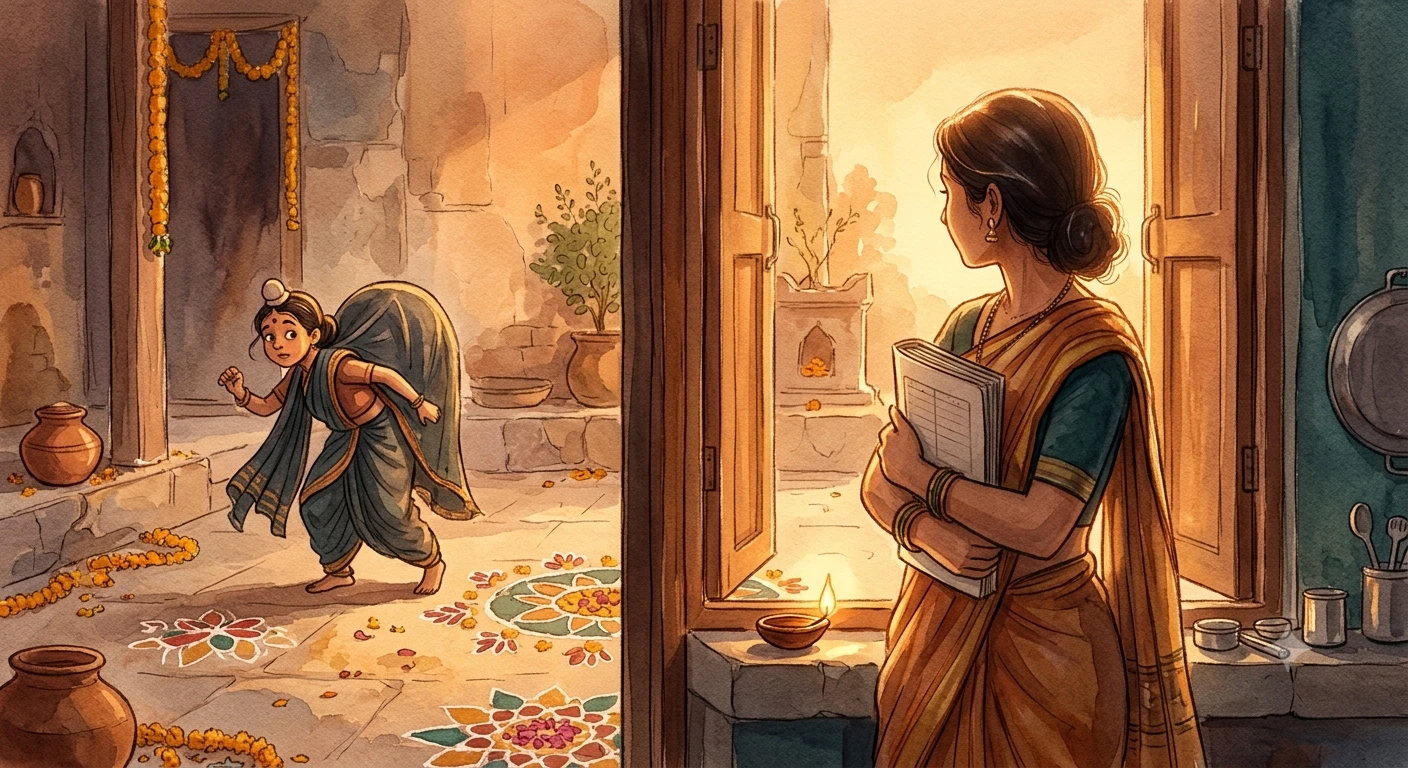
On a Thursday, she heard Sagar shouting her name from the lane.
“Anju! One over only!”
She pushed her book away. “Papa, not today. I’ll do two hours tomorrow.”
Dinkar was at the other end of the room, ironing his khaki conductor’s shirt for the morning. He did this every night, whether the shirt needed it or not. He didn’t look up from the collar.
“You think I wake up at four wanting to stand in a bus with sixty people breathing on me?”
“That’s your job.”
“And this is yours.” He pressed the iron to the cuff. “The 332 doesn’t ask what mood I’m in.”
She waited for more. There was no more. He hung the shirt on its nail, and the steam hissed in the quiet.
Sagar called again. Anjali looked at the watch. 7:11.
She picked up her pencil with a face like a shut door and did the hour.
Some days it went well. Some days she wrote the same fraction sum five times and got it wrong five different ways.
Her father never asked how it had gone. He only said, “Did you give your hour?” and she said yes, or sometimes a sulky “Obviously,” and that was the end of it.
She noticed other things that winter, because angry people notice things.
She noticed that his boots were at the door by ten past five every morning, laces already tied. She noticed the ka-chak of his ticket machine as he tested it twice before leaving, like a man checking a lock.
In January, he had a fever of a hundred and one. She saw him sit on the doorstep to tie his laces, stopping between each knot. Then he went to work.
In February, she went looking for Sellotape to fix her geometry box and opened the Marie biscuit tin on the shelf.
It held no tape. It held bus tickets, hundreds of them, in rubber-banded bundles by month. Each one was a used ticket, punched through with the little hole.
She turned one over. On the back, in pencil and square capital letters, was a single word and its meaning in Marathi.
ACCOUNT — hisab.
She turned over another. PATIENT — dheer. Another. REQUIRE — garaj.
In the last bundle, one ticket said: Anju used ‘consequently’ at dinner. Ask what it means.
She remembered saying it three weeks earlier, about her Hindi test. She had not noticed him listening.
Anjali stood still, holding the ticket. She thought of his tired hands, the old watch and the evenings when he sat quietly across from her with the newspaper.
Dinkar came in with the vegetable bag. He looked at the open tin, then at her. He set the bag down and sat on the cot. For once, he didn’t pretend he hadn’t seen anything.
“You sit across from me every night,” she said. “With the newspaper. I thought you were reading the cricket scores.”
“Cricket I understand,” he said. “This is harder.”
“Papa. Why didn’t you tell me?”
He rubbed his thumb along the safety pin on his watch strap.
“If I told you, you’d do it for me. I didn’t want that.” He shrugged. “Some nights the words go in. Some nights they sit outside like guests. I do my hour anyway.”
She turned the ticket over. ACCOUNT. She put it back in its bundle, in its place, and closed the lid.
The next evening at seven, Dinkar took off his watch and laid it face-up on the table.
He picked up the newspaper and held it open between them, as he always did.
Anjali opened her book. She looked at the watch, then at the white wall of the newspaper. Behind it, she heard a pencil begin.
Scratch, scratch.
Hers answered.
Outside in the lane, Sagar was calling her name again. Neither of them looked up.
📄 Free printable worksheet available below.
Complete the learning activities and download it at the end of this lesson.