
English Short Stories

The Waiting Room

The Waiting Room

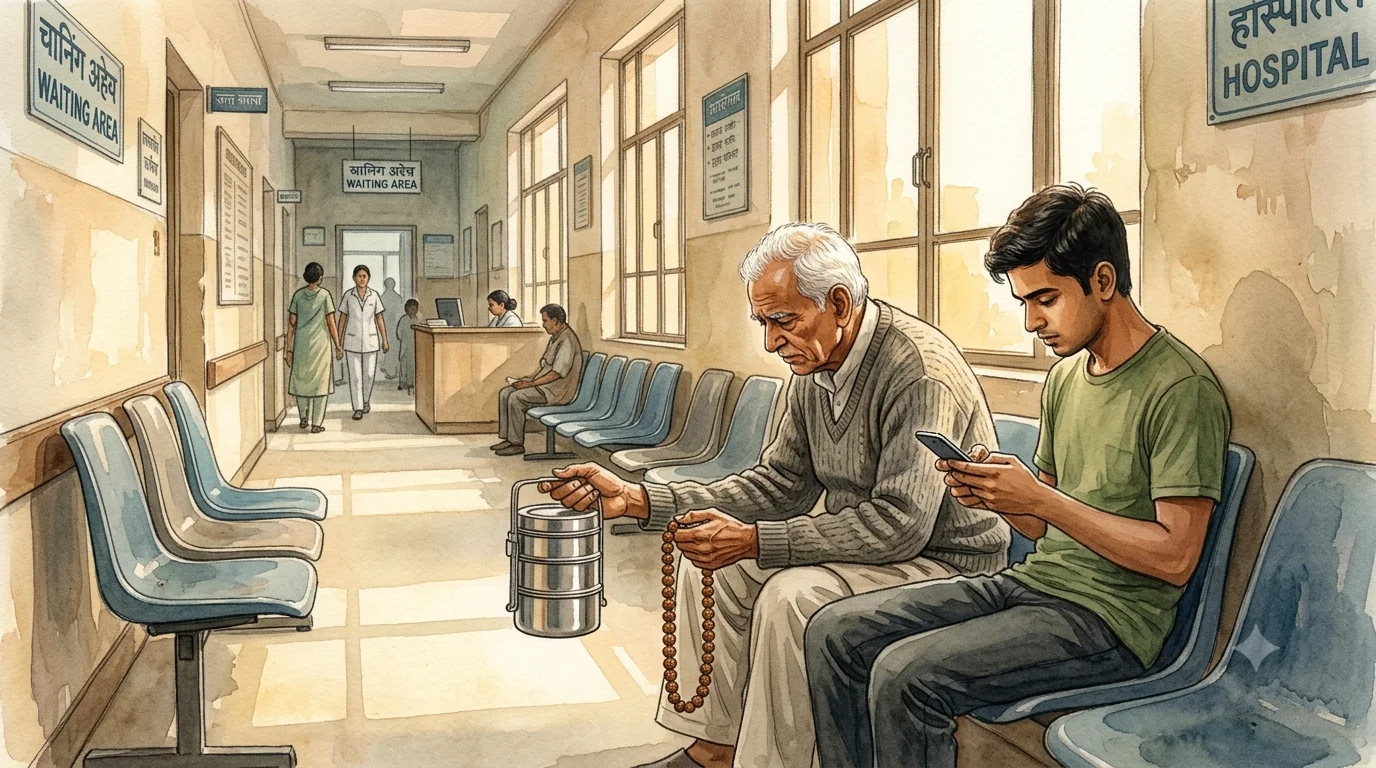
A young man and an elderly stranger wait together in a hospital corridor — Krishna story about surrender and anxiety.
Reading Time: 3 minutes

The corridor outside Pathology at Sahara Hospital had exactly fourteen plastic chairs, and Rohan had counted them twice by 9:40 am, mostly because counting was easier than thinking about what the fifteen-minute wait had already turned into ninety.

His mother had gone in for the biopsy results alone — she’d insisted, the way she insisted on most things, waving him back toward the chairs with the same hand gesture she’d used to shoo him off school buses twenty years ago. Now Rohan sat with his phone face-up in his lap, refreshing nothing, texting Naveen the same three words over and over — still no news — because typing something felt marginally better than sitting with the alternative.

An old man had settled into the chair beside him around nine, a steel tiffin box on his knees, untouched. He wore a faded grey sweater despite the Lucknow morning already warming toward heat, and a string of rudraksha beads moved slowly through his fingers, not in prayer exactly, more like a habit his hands had kept long after the reason for it had blurred.

“First time here?” the old man asked, not looking over.

“My mother,” Rohan said. “Biopsy.”

“Ah.” The old man nodded slowly, the beads still moving. “My wife has dialysis, every Tuesday and Friday, going on eleven months now. I know this bench better than my own drawing room.”

Rohan didn’t know what to say to that, so he said nothing, which the old man seemed entirely comfortable with.

“You’re doing the thing,” the old man said eventually, “where you try to already know the answer, so it can’t surprise you.”

Rohan looked up. “Is it that obvious?”

“You’ve read the same sentence on that phone four times. I’ve been counting.” A small smile, gone as quickly as it came. “I used to do it too. First few months, I thought if I worried hard enough, thoroughly enough, nothing bad could arrive without my permission. As if worry were a kind of insurance.”

“Doesn’t it help? Being prepared?”

“Prepared, yes. There’s a difference between prepared and this.” He gestured, loosely, at Rohan’s phone, his knee bouncing, the general coiled state of him. “This isn’t preparing for anything. This is just suffering twice — once now, imagining it, and again later, if it happens.”

A nurse called a name from the far door — not Rohan’s mother’s — and an entire family rose at once, too fast, then sat back down when it turned out to be someone else’s turn.

“My son tells me I should stop coming,” the old man said, once the corridor had settled again. “Sit at home, he says, I’ll call you the moment there’s news. But I told him — coming here isn’t about the news. It’s the only part of this whole business that’s actually mine to do. Sitting beside her. Carrying the tiffin she won’t eat but likes having anyway. The rest —” he opened one hand, let it fall closed again, unhurried — “the rest was never really in my hands to begin with. Wasn’t then. Isn’t now.”

“That sounds like giving up.”

“Does it?” He didn’t seem offended by the accusation. “I don’t think so. Giving up would be not coming. Giving up would be sitting at home refreshing my phone the way you’re refreshing yours, as if that changes what’s already been decided in some lab down that corridor.” He tapped the tiffin box once, absentmindedly. “This is the opposite of giving up. I do exactly what’s mine to do, fully, and I let go of the part that was never mine to hold in the first place.”

Rohan turned this over slowly, the way you turn over something you’re not sure yet whether you agree with.

“There’s a line,” the old man said, “I heard once, years ago, at a satsang I mostly attended because my wife dragged me. Something about surrendering the outcome, not the effort. I didn’t understand it then. I understood it about the fourth month of these Tuesdays and Fridays.”

The door opened. Rohan’s mother stepped out, adjusting her dupatta, her face doing the particular thing faces do right before they decide whether to deliver good news or bad — a half-second where nothing has been said yet and everything still feels possible.

“Benign,” she said, before he could even stand. “They want a follow-up scan in six months, just to be sure. But benign.”

Rohan stood so fast his phone clattered to the floor, and for once he didn’t reach for it.

When he turned to introduce her to the old man, the chair beside him was already empty — a nurse had called a name from the dialysis ward, and he’d gone in without ceremony, the way he must have gone in a hundred Tuesdays and Fridays before this one, tiffin box still in hand, still mostly untouched.

Scripture/Source: Inspired by the Bhagavad Gita, Chapter 18, Verse 66, and Krishna’s broader teaching on surrender — that true surrender means fully doing what is ours to do, while releasing attachment to an outcome that was never within our control. Not a direct verse translation; adapted as an original story.

Continue Reading

Faith in Krishna — a different kind of uncertainty, and the same quiet trust that doesn’t ask you to stop trying.

📄 Free printable worksheet available below.
Complete the learning activities and download it at the end of this lesson.

📖 Story in Brief
Rohan waits outside Pathology while his mother's biopsy results are read, counting chairs and refreshing his phone to hold off the fear. An old man beside him, waiting for his own wife's dialysis, shares what eleven months of hospital corridors taught him — that showing up fully is his to do, and the outcome never was. When the results finally come back benign, Rohan realizes he spent the wait suffering twice for nothing.
💡 The Lesson Inside
Real surrender isn't giving up — it's doing fully what's actually ours to do, and releasing the part that was never in our hands to begin with. Worry rehearses pain that hasn't happened yet, without changing what's already decided.
✨ Words Worth Keeping
Coiled
tightly wound or tensed, like something ready to spring.
You might say: He sat coiled with nerves the entire drive to the interview.
Marginally
only slightly, by a small amount.
You might say: The second attempt was marginally better than the first, though still far from perfect.
Untouched
not used, eaten, or handled, left exactly as it was.
You might say: Her lunch sat untouched on the desk through the entire meeting.
Absentmindedly
done without full attention, almost automatically, while thinking of something else.
You might say: She absentmindedly stirred her tea long after the sugar had dissolved.
Ceremony
formal fuss or ritual around an action, often unnecessary.
You might say: He left the party without ceremony, slipping out before anyone noticed.
🌱 Phrases to Remember
Suffering twice
experiencing pain both in anticipation of something and again if it actually happens.
In real life you might say: Replaying the argument all night was just suffering twice over something already over.
A kind of insurance
treating an action as protection against a bad outcome, even when it offers none.
In real life you might say: He checked his bag for the fifth time, as if checking were a kind of insurance against forgetting something.
Never really in my hands
describing something entirely outside a person's control, however much they want to influence it.
In real life you might say: The final decision was never really in her hands, no matter how well she'd prepared.
Doing exactly what's mine to do
focusing fully on one's own responsibility rather than the result it may or may not produce.
In real life you might say: All he could do now was study well and show up on exam day
doing exactly what was his to do.
Settled again
a place or situation returning to calm after a brief disruption.
In real life you might say: The classroom settled again once the fire alarm test had finished.
📚 Quick Glossary
Dupatta
a long scarf traditionally worn with Indian outfits like the salwar kameez, often draped over the shoulders or head.
Satsang
a gathering for spiritual teaching, discussion, or devotional singing, common across Indian communities.
Tiffin
a stacked metal lunchbox commonly used across India to carry home-cooked meals.
🎬 See It in Action
1

Coiled — The runner stood coiled at the starting line, waiting for the signal.

2

Marginally — Her second essay draft was marginally clearer than the first.

3

Untouched — The birthday cake sat untouched until the candles were lit.

4

Absentmindedly — He absentmindedly hummed the same tune all afternoon.

5

Ceremony — They signed the papers without ceremony, in under five minutes.

🗣️ Say It Right
Dupatta
//doo-PUT-tah//
Satsang
//SUT-sung//
Tiffin
//TIF-in//

🎯 Complete the Story Challenges

🧩 Vocabulary Explorer ✏️ Context Architect Timeline Master ✍️ Creative Novelist
Game 1: Word Match ✨ Reward: +10 XP

Vocabulary Matcher

Match the vocabulary word on the left with its correct meaning on the right.

Marginally
Untouched
Absentmindedly
Coiled
only slightly, by a small amount.
tightly wound or tensed, like something ready to spring.
not used, eaten, or handled, left exactly as it was.
done without full attention, almost automatically, while thinking of something else.
Free Reading Comprehension Worksheet

Strengthen your English skills with a printable worksheet based on this story.

Vocabulary Practice Reading Comprehension Critical Thinking Writing Skills
Download & Print Worksheet

Free for students, parents, teachers and ESL learners.

One more story before you go...

A husband discovers his wife's smaller plate in the kitchen — a short moral story about sacrifice in marriage.

The Steel Tiffin

Reading Time: 2 minutesRamesh worked in a small accounts office near Dadar station. Every morning at eight, his wife Sunita packed his tiffin — the old steel one with a dent on the

Read More »
Grandfather greets son and grandson at an Indian railway platform at evening — nostalgic family reunion story

The Railway Station Reunion

Reading Time: 2 minutesBaburao Deshmukh reached platform two hours before the train was due. He always did. The station master, Prakash, had stopped asking why years ago. He simply nodded from his little

Read More »

Stories you may like...

A grandfather and grandson watering tomato plants on a Hyderabad terrace garden — Krishna story about burnout and balance.

Reading Time: 3 minutesKiran hadn’t left the office before ten at night in nineteen days, and he wore the number like a badge,

Read More »
An empty cane chair at a Bengali family's Durga Puja table — Krishna story about grief and loss.

Reading Time: 3 minutesThe cane chair at the head of the table had been empty for four months, but nobody had said so

Read More »
A worn white Santro parked beside a gleaming new Fortuner SUV in an Indian residential society — Krishna story about desire.

Reading Time: 4 minutesNinad had been driving the Santro for eight months now — errands mostly, his mother’s saree emergencies, his father’s files

Read More »

Readers Also Enjoyed

📖 Finding your next story...

Learn something new

Featured Vocabulary
Commitment
A promise to stay loyal and dedicated.
Literary Term
Ignore
To not pay attention to something
Idiomatic Expression
Leaning against
resting one's body weight on someone or something for support
Speech & Pronunciation
Crops
Phonetic: KROPS

Sign up to my newsletter

A story for every mood: