
 By
By What would you do if you lost the one thing you thought defined you? Meera was a painter who could no longer see colours. Everyone said her career was over. But she discovered that sometimes our biggest challenges become our greatest gifts.
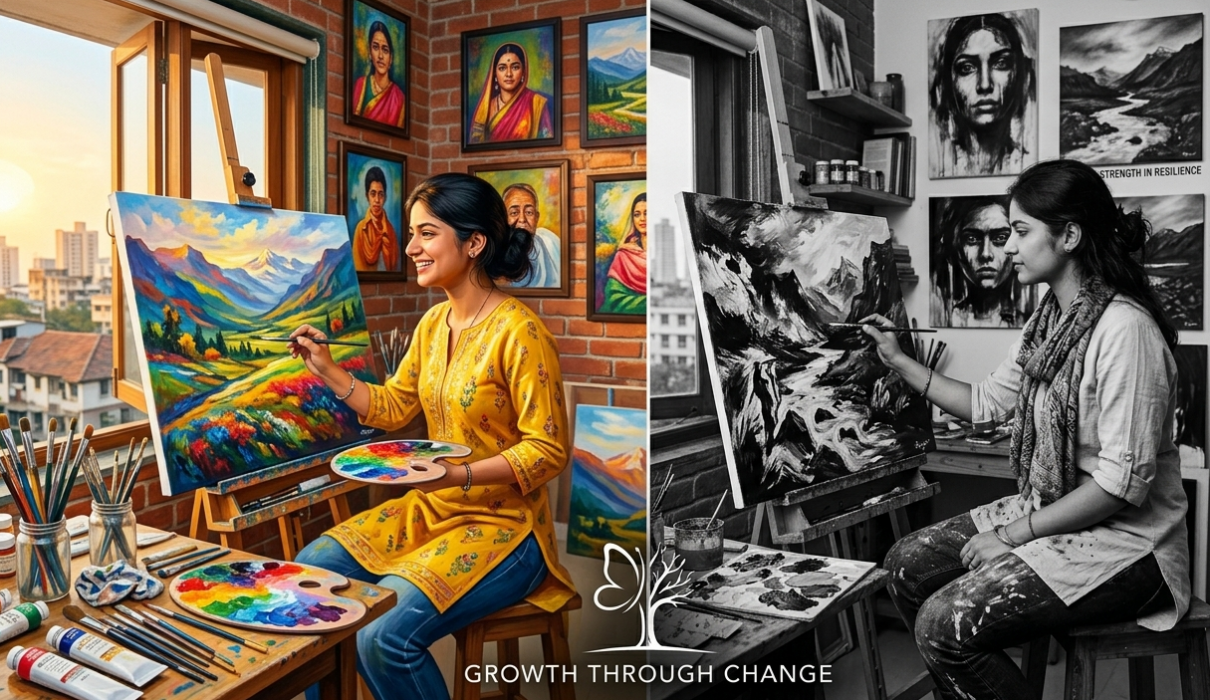
Meera loved colours more than anything in the world. Every morning, she would wake up in her small Mumbai apartment and rush to her easel. Red sunrises. Blue oceans. Golden temples. Green gardens. She painted the vibrant world around her.
At 24, she had just started getting recognition. A gallery in Bandra wanted to display her work. Art students followed her on Instagram. Her parents, who once worried about her “impractical” career choice, were finally proud.
Life was perfect. Until it wasn’t.
One Tuesday morning, Meera woke up, and something felt wrong. The world looked… strange. Flat. Grey.
She blinked hard. Rubbed her eyes. Looked at her colourful paintings on the wall.
They were all grey. Different shades of grey, but no colours.
Panic set in. She ran to the window. The busy Mumbai street below—usually a riot of colours—looked like an old black-and-white photograph.
“This can’t be happening,” she whispered.
The doctor’s words were clinical and cold. “It’s called achromatopsia. A rare condition. Your eyes have lost the ability to see colours. I’m sorry, but there’s no cure.”
“Will it come back?” Meera asked, her voice shaking.
“Unlikely,” the doctor said gently. “You’ll see the world in black, white, and shades of grey from now on.”
Meera sat in silence. Her whole identity was built on seeing and painting colours. Without that, who was she?
For three months, Meera didn’t paint. She didn’t even enter her studio. The canvases sat untouched, gathering dust. Her paints dried up in their tubes.
Friends tried to encourage her. “You can still draw!” they said. “Maybe try sculpting?”
But Meera felt hollow inside. “I’m a colour painter,” she would say. “What’s the point of painting if I can’t see colours?”
Her art gallery show was cancelled. Students stopped asking her for advice. The world moved on, but Meera felt stuck.
One evening, her younger sister Priya visited. She found Meera sitting in the dark.
“Di, you can’t give up,” Priya said softly.
“I didn’t give up. Life gave up on me.”
“No,” Priya insisted. “You’re still an artist. Colours were never your real gift. Your real gift was making people feel something when they saw your work.”
Meera didn’t respond, but the words stayed with her.
Late that night, unable to sleep, Meera walked into her dusty studio. She turned on the light and stared at the blank canvas.
“Okay,” she said to herself. “No colours. But I can still see shapes. Light and shadow. Texture.”
She picked up black paint. Just black. And white. And grey.
She started painting what she felt instead of what she saw.
She painted loneliness as deep shadows with a single beam of light.
She painted hope as gentle gradients from dark to light.
She painted love as soft, blending greys that merged into each other.
Hours passed. When she finally stepped back, she realised something: this painting made her feel more than any colourful painting she’d ever done.
Over the next few months, Meera developed a completely new style. Her black-and-white paintings were different from anything in the art world. They weren’t just pictures—they were emotions captured in shades of grey.
She painted using texture too—thick paint, thin washes, rough strokes, smooth blends. Each texture told part of the story.
She started posting her new work online with a simple caption: “Seeing the world differently.”
The response shocked her.
“This made me cry.”
“I’ve never felt so much from a painting.”
“The absence of colour makes it more powerful, not less.”
Six months after losing her colour vision, Meera held her first exhibition of black-and-white work. She titled it: “Beyond Colour: Seeing with the Heart.”
The gallery was packed. People stood silently in front of her paintings, deeply moved. Art critics called her work “revolutionary” and “emotionally raw.”
A famous art collector bought three pieces. An international magazine wanted to feature her story.
But the moment that mattered most came when a young girl approached her.
“I’m colorblind,” the girl said shyly. “Everyone says I can’t be an artist because of it. But your paintings… they show me I can.”
Meera knelt down to the girl’s level. “You don’t need to see every colour to create something beautiful. You just need to see with your heart.”
Today, Meera’s black-and-white paintings sell for more than her colored ones ever did. She teaches workshops for artists with disabilities. She speaks at schools about turning obstacles into opportunities.
When people ask her if she wishes she could see colours again, she thinks carefully before answering.
“Part of me misses colours,” she admits. “But losing them taught me something important: I was never just a painter of colours. I was always a painter of feelings. It took losing my sight to finally see that truth.”
She keeps one of her old colourful paintings in her studio—not to make her sad, but to remind her of her journey. From seeing the world one way to seeing it completely differently. From thinking she had lost everything to discovering she had everything she needed all along.
Her limitation became her liberation. Her loss became her unique voice. And the painter who couldn’t see colours taught the world to see art in a whole new way.
MORAL
“Your limitations don’t define you—how you respond to them does. What seems like your biggest weakness can become your greatest strength if you’re brave enough to see it differently. True art, like true strength, comes not from what you have, but from what you do with what remains.
GLOSSARY
- Vibrant — Full of bright, strong colors; lively and energetic
- Easel — A wooden stand that holds a canvas for painting
- Recognition — Being noticed and appreciated for your work
- Impractical — Not sensible or realistic; not likely to work
- Riot — Here, it means a lot of something in a wild, exciting way
- Clinical — Related to medical treatment; also means cold and unemotional
- Achromatopsia — A medical condition where a person cannot see colors
- Identity — Who you are; what makes you “you”
- Hollow — Empty inside; feeling like something important is missing
- Canvas — A piece of cloth stretched on a frame, used for painting
- Gradients — A gradual change from one shade to another
- Merged — Blended together; combined into one
- Revolutionary — Completely new and different; groundbreaking
- Raw — Honest and powerful; showing true emotions without hiding them
- Liberation — Freedom; being set free from something that held you back
VOCABULARY LIST
- Vibrant — Colourful, bright, lively
- Recognition — Fame, acknowledgement, appreciation
- Panic — Fear, alarm, anxiety
- Clinical — Medical, cold, unemotional
- Diagnosis — Medical conclusion, finding, determination
- Identity — Self, character, personality
- Hollow — Empty, vacant, meaningless
- Encourage — Support, motivate, inspire
- Insisted — Demanded, stated firmly, maintained
- Texture — Surface quality, feel, touch
- Gradients — Shades, transitions, progressions
- Response — Reaction, answer, feedback
- Revolutionary — Innovative, groundbreaking, radical
- Raw — Genuine, unfiltered, honest
- Featured — Highlighted, showcased, presented
- Obstacle — Challenge, barrier, difficulty
- Liberation — Freedom, release, emancipation
- Limitation — Restriction, constraint, boundary
- Workshop — Class, seminar, training session
- Unique — Special, one-of-a-kind, distinctive
KEY PHRASES
- “riot of colours” — A lot of bright, exciting colours all mixed together
- “felt stuck” — Unable to move forward; trapped in a situation
- “give up on” — Stop believing in someone or something; abandon hope
- “see with your heart” — Understand or perceive things through feelings and emotions, not just eyes
- “turning obstacles into opportunities” — Making challenges work in your favour; finding advantages in difficulties
- “what remains” — What is left after something is lost or taken away
- “gathered dust” — Unused for a long time; neglected
USAGE EXAMPLES
- The children’s party was a riot of balloons, laughter, and music.
- After failing twice, she felt stuck and didn’t know what to do next.
- Despite the diagnosis, he decided to live life fully.
- Her honest speech about failure was raw and made everyone emotional.
- Learning a new language can turn the obstacle of moving to a new country into an opportunity to grow.