

 By
By Have you ever been told to stop asking so many questions? Meet Ananya, a girl whose favorite word was “Why?”—and how that one simple question changed her life forever.
The Question Girl
“Why is the sky blue?” “Why do birds fly south?” “Why does ice melt?”
In the small town of Jaipur, everyone knew eight-year-old Ananya as “the question girl.”
“Ananya, stop asking so many questions!” her teacher Mrs. Sharma would say.
“Just accept things as they are,” her grandmother told her.
“You talk too much,” her classmates complained.
But Ananya couldn’t help it. She wanted to understand everything.
The Annoying Habit
In school, Ananya’s hand shot up constantly.
“Why do we memorize this poem?” “Why does this math formula work?”
Her teachers got annoyed. “We don’t have time for all your questions!”
At home, it was the same.
“Why do you add turmeric to food?” “Why does the fan spin?”
Her mother sighed. “You ask too many questions, beta.”
Even her friends avoided her. “She never stops asking why!”
Ananya felt lonely. Maybe everyone was right. Maybe asking questions was bad.
The New Teacher
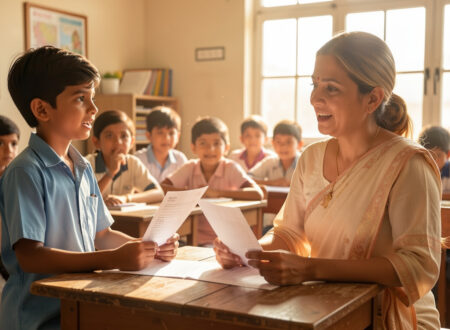
One day, Mr. Patel, a new science teacher, joined their school.
In his first class, Ananya raised her hand. “Why does water evaporate?”
The class groaned. “Not again!”
But Mr. Patel smiled. “That’s an excellent question! Who else wants to know why?”
Ananya blinked in surprise. No teacher had ever said that before!
After class, Mr. Patel called her aside.
“Don’t ever stop asking questions,” he said. “Do you know what scientists do all day? They ask ‘why.’ Sir Isaac Newton asked why apples fall down. Marie Curie asked why elements glow. Every scientist was once a curious child.”
For the first time, Ananya didn’t feel annoying. She felt special.
Learning to Find Answers
Mr. Patel taught Ananya to find answers herself.
“When you have a question, first try to find the answer. Read books. Observe. Then, if you still don’t understand, ask.”
Ananya started visiting the library. She read books about science, nature, and space.
She started a “Question Notebook”:
- Questions she had
- What she thought the answer might be
- Where she found the real answer
- New questions
Her questions became better. Instead of “Why is the sky blue?” she asked “Why does the sky’s color change during sunrise?”
Teachers noticed. Her questions now sparked interesting discussions.
The Science Fair
When Ananya was twelve, she had a question: “Why do some street dogs in Jaipur sleep on the road at night?”
She observed for three months. Dogs slept on roads heated by sun all day. The warm asphalt kept them comfortable at night.
She created a project showing temperature differences. It won first prize at school, then district, then state level!
A newspaper wrote: “Local Girl’s Curiosity Wins State Science Fair.”
Her grandmother, who had told her to stop asking, framed the article proudly.
Today, Ananya is 24 and studies environmental science. She researches how animals adapt to city life.
She still asks “why” all the time. Now, it’s her job.
She visits schools, talking to children.
“Never let anyone make you feel bad for being curious,” she tells them. “Every question is a door opening. Some doors lead to small rooms. Some lead to huge discoveries.”
She talks about famous scientists who asked “why”:
- Why do objects fall? (Gravity)
- Why do people get sick? (Medicine)
- Why is the earth round? (Astronomy)
“Every answer started with a question,” she says.
The Message
Ananya’s message to students learning new things: Keep asking questions.
“When you’re learning English, ask ‘Why is this word spelled this way?’ When studying math, ask ‘Why does this formula work?'”
“The children who ask the most questions often become the adults who discover the most answers.”
She still carries her old “Question Notebook.” It reminds her that curiosity isn’t annoying—it’s a superpower.
“Being curious means you’re paying attention to the world. Never apologize for wanting to understand things better.”
And whenever she meets a child who asks too many questions, she smiles and says, “You remind me of someone I know. Keep asking. The world needs curious minds like yours.”
MORAL
Curiosity is not annoying—it’s your superpower. Every great discovery started with someone asking ‘Why?’ Never stop questioning, never stop learning, and never let anyone make you feel bad for wanting to understand the world better. The question you ask today might lead to the answer that changes tomorrow.
GLOSSARY
- Curiosity — A strong desire to know or learn something
- Frustrated — Feeling annoyed or upset because something is difficult
- Memorize — To learn something so well that you can remember it perfectly
- Formula — A rule in math or science shown using symbols and numbers
- Textbook — A book used for studying a particular subject in school
- Turmeric — A yellow spice used in Indian cooking
- Evaporate — When liquid turns into gas or vapor
- Hesitantly — In an uncertain or nervous way; not confident
- Brilliant — Very clever; extremely good
- Observe — To watch carefully
- Migrate — To move from one place to another (usually animals or birds)
- Asphalt — The black material used to make roads
- Adapt — To change to fit new conditions
- Breakthrough — An important discovery or development
- Superpower — A special ability; here, a very valuable skill
VOCABULARY LIST
- Curious — Interested, inquisitive, eager to learn
- Annoying — Irritating, bothersome, frustrating
- Constantly — All the time, continuously, always
- Frustrated — Annoyed, irritated, upset
- Hesitantly — Uncertainly, nervously, cautiously
- Excellent — Very good, outstanding, superb
- Brilliant — Smart, clever, intelligent
- Aside — To one side, privately, separately
- Discovery — Finding, breakthrough, revelation
- Research — Study, investigate, examine
- Observe — Watch, notice, see
- Sparked — Started, triggered, caused
- Adapt — Adjust, change, modify
- Breakthrough — Achievement, advance, progress
- Invention — Creation, innovation, new device
- Cure — Treatment, remedy, medicine
- Apologize — Say sorry, express regret
- Active — Engaged, working, functioning
- Discover — Find out, learn, uncover
- Understand — Comprehend, grasp, know
KEY PHRASES
- “shot up” — Rose quickly (here, her hand went up fast to ask a question)
- “turning point” — The moment when things start to change
- “sparked interesting discussions” — Started good conversations; made people think and talk
- “paying attention to the world” — Noticing and caring about what happens around you
- “curious mind” — A person who wants to learn and understand things
- “just how it is” — An expression meaning “accept it without questioning”
- “refuse to stop” — Decide not to quit; keep going despite obstacles
USAGE EXAMPLES
- Her curiosity about space led her to become an astronaut.
- He observed the birds carefully before drawing them.
- The teacher’s interesting question sparked a great class discussion.
- Scientists research diseases to find cures.
- She refused to give up even when the problem was difficult.