
English Short Stories

The Teacher Who Remembered Everyon’s Name

The Teacher Who Remembered Everyon’s Name

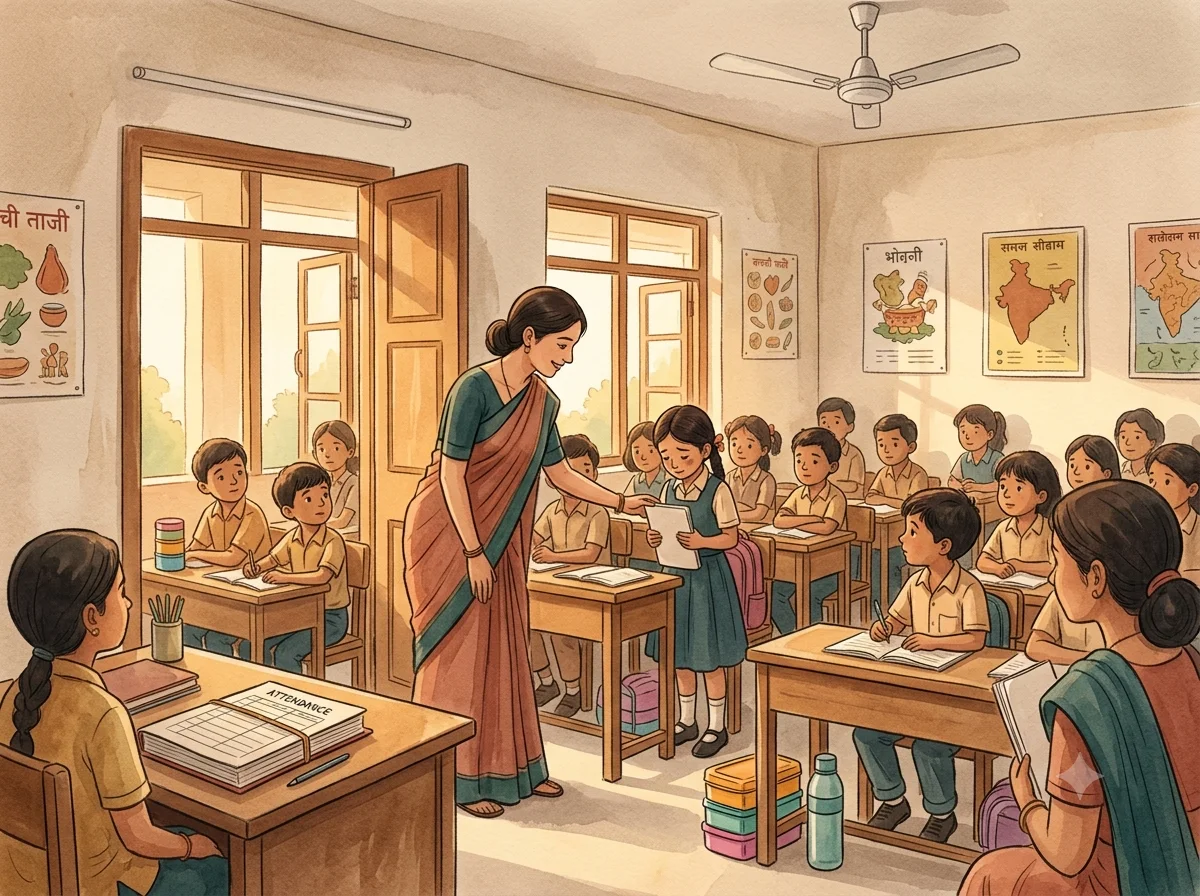
A shy schoolgirl in a crowded Indian classroom — moral story about a teacher who remembers names
Reading Time: 2 minutes

In Class 5-C of the Zilla Parishad school in Latur, forty-six children sat elbow to elbow, three to a bench meant for two, and the fan overhead groaned more than it cooled.

Every morning began the same way. Their class teacher, Wagh Sir, called the roll from a register held together with a rubber band, reading names in a rush, eyes never leaving the page.

“Ashwini… Bhagwat… Chavan… Deshmukh…”

He never looked up. He never needed to. A voice said “Present, Sir” and he moved on.

In the last row, third seat from the wall, sat a girl named Meera Salunkhe. She had failed her name three times that week — once when he called “Salunke” instead of “Salunkhe,” once when he skipped her altogether and had to double back, and once when another Meera answered first and nobody noticed the mix-up until the tiffin break.

Meera did not correct anyone. She had stopped trying in February.

Then, in June, Wagh Sir retired, and a new teacher came from Nanded — Kalyani Ma’am, thin as a reed, with a voice that carried without being loud.

On her first day, she did not open the register. She stood at the door instead and asked each child, one by one, to say their own name as they walked in.

“Say it exactly how your family says it. Not how the register says it.”

When Meera’s turn came, she mumbled her name toward her shoes.

“Once more,” Kalyani Ma’am said. “I want to hear it properly.”

“Meera. Salunkhe.” This time a little louder, cheeks warm.

“Meera Salunkhe,” the teacher repeated, and the way she said the surname — the “kh” landing soft, not swallowed — made it sound like it belonged to someone worth knowing.

That was Monday.

By Thursday, Kalyani Ma’am had learned the names of all forty-six children — not just the first names, but who was whose sister, which twin answered first, which boy’s grandmother had raised him after his mother went to work in Pune. She wrote none of it down. She simply asked, and remembered, and used it.

She started calling on Meera by name during lessons — not to catch her out, but because she had noticed the girl’s notebook, filled edge to edge with tiny, careful handwriting, answers nobody had asked to see.

“Meera, read your answer to the class.”

Meera’s hands went cold. But she read it — her sentence about the water cycle, evaporation and condensation explained in words simpler than the textbook’s — and for the first time in Class 5-C, forty-five other children turned to look at the girl in the last row.

By August, Meera was answering without being called on. By October, she was helping Roshni next to her with fractions, her voice no longer aimed at her shoes.

At the Republic Day function, when the school asked for a student to recite the pledge, three teachers gave the same name without discussing it first.

Meera stood at the microphone in a borrowed white dress, and somewhere in the crowd, Kalyani Ma’am mouthed the words along with her, silent, the way you do when you already know someone will get it right.

After the function, Meera’s mother found Kalyani Ma’am near the tea stall and did not know what to say, so she said the only thing that felt true: “She talks at home now. Since June, she talks.”

Kalyani Ma’am only smiled and said, “She always had things to say. Somebody just had to ask her name properly.”

📄 Free printable worksheet available below.
Complete the learning activities and download it at the end of this lesson.

📖 Story in Brief
A quiet girl in the back row of a crowded government school classroom has spent a year going unnoticed, her name mispronounced or skipped at roll call. When a new teacher learns to say her name properly and asks about her life, the girl begins to speak up in class and at home. It turns out that being seen by one person, clearly and by name, is sometimes all it takes to change how a child sees herself.
💡 The Lesson Inside
A name said carelessly can make a child feel like a line in a register. A name said properly — with the right sound, the right weight — can make her feel like someone worth knowing. Kalyani Ma'am never gave a speech about kindness. She simply learned forty-six names and used them, and one girl in the back row started talking again.
✨ Words Worth Keeping
Mumbled
spoke in a low, unclear voice, often out of nervousness or shyness.
You might say: He mumbled an apology and hurried out of the room.
Carried
travelled a distance and was still heard clearly, usually about sound.
You might say: Her laughter carried across the entire hall.
Register
an official book or list where names or attendance are recorded.
You might say: The teacher marked the register before the bell rang.
Rush
doing something quickly, often without full attention.
You might say: She finished her chores in a rush before the guests arrived.
Pledge
a formal promise, often spoken aloud together as a group.
You might say: Every student stood to say the pledge before assembly began.
🌱 Phrases to Remember
Thin as a reed
very slim in build.
In real life you might say: Her grandfather was thin as a reed but could still carry two buckets of water at once.
Elbow to elbow
packed closely together with little space.
In real life you might say: The train compartment was elbow to elbow during the festival rush.
Doubled back
went back to correct or repeat something missed.
In real life you might say: He doubled back to check if he'd locked the front door.
Aimed at her shoes
spoke or looked down out of shyness or embarrassment.
In real life you might say: He kept his answer aimed at his shoes when the teacher asked why he was late.
Stopped trying
gave up making an effort, often quietly.
In real life you might say: After the third rejection, he almost stopped trying to find a job.
📚 Quick Glossary
Zilla Parishad school
a government-run school in India, typically found in small towns and villages, funded by the local district council.
Tiffin
a home-packed meal, usually carried to school or work in a small stacked container; also the short break when it's eaten.
Sir/Ma'am
the common form of address Indian students use for teachers, regardless of the teacher's actual name.
Republic Day
January 26th, an Indian national holiday marking the day the Constitution came into effect, often celebrated at schools with flag hoisting and the pledge.
🎬 See It in Action
1

He mumbled an apology and hurried out of the room.

2

Her laughter carried across the entire hall.

3

The teacher marked the register before the bell rang.

4

She finished her chores in a rush before the guests arrived.

5

Every student stood to say the pledge before assembly began.

🗣️ Say It Right
Meera
/say it like: MEE-ra/
Salunkhe
/say it like: sa-LOONK-hey/
Kalyani
/say it like: kal-YA-nee/

🎯 Complete the Story Challenges

🧩 Vocabulary Explorer ✏️ Context Architect Timeline Master ✍️ Creative Novelist
Game 1: Word Match ✨ Reward: +10 XP

Vocabulary Matcher

Match the vocabulary word on the left with its correct meaning on the right.

Carried
Mumbled
Rush
Register
an official book or list where names or attendance are recorded.
doing something quickly, often without full attention.
spoke in a low, unclear voice, often out of nervousness or shyness.
travelled a distance and was still heard clearly, usually about sound.
Free Reading Comprehension Worksheet

Strengthen your English skills with a printable worksheet based on this story.

Vocabulary Practice Reading Comprehension Critical Thinking Writing Skills
Download & Print Worksheet

Free for students, parents, teachers and ESL learners.

One more story before you go...

A girl kneels over a smudged peacock rangoli at dawn — a story about failure and trying again.

The Rangoli That Went Wrong

Reading Time: 2 minutesMeera had been drawing rangoli since she was four, tracing chalk circles on the cool marble of their veranda while her grandmother hummed old songs nearby. This Diwali, the housing

Read More »

Stories you may like...

A young girl offers a second birthday cake to send to the family cook's daughter — a Krishna story about equal vision.

Reading Time: 3 minutesLakshmi had missed her own daughter’s birthday to bake someone else’s. She’d been up since five that morning, icing a

Read More »
Illustration of a teenage girl holding her father's old, worn badminton racket at a table, looking at it thoughtfully while her father sits beside her near an old photograph.

Reading Time: 3 minutesAnanya Rao stood at the service line, shuttle balanced on her racket, and did the math again. Three points from

Read More »
A woman waits anxiously at an airport gate after hearing news of her father's surgery — a Krishna story about letting go of worry.

Reading Time: 3 minutesYour phone buzzes at 5:47 am, and the moment you see your sister’s name on the screen, your stomach tightens.

Read More »

Readers Also Enjoyed

📖 Finding your next story...

Learn something new

[ess_learning_sidebar]

Sign up to my newsletter

A story for every mood: