
English Short Stories

The Man Who Ran on Empty

The Man Who Ran on Empty

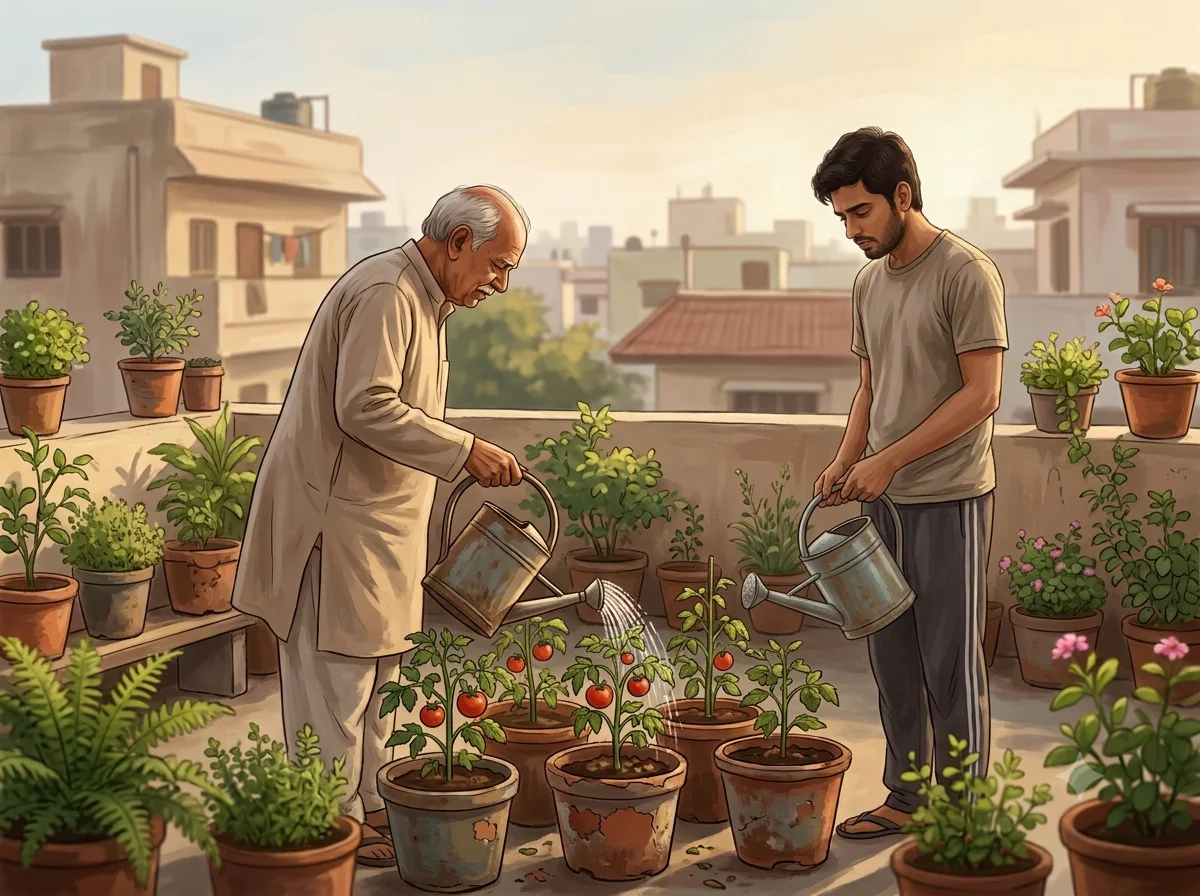
A grandfather and grandson watering tomato plants on a Hyderabad terrace garden — Krishna story about burnout and balance.
Reading Time: 3 minutes

Kiran hadn’t left the office before ten at night in nineteen days, and he wore the number like a badge, the way people wear numbers they’ve stopped questioning.

The Series B pitch was six weeks out. He’d told himself six weeks was survivable — six weeks of skipped lunches, of answering Slack at midnight, of falling asleep mid-sentence on calls with the Singapore office and hoping nobody noticed. HITEC City at 11 pm looked the same as HITEC City at 11 am, glass towers lit up regardless of the hour, as if the whole district had agreed collectively to stop sleeping.

Then, on a Tuesday, Kiran didn’t get out of bed. There was no single reason he could point to — no fight, no bad news, nothing he could have named if someone had asked. He just didn’t get up.

Not sick, not injured. Just unable, in the way that only makes sense from the inside. He watched the ceiling fan for four hours. His phone buzzed eleven times before he turned it face-down and left it there. By evening he’d eaten nothing except the leftover biryani in the fridge, cold, straight from the container, and watched three seasons of a show he couldn’t have named the plot of an hour later.

Meera found him like that on day three, unshowered, the blinds still shut at 4 pm.

“You’ve barely spoken in two days.”

“I’m fine. Just tired.”

“You’ve been tired for six weeks. This isn’t tired.” She sat on the edge of the bed, not touching him, just present. “This is something else.”

He didn’t have an answer for what the something else was. He genuinely didn’t know — only that the same man who couldn’t stop working three weeks ago now couldn’t make himself reply to a single email, and both versions of him felt equally out of his own control.

His father called that weekend, the way he did every Sunday, and Kiran almost didn’t pick up. He did, eventually, mostly because not picking up would have required an explanation he didn’t have.

“Come to Kompally,” Nanna said, not asking. “The tomatoes need looking at. Thatha’s knees are giving him trouble this week.”

Kiran went, mostly because it was easier than staying.

His grandfather’s terrace garden hadn’t changed in Kiran’s whole life — the same chipped clay pots, the same rusted watering can, the same eleven tomato plants that somehow produced exactly enough for the household and nothing more, every single year. Thatha was out there when Kiran arrived, moving along the row with the can, unhurried, the way he’d been doing it every morning since before Kiran was born.

“You look terrible,” Thatha said, not looking up.

“Thanks, Thatha.”

“Sit. Or don’t. The plants don’t mind either way.” He finished the row he was on, set the can down, and lowered himself onto the low stone bench with the particular care of a man whose knees had opinions of their own now.

Kiran sat, mostly to avoid standing.

“You know I water these every day,” Thatha said. “Rain or no rain. Fever or no fever. The August I had the surgery, your Amma did it, exactly the amount I told her, not a drop more.”

“Isn’t that a bit much? Every single day?”

“Every single day is nothing. It’s ten minutes.” Thatha turned one leaf over, checking its underside for something only he was looking for. “The mistake people make is thinking care has to be dramatic to count. So they don’t water for two weeks, then they flood the pot to make up for it, and wonder why the roots rot.” He set the leaf back down gently. “Or they water so much, so eagerly, the first week, that by August they can’t be bothered to water at all.”

Kiran said nothing, but something in his chest had gone quiet in a way it hadn’t in nineteen days.

“Your father tells me you’ve been sleeping four hours a night for a month,” Thatha said, not as an accusation, just a fact laid on the bench between them. “And now, this week, sixteen hours a day, doing nothing at all.” He shrugged. “Same mistake. Different pot.”

Kiran picked up the second watering can without being asked, and found the row Thatha hadn’t reached yet.

He didn’t overdo it. He didn’t skip a plant either. Just the amount each one needed, moving down the line at Thatha’s pace instead of his own, which turned out to take exactly as long as it needed to and no longer.

By the time he drove back to the flat that evening, he hadn’t decided anything about the pitch, or the six weeks, or what Monday would look like. But he texted his manager — a short message, nothing dramatic, just that he’d be logging off at seven for the rest of the week, starting today.

He put his phone away before he could watch for the reply.

Scripture/Source: Inspired by the Bhagavad Gita, Chapter 14, on the three gunas — Krishna’s teaching that both excessive restless activity (rajas) and heavy inertia (tamas) pull a person away from balance, while steady, even effort (sattva) sustains without exhausting. Not a direct verse translation; adapted as an original story.

Continue Reading

The Pothole — a different kind of daily frustration, and a father who also finds his answer in something small and repeated.

📄 Free printable worksheet available below.
Complete the learning activities and download it at the end of this lesson.

📖 Story in Brief
Kiran, a Hyderabad tech worker, swings from nineteen straight days of overwork into three days of total inertia, unable to explain either state to himself or his wife. A weekend at his grandfather's terrace garden, watering the same eleven tomato plants he's tended daily for decades, shows Kiran a different rhythm — not intense, not idle, just enough, every day.
💡 The Lesson Inside
Both burnout and total inertia come from the same mistake: care that isn't sustainable because it isn't consistent. Real balance looks less dramatic than either extreme, and it's usually enough.
✨ Words Worth Keeping
Inertia
a strong resistance to movement or change, a state of staying still even when action is needed.
You might say: After the long holiday, it took real effort to shake off the inertia and get back to work.
Unhurried
calm and relaxed, not rushed, taking exactly the time something needs.
You might say: The old tailor worked in an unhurried way, never rushing a single stitch.
Dramatic
done in an exaggerated, intense, or attention-grabbing way.
You might say: He made such a dramatic show of apologizing that it almost felt insincere.
Sustainable
able to be continued or maintained over a long period without running out or breaking down.
You might say: Her study schedule was sustainable because she never pushed herself past what she could keep up.
Rot
to decay or spoil gradually, usually from neglect or excess.
You might say: The fruit had begun to rot after sitting untouched on the counter for a week.
🌱 Phrases to Remember
Ran on empty
continued functioning despite having nothing left to give, until suddenly unable to continue at all.
In real life you might say: By exam week she was running on empty, surviving on caffeine and willpower alone.
Face-down
turned over and set aside deliberately, often to avoid distraction or temptation.
In real life you might say: He kept his phone face
down during dinner so he could actually be present with his family.
Same mistake, different pot
repeating the same underlying error, just in a new situation or form.
In real life you might say: Quitting the gym for a month then training twice a day is the same mistake, different pot.
At their own pace
moving at a rhythm that fits a person or task naturally, rather than being rushed or forced.
In real life you might say: Every child learns to read at their own pace, and pushing too hard rarely helps.
Something else entirely
different in nature from what it first appears to be, not just a smaller version of it.
In real life you might say: Her silence wasn't shyness. It was something else entirely.
📚 Quick Glossary
Nanna
a Telugu word for father, used warmly across Telugu-speaking households.
Amma
a Telugu and broadly Indian word for mother, used affectionately at home.
Thatha
a Telugu word for grandfather, commonly used with warmth across Andhra Pradesh and Telangana.
Kompally
a residential neighbourhood on the outskirts of Hyderabad, known for its quieter, more suburban character compared to the city centre.
HITEC City
a major business and technology district in Hyderabad, home to many IT and software companies.
🎬 See It in Action
1

Inertia — After months of remote work, he found the inertia hard to shake once office life resumed.

2

Unhurried — The elderly couple walked through the market at an unhurried pace, enjoying every stall.

3

Dramatic — She made a dramatic entrance, arriving twenty minutes late in a bright red coat.

4

Sustainable — A sustainable diet is one you can actually stick to for years, not just weeks.

5

Rot — Left in the rain, the wooden bench had started to rot at the corners.

🗣️ Say It Right
Thatha
//THAH-thah//
Kompally
//kom-PUL-lee//
Inertia
//in-UR-shuh//

🎯 Complete the Story Challenges

🧩 Vocabulary Explorer ✏️ Context Architect Timeline Master ✍️ Creative Novelist
Game 1: Word Match ✨ Reward: +10 XP

Vocabulary Matcher

Match the vocabulary word on the left with its correct meaning on the right.

Unhurried
Dramatic
Sustainable
Inertia
able to be continued or maintained over a long period without running out or breaking down.
done in an exaggerated, intense, or attention-grabbing way.
calm and relaxed, not rushed, taking exactly the time something needs.
a strong resistance to movement or change, a state of staying still even when action is needed.
Free Reading Comprehension Worksheet

Strengthen your English skills with a printable worksheet based on this story.

Vocabulary Practice Reading Comprehension Critical Thinking Writing Skills
Download & Print Worksheet

Free for students, parents, teachers and ESL learners.

One more story before you go...

Boy offering butter to Krishna statue in quiet temple

A Cup of Butter and a Conversation

Reading Time: < 1 minuteOne rainy afternoon, 14-year-old Aarav sat cross-legged on the verandah, staring at the grey clouds. His grandmother was inside, chanting softly from the Bhagavad Gita. Aarav sighed. “Krishna never speaks

Read More »

Stories you may like...

An empty cane chair at a Bengali family&apos;s Durga Puja table — Krishna story about grief and loss.

Reading Time: 3 minutesThe cane chair at the head of the table had been empty for four months, but nobody had said so

Read More »
A worn white Santro parked beside a gleaming new Fortuner SUV in an Indian residential society — Krishna story about desire.

Reading Time: 4 minutesNinad had been driving the Santro for eight months now — errands mostly, his mother’s saree emergencies, his father’s files

Read More »
A young woman and an old flute player at Bandra Bandstand sunset — Krishna story about social media addiction.

Reading Time: 3 minutesAisha Deshmukh’s phone buzzed at 11:47 pm, and she was awake in a second, thumb already unlocking the screen before

Read More »

Readers Also Enjoyed

📖 Finding your next story...

Learn something new

Featured Vocabulary
Steadily
In a constant, regular manner, consistently
Literary Term
Football practice
sports training session
Idiomatic Expression
In real life you might say: Sharing works both ways
if you share your tiffin today, your friend will share tomorrow.
Speech & Pronunciation
Particular
Phonetic: say it like: par-TIK-yoo-ler

Sign up to my newsletter

A story for every mood: