
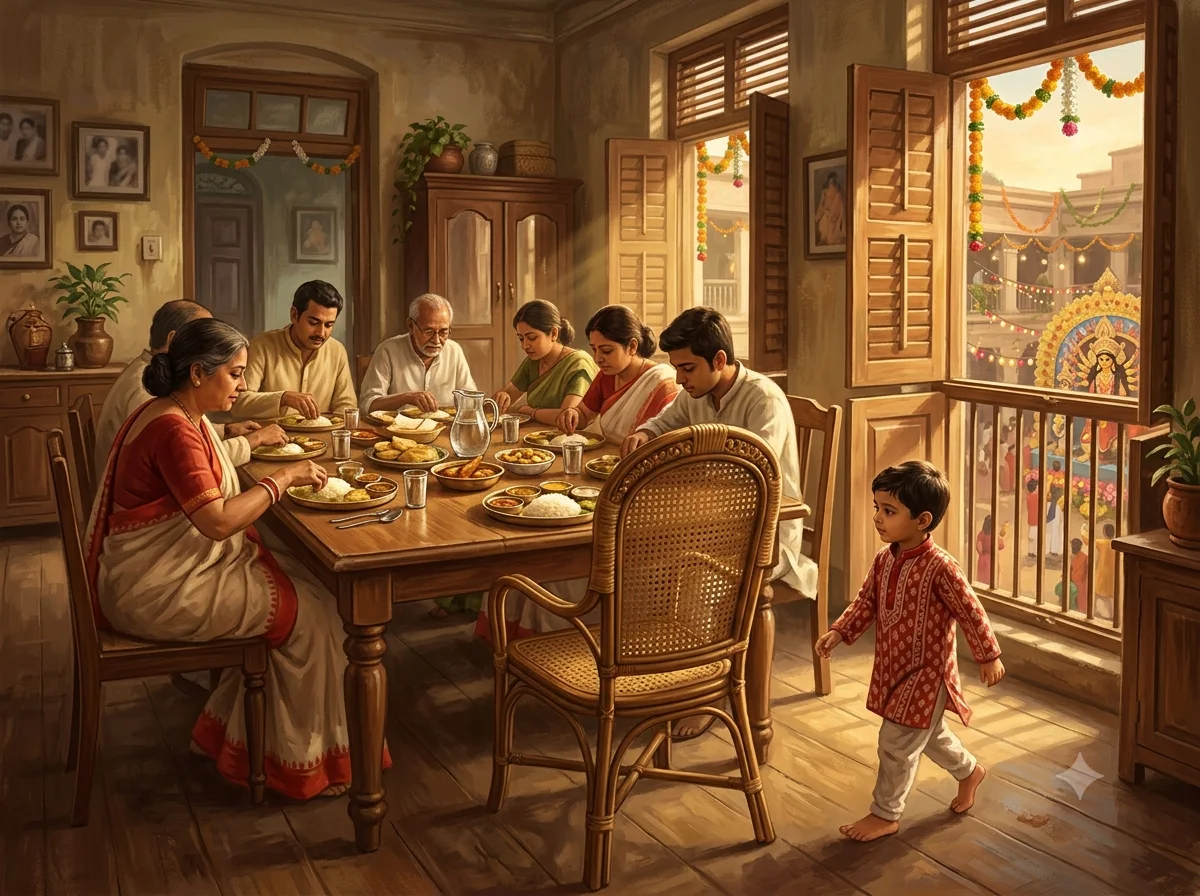
The cane chair at the head of the table had been empty for four months, but nobody had said so out loud until Ishaan, seven years old and unaware of the rule nobody had written down, pulled it out and climbed onto it during the Ashtami lunch.
“Ishaan, not there,” his mother Sharmila said quickly, already half out of her own seat.
The boy froze, one knee still on the cane seat, waiting to find out what he’d done wrong.
“He’s just a child,” Dida said from her corner of the room — quietly enough that it wasn’t really an argument. Ishaan slid back down onto the floor mat anyway and wandered off toward the courtyard, where the dhak drums from the pandal two streets away rattled the window glass.
Ananya watched all this from across the table, a plate of khichuri and labra going cold in front of her. Four months since Dadu’s chair had become the chair nobody used, and the whole house still organized itself around the shape of his absence, the way a room rearranges itself around a piece of furniture that’s been moved.
She hadn’t meant to go up to his study that afternoon. She’d gone looking for a spare fan for the guest room, and instead found the door slightly open, the smell of old paper and mustard-oil hair tonic still faintly there, four months on, in a way that undid something in her chest before she’d even stepped inside.
His reading glasses were still on the desk, folded, waiting for a face that would never come back to reclaim them. Beside them, his old Gita — not the ornamental one from the puja shelf downstairs, but this one, cloth-bound, spine cracked white from being opened at the same pages for forty years.
She sat down in his chair, the actual chair, not the one downstairs that had quietly become a monument, and opened the book without really deciding to.
It fell open on its own to a page worn soft at the corner, the way pages go when a hand returns to them again and again. Pencil in the margin, his handwriting, small and slanted the way it always was on birthday cards and grocery lists — “Not born. Cannot die. Only the coat changes.”
Underneath, in a different, later ink, like he’d added it years after the first note: “Read this the year Baba died. Read it again the year I turned seventy. Still true both times, which surprised me.”
Ananya read it twice, then a third time, and found she wasn’t crying the way she’d been bracing herself to, downstairs, every time someone mentioned him. It was something quieter than that — more like the feeling of finding a letter addressed, unexpectedly, to exactly the person she happened to be that day.
She heard Ishaan’s feet on the stairs before she saw him, chasing something invisible, the particular thunder that only a seven-year-old produces on a wooden staircase. He stopped in the doorway when he saw her.
“Am I in trouble?”
“No.” She closed the book carefully, keeping a finger at the page. “Come here a second.”
He came and stood at her knee, unbothered by dust or old-paper smell, in the way only children are.
“Dadu used to sit exactly like that,” Ananya said, “with a book open and his glasses pushed up on his forehead, forgetting he wasn’t wearing them.”
Ishaan considered the glasses on the desk with new interest. “Can I wear them?”
“They won’t help you see anything. He was very shortsighted.” She smiled, surprising herself with it. “But you can hold them if you want.”
Downstairs, lunch had mostly finished by the time they came back down, plates cleared to the kitchen, Dida dozing in her chair by the window, the dhak still going somewhere outside, low and constant under everything else, the way it had been all week.
The cane chair sat empty at the head of the table, same as it had for four months.
Ishaan walked past it, hesitated, glanced at his mother, who this time said nothing at all, and climbed up into it — not with the same uncertain scramble as before, but simply, the way a child sits down anywhere there’s room.
Nobody moved to stop him.
Ananya, watching from the doorway, found she didn’t want them to.
Scripture/Source: Inspired by the Bhagavad Gita, Chapter 2, Verses 20 and 27 — Krishna’s teaching that the soul is never born and never dies, and that grieving the inevitable brings no lasting peace. Not a direct verse translation; adapted as an original story.
Continue Reading
Faith in Krishna — a different kind of hardship, and the same quiet trust that carries a person through what can’t be controlled.
📄 Free printable worksheet available below.
Complete the learning activities and download it at the end of this lesson.
✨ Words Worth Keeping
🌱 Phrases to Remember
📚 Quick Glossary
🎬 See It in Action
Rattled — The old ceiling fan rattled every time it was switched on.
Undid — A single kind word undid the tension that had built up all week.
Slanted — The old photograph hung slightly slanted on the wall.
Shortsighted — Without his glasses, he was too shortsighted to read the menu.
Monument — The trophy shelf had become a quiet monument to her college years.


