
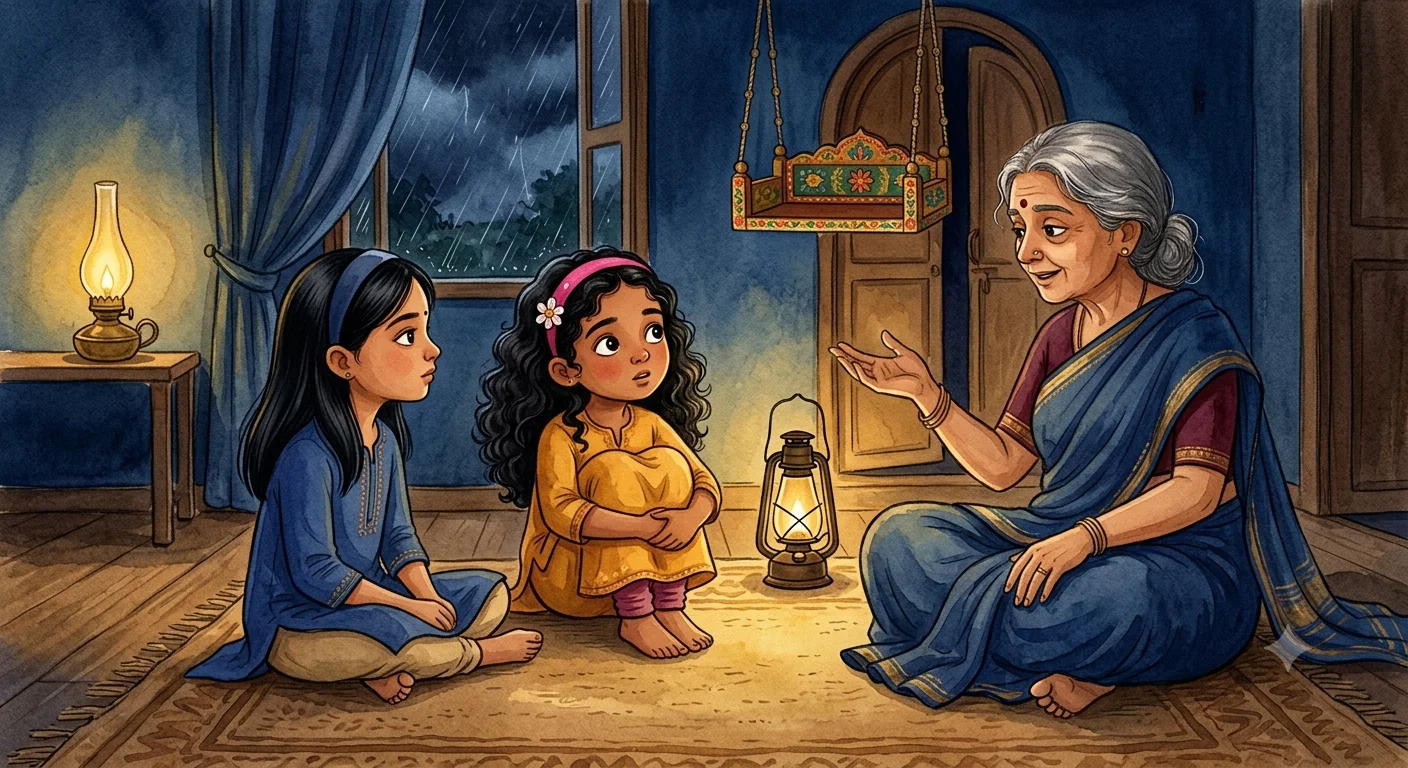
Diya arrived at Bhoomi’s house holding a tiny wooden swing, freshly painted, still smelling faintly of turmeric-yellow paint.
“For tonight,” she said, holding it up proudly. “Baby Krishna needs somewhere to sleep once he arrives, no?”
“He arrives at midnight, Diya. Not for a nap.” Bhoomi hung the little swing from the hook above the doorway anyway, testing it with one finger until it swayed just right.
“Fine, but why midnight? Why not morning, like a normal birthday?”
Dadi, straining rice at the kitchen doorway, answered without turning around. “Because that’s exactly when it happened. Sit. This one has a proper story, and it isn’t a soft one.”
They sat.
“Long ago, in the city of Mathura, there ruled a king named Kansa. A voice from the sky had warned him that his own sister’s eighth child would end his reign. Kansa didn’t wait to see if the voice was right. He locked his sister Devaki and her husband Vasudev in a stone cell, posted guards at the door day and night, and took each child from them the moment it was born.”
“Each one,” Diya repeated, very quietly, no longer smiling.
“Six times,” Dadi said. “Six times Devaki held her baby for a few minutes and no longer. You can imagine what that does to a mother’s heart, waiting for the seventh, the eighth, wondering if it will only happen again.”
Bhoomi had gone still, the way she did when a story stopped being just a story.
“The eighth child was born at midnight, in that same cell, during a storm loud enough to rattle the prison walls. Lightning came one after another. The guards, who had never once slept on duty in years, fell asleep standing where they stood. The chains on the door fell open on their own, link by link, without a single hand touching them.”
“And then?” Bhoomi asked, though she already half knew.
“Vasudev lifted his newborn son, wrapped him close against the rain, and walked straight past the sleeping guards and out into the storm. He didn’t stop at the city gates. He walked all the way to the river Yamuna — and the Yamuna that night was not a river you could cross. It was swollen black with rain, roaring loud enough to drown out thunder.”
Diya pulled her knees up to her chest. “He went in anyway?”
“He stepped in anyway, the baby held high above his head with both arms. The water climbed to his waist, his chest, his shoulders, his chin — Dadi paused there deliberately — and just when it seemed it would take them both, it fell back. Just enough. He walked the rest of the way with the river no higher than his knees.”
“Because the river knew,” Diya said, half a question.
“Some say that. On the far bank, in the safety of Gokul village, Vasudev left his son with a family who would raise him far from Kansa’s reach, and turned back into the storm alone, to return to the cell before the guards woke.” Dadi set down the sieve. “That child was Krishna.”
Nobody spoke. The rice had stopped steaming, and outside, the wind had picked up exactly the way it had in the story.
“That’s why we stay awake tonight,” Dadi said at last. “Because his own father did. One man, in a flood, holding everything he loved above the water, walking home alone in the dark to make sure it counted.”
At midnight, the little wooden swing above the doorway rocked once on its own, caught by a draft from the window nobody remembered opening — and neither girl said a word. They just watched it move, and kept watch, the way somebody once did for them.
📄 Free printable worksheet available below.
Complete the learning activities and download it at the end of this lesson.
✨ Words Worth Keeping
🌱 Phrases to Remember
📚 Quick Glossary
🎬 See It in Action
Prophecy – The fortune teller's prophecy unsettled the whole village for weeks.
Reign – Her reign as class monitor lasted only one term.
Roaring – The stadium crowd was roaring after the final goal.
Swollen – His ankle was swollen after the long trek uphill.
Deliberately – He walked deliberately slowly, dragging out the surprise.


