
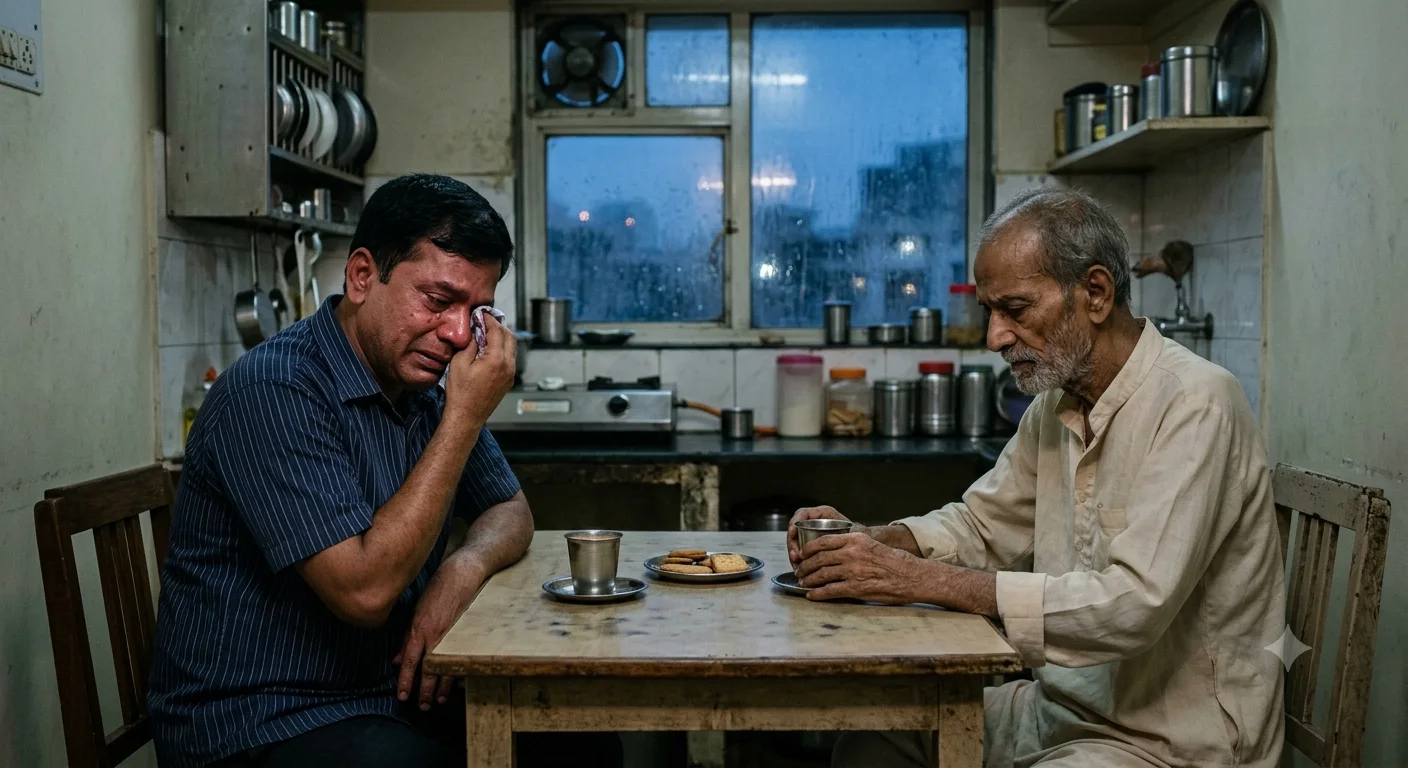
The clock on the wall said 5:47 AM. Outside the kitchen window, Mumbai was still sleeping under a blanket of grey monsoon clouds.
Vijay sat at the wooden dining table, his cold coffee untouched for forty minutes. Across from him sat his father, Ashok, who was not supposed to be there.
Six months ago, the doctor had used the word progressive. Three months ago, the word was advanced. Last week, the word was weeks.
But this morning, Ashok had walked from his bed to the kitchen without holding the wall. He had poured himself tea. He had sat down.
“Why are you crying?” Ashok asked, stirring sugar he could no longer taste.
“I’m not crying,” Vijay lied, wiping his face with his sleeve.
“Good. Because I need to tell you something important.”
Vijay straightened. His father had been a principal for thirty-four years. His important always meant a lecture. Vijay braced himself.
“When you were seven,” Ashok began, “you broke my grandmother’s brass lamp. The one from 1942.”
Vijay nodded. He remembered hiding under his bed for three hours.
“I shouted at you for two days. Do you remember what you said?”
“No, Baba.”
“You looked at me and said, ‘But you love me more than the lamp, right?'”
Vijay felt something crack inside his chest.
“I lied to you,” Ashok continued. “I said yes. But that night, I stayed awake because the truth was—I didn’t know. I didn’t know if I loved you more than a lamp. I was a young father. I was stupid.”
Vijay opened his mouth, but no sound came out.
“For thirty years,” Ashok said quietly, “I have wanted to tell you that I was wrong. I love you more than every lamp, every house, every medal, every student, every everything. But I didn’t know how to say it without sounding weak.”
The rain started outside. Soft at first, then heavy.
“You are not weak, Baba.”
“I am dying,” Ashok said. “That is a different thing. Weakness is dying without saying what matters. So I am saying it now.”
He reached across the table. His hand was thin, the skin loose, the veins visible like rivers on a map. Vijay held it.
“You were a difficult boy,” Ashok added, and Vijay laughed—a wet, broken laugh.
“I know, Baba.”
“You never listened.”
“I know.”
“You argued with every teacher I hired.”
“I was right about Mrs. Sharma. She couldn’t teach math.”
Ashok laughed too. It turned into a cough, then back into a laugh.
“Listen to me now,” Ashok said, holding Vijay’s hand tighter. “You are a good man. Not because of me. Because of you. I just watched. That was my only job. To watch and not break you.”
The tea grew cold. The rain grew loud. And Vijay sat with his father for forty-seven more minutes, saying nothing important—just remember that time and yes, I remember and I love you, Baba and I know, beta. I have always known.
At 6:34 AM, Ashok stood up, kissed Vijay on the top of his head like he was seven years old again, and walked slowly back to bed, holding the wall this time.
Three weeks later, he was gone.
But Vijay never forgot the morning his father told him the truth about the lamp. And when Vijay’s own son broke a glass in 2019, Vijay did not shout. He picked up the pieces. And he said, “I love you more than the glass. Never doubt that.”
Because that is what fathers do. They learn. Sometimes late. But never too late.
✨ Words Worth Keeping
🌱 Phrases to Remember
📚 Quick Glossary
🎬 See It in Action
The clock on the wall ticked loudly in the silence between them.
Vijay wiped his face with his sleeve, pretending the wetness was from the rain.
Ashok stirred sugar into his tea even though his taste buds had stopped working months ago.
The veins on the back of his father's hand looked like a map of roads Vijay had never traveled.
When Vijay's son broke the glass, he heard his father's voice from across time and did the right thing.


