
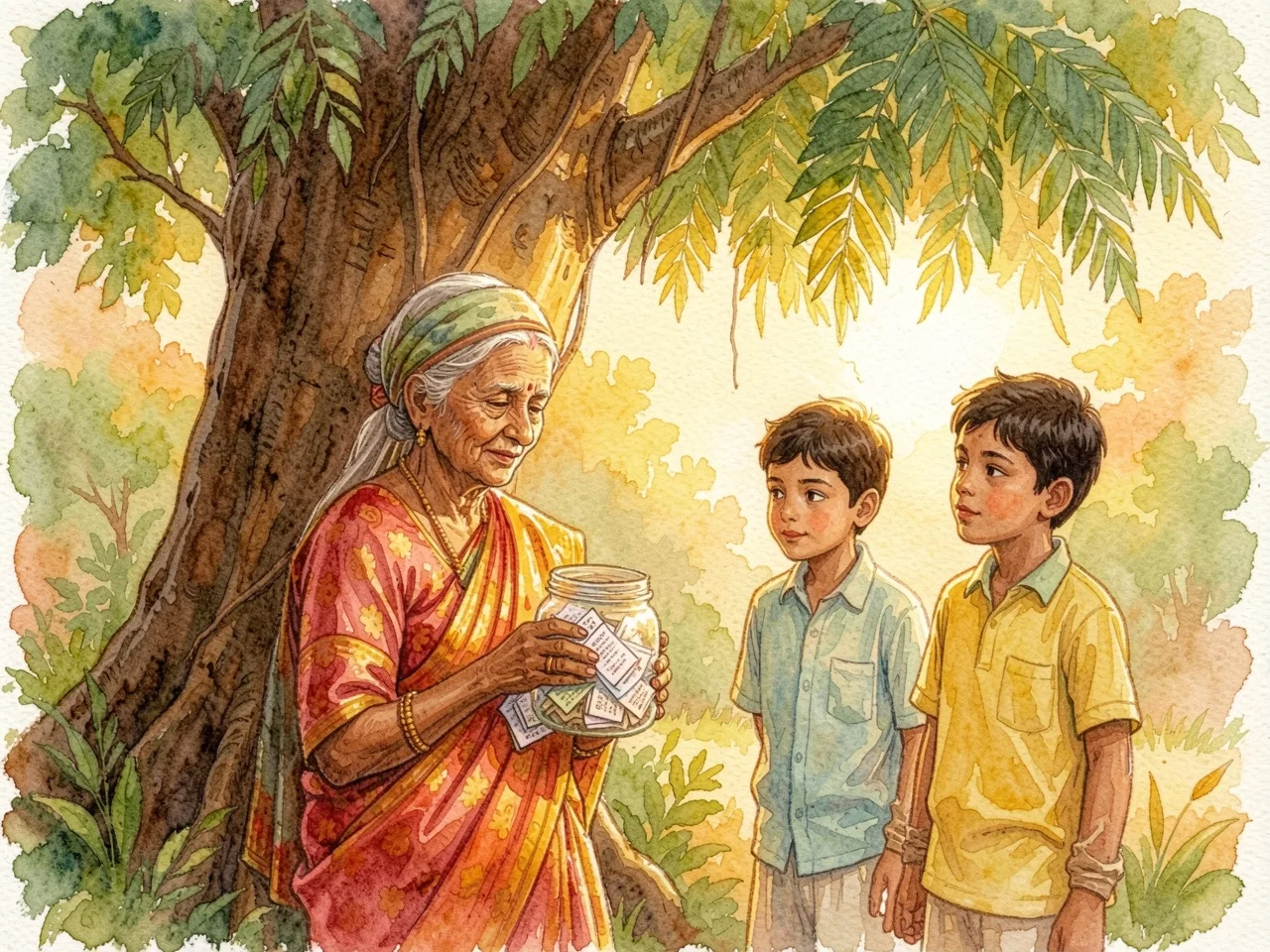
The park bench near the peepal tree was Dadi’s favourite spot in all of Dadar.
Every afternoon, she would wait there with two steel tiffin boxes — one for Priya, one for Rohan — because she believed hungry children had no patience for wisdom.
That Tuesday, the children arrived louder than usual.
“Dadi, Sahil got the new cricket bat and I didn’t,” Rohan announced, dropping his bag on the bench like it had personally wronged him.
Priya was not far behind. “My phone is so old. Everyone has the new one. Everyone.”
Dadi said nothing. She opened the tiffin boxes, handed them their snacks, and watched two pigeons fight over a single peanut near the fountain.
“Are you listening, Dadi?” Priya asked.
“I’m always listening,” she said. “Eat first.”
They ate. The park filled with the usual sounds — children on swings, an old man doing slow circles on a bicycle, a vendor calling out chaat from his cart. When the tiffin boxes were empty, Dadi reached into her cloth bag and pulled out a small glass jar.
It was nothing special. A pickle jar, cleaned and dried, with a faded label still half-stuck to the side. Inside it were folded slips of paper — dozens of them, pressed together like little prayers.
“What is that?” Rohan asked.
“My gratitude jar,” Dadi said simply.
Priya looked at it the way teenagers look at anything their grandmother produces from a cloth bag — with polite suspicion.
“Every morning,” Dadi said, “I write one thing I am grateful for. I fold it. I put it in the jar.”
“Since when?” Rohan asked.
“Since the year your grandfather died.”
The park noise continued around them, but between the three of them, everything went still.
Dadi turned the jar slowly in her hands. The afternoon sun caught the glass and threw small light shapes on her sari.
“That was a hard year,” she said. “The house felt too big. The mornings felt too long. I did not know what to do with the quiet.” She paused. “So I started writing. One thing. Just one. Every day.”
“What kinds of things?” Priya asked. Her voice had changed — softer now, the phone forgotten.
“Small things. That the chai was hot. That the crow came back to the window. That Rohan called on Sunday even though he had exams.” She looked at him. He looked away, a little embarrassed. “That Priya braided her hair the way her mother used to.”
Priya blinked.
“You noticed that?” she said.
“I notice everything,” Dadi said. “That is what gratitude teaches you. To notice.”
She held the jar out to Rohan. He took it carefully, as if it might open.
“There are maybe four hundred slips in here,” she said. “Four hundred mornings when I could have started the day thinking about what was missing. I chose not to.”
Rohan held the jar for a long moment. Then he passed it to Priya.
Priya turned it over. A small slip had worked its way to the bottom, and she could make out three words through the glass in her grandmother’s uneven handwriting.
Both children — healthy.
She put the jar down on the bench between them and did not say anything. There was nothing that needed to be said.
On the walk home, Rohan kicked a stone ahead of him the way he always did. But somewhere near the corner with the flower stall, he said, “Dadi, do you think I could have a jar too?”
Dadi took his hand. “I already bought you one,” she said. “Pink lid. I know you hate pink.”
He laughed. She laughed.
Priya, walking just behind them, was already thinking about what she would write first.
✨ Words Worth Keeping
🌱 Phrases to Remember
📚 Quick Glossary
🎬 See It in Action
She reached into her bag and pulled out a small notebook filled with things she had quietly noticed over the years.
He ate first without complaining, which was unusual, and she filed that away as something to remember.
Every morning began with one line — not a plan, not a worry — just one thing worth keeping.
The jar on the windowsill was nothing remarkable to look at, but it held four years of deliberate mornings.
When she finally told him what she had been doing all along, he did not have words for it — only a look that said he understood.


