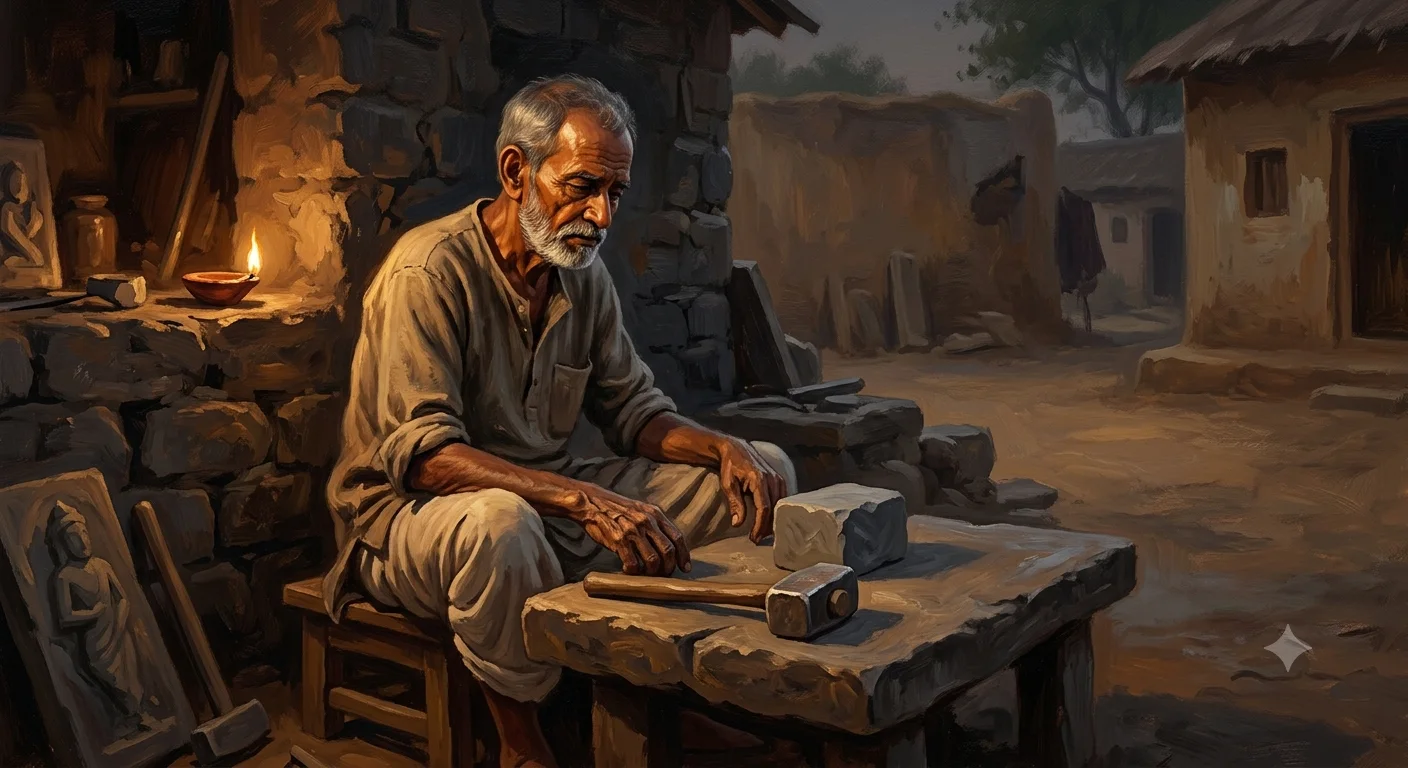
His hands knew stone the way a mother knows her child’s cry — by feel, by instinct, by something that could not be taught. The village temple had three of his statues. The raja’s courtyard had two more. When people wanted something carved from stone, they came to Narayan first.
So when the royal minister arrived at his door with a stone wrapped in silk, Narayan did not even look up from his work.
“The maharaja wants a statue of Lord Vishnu,” the minister said, setting the stone on the workbench. “Seven days. Fifty gold coins.”
Narayan unwrapped the silk and turned the stone over in his palms. It was beautiful — dark grey, almost black, with a faint shimmer running through it like a river seen from a great height. He nodded once. The minister left.
That evening, Narayan lit his lamp, rolled up his sleeves, and picked up his heaviest hammer.
He struck the stone.
Nothing.
He struck it again. The hammer rang out across the quiet courtyard. His wife looked up from the doorway. He did not look back.
Again. And again. And again.
Ten strikes. Twenty. The stone sat unmoved, indifferent, like a sleeping thing that refused to be woken.
Thirty strikes. His shoulder had begun to ache. He switched hands.
Forty. The lamp flame wavered in the night breeze. A dog barked somewhere in the village and went quiet.
Fifty.
Narayan set down the hammer. He stood very still, breathing hard, staring at the stone. Not a single crack. Not a single mark. Thirty-one years of knowing stone, and this one had beaten him.
What is the point of a fifty-first blow, he thought, when fifty have done nothing?
He wrapped the stone back in its silk, carried it to the minister’s house the next morning, and set it on the table without meeting the man’s eyes.
“It cannot be done,” he said. “The stone will not break. Lord Vishnu’s statue is not possible from this.”
The minister said nothing. He had no choice — the maharaja’s order had to be fulfilled. He sent word to the village and waited.
By afternoon, a young sculptor arrived. He was nobody in particular. No temple had his work. No courtyard had his name. He carried a single bag of tools and wore dust on his sandals like a man who had walked a long way.
The minister showed him the stone. The young sculptor looked at it for a long moment. Then he reached into his bag, pulled out a hammer not very different from Narayan’s, and struck the stone once.
It split cleanly in two.
The minister stared.
The young sculptor set down his hammer and began to study the two halves, already seeing the god inside them.
That evening, as the minister walked home past Narayan’s house, he saw the old sculptor sitting outside in the half-dark, staring at nothing. He paused at the gate.
“You had struck it fifty times,” the minister said quietly. “The stone was already ready to break. It was waiting for one more blow.”
Narayan did not answer for a long time.
Then he said, in a voice that carried thirty-one years of work and one night of regret — “I know.”
He picked up a small stone from the ground beside his foot. Turned it over in his palm. Set it down again.
“I know.”
📖 Story in Brief
Narayan, the best sculptor in the village, is given a beautiful stone and tasked with carving a statue of Lord Vishnu. He strikes it fifty times and it does not break. He gives up — one blow before the breakthrough. A young unknown sculptor arrives and breaks the stone on his very first strike. The minister walks past Narayan's house that evening and tells him the truth. The old sculptor already knows. Some lessons do not need to be explained. They only need to be felt.
💡 The Lesson Inside
The stone did not fail Narayan. Narayan failed the stone. Fifty blows had done their work quietly — loosening, shifting, preparing — without a single crack to show for it. Progress had happened. He simply could not see it. This is the cruelest distance in any endeavour — the distance between the last attempt you made and the one you decided not to. The fifty-first blow is never really about strength. It is about the willingness to try one more time when every visible sign tells you it is pointless. That willingness is rarer than talent. And it is worth more than fifty gold coins.
✨ Words Worth Keeping
Indifferent
showing no reaction, no feeling, no sign of being affected — the way a stone sits under a hammer as if the blows do not matter.
Instinct
a deep inner knowledge that comes not from thinking but from years of experience — the kind of understanding that lives in your hands, not your head.
Regret
the quiet, heavy feeling of wishing you had done something differently — not loud like grief, but persistent, like a stone in your shoe.
Wavered
moved unsteadily, flickered, or showed signs of weakening — the way a flame moves in wind or a person's confidence shakes under pressure.
Endeavour
a serious, sustained attempt to do something difficult — more committed than a try, more personal than a task.
📚 Quick Glossary
Maharaja
a great king or ruler in Indian tradition. The word comes from Sanskrit — maha meaning great and raja meaning king. A maharaja held complete authority over his kingdom and his word was law.
Minister
a senior official who served the king and carried out royal orders. In Indian kingdoms, the minister — or mantri — was trusted with the most important tasks and answered directly to the ruler.
Lord Vishnu
one of the principal deities of Hinduism, known as the Preserver of the universe. Vishnu is worshipped across India and his statues are found in temples in every village and city. Carving his statue was considered one of the highest honours a sculptor could receive.
Gold coins
the currency of reward and payment in ancient and medieval India. Fifty gold coins represented a significant sum — enough to change a family's circumstances — which is why Narayan accepted the commission without hesitation.
Sculptor
a craftsman who carves figures and forms from stone, wood, or metal. In Indian villages, sculptors were highly respected artisans whose work lived in temples for centuries after them.
💬 Reflection Corner
Narayan had thirty-one years of experience and was the best sculptor in the village. Yet he gave up. Do you think experience can sometimes make us more likely to give up — because we believe we know what is and is not possible?
The stone did not show a single crack after fifty blows. How do you recognise progress in your own life when there is no visible sign of it yet?
When the minister told Narayan the truth — that the stone was ready to break — Narayan said simply, "I know." Why do you think he said it twice? What do you think he was really feeling in that moment?
The young sculptor who broke the stone on the first blow had no reputation, no temple work, no famous name. What does his success in this story tell us about the relationship between experience and fresh eyes?
Think of something you gave up on — a skill, a habit, a goal — just before you might have broken through. What would you do differently today?
Match the vocabulary word on the left with its correct meaning on the right.
Wavered
Regret
Instinct
Indifferent
showing no reaction, no feeling, no sign of being affected — the way a stone sits under a hammer as if the blows do not matter.
the quiet, heavy feeling of wishing you had done something differently — not loud like grief, but persistent, like a stone in your shoe.
moved unsteadily, flickered, or showed signs of weakening — the way a flame moves in wind or a person's confidence shakes under pressure.
a deep inner knowledge that comes not from thinking but from years of experience — the kind of understanding that lives in your hands, not your head.
Game 2: Context Solver✨ Reward: +15 XP
Story Context Solver
Analyze the story clues below and tap the vocabulary term that matches perfectly.
1. 📖 Meaning: "showing no reaction, no feeling, no sign of being affected — the way a stone sits under a hammer as if the blows do not matter."
2. 📖 Meaning: "a deep inner knowledge that comes not from thinking but from years of experience — the kind of understanding that lives in your hands, not your head."
3. 📖 Meaning: "the quiet, heavy feeling of wishing you had done something differently — not loud like grief, but persistent, like a stone in your shoe."
Game 4: Story Sequencer✨ Reward: +20 XP
Timeline Sorting
The story paragraphs got jumbled up! Click the 🔼 and 🔽 buttons on each card to arrange them back into the correct chronological order.
"The maharaja wants a statue of Lord Vishnu," the minister said, setting the stone on the workbench. "Seven days. Fifty gold coins."
So when the royal minister arrived at his door with a stone wrapped in silk, Narayan did not even look up from his work.
His hands knew stone the way a mother knows her child's cry — by feel, by instinct, by something that could not be taught. The village temple had three of his statues. The raja's courtyard had two more. When people wanted something carved from stone, they came to Narayan first.
Narayan had been a sculptor for thirty-one years.
Game 7: Story Builder✨ Reward: +30 XP
Creative Author Lab
Become the author! Write a short story or paragraph below. To unlock your reward points, you must write between 25 and 250 words and include at least two words from your vocabulary bank.
Reading Time: 2minutesRamesh worked in a small accounts office near Dadar station. Every morning at eight, his wife Sunita packed his tiffin — the old steel one with a dent on the
Reading Time: 2minutesLong ago, in a quiet village at the edge of a forest, there lived a young shepherd boy named Arjun.Every day, he took his sheep to graze on the green