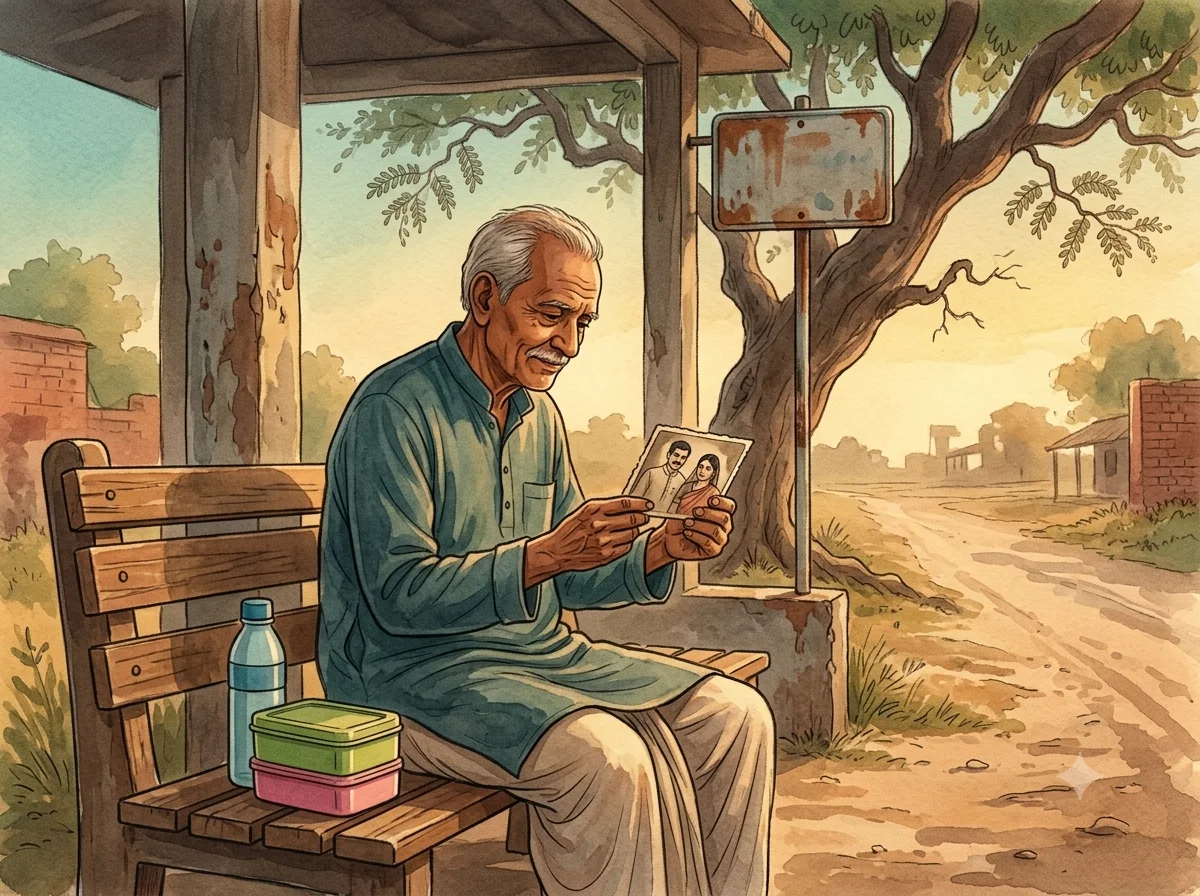
In Devgarh, the highway had stopped sending its buses down the old lane years ago, but the bus stop was still there — a rusted iron pole, a concrete bench worn smooth, a tin roof that rattled whenever the wind picked up.
Every evening, without fail, Keshav Anna walked the half-kilometre from his house to that bench and sat facing the empty road, watching the sky turn the colour of turmeric and then ash.
Devgarh was a town of one main road, two temples, and a school with a leaking roof. Everyone knew everyone, and everyone knew about Keshav Anna’s bench, the way you know about a landmark — the peepal tree near the well, the crack in the temple bell.
The children of Devgarh had grown up watching him. They called him the man who waits for a bus that never comes.
Ira, eleven years old and full of questions nobody else dared to ask, finally sat beside him one evening. “Anna, why do you come here? No bus stops here anymore.”
Keshav Anna did not answer right away. He never did.
“When I was your age,” he said finally, “I had a friend. Ramu. We grew up in the same lane, shared the same school bench, stole mangoes from the same tree behind the temple, and got the same beating from our mothers for it.”
Ira waited. The old man’s stories always came slowly, like water finding its way downhill.
“In 1978, Ramu left for Bombay. His family needed money, and there was none to be found here. The evening he left, I walked him to this very stop.” He touched the iron pole beside him, as if greeting an old acquaintance.
“He held my hand and said, ‘Keshav, I’ll come back when I’ve made something of myself. Wait for me at this stop.’ I told him I would. Come rain or shine.”
That night, Ira went home and asked her grandmother about Ramu, half expecting a shrug. Her grandmother’s eyes went soft instead. “Ramu… yes. Loud boy, always climbing where he shouldn’t. Broke his arm falling out of that tamarind tree once.” She didn’t know what had become of him, but she confirmed one thing — this was not an old man’s invented story.
For the first few years, Ramu wrote letters. Then the letters became fewer — a line from the STD booth once a year, a card at Diwali. Then, after 1991, nothing at all.
“Didn’t you try to find him?” Ira asked.
“I wrote to the address I had. It came back unopened, twice. After that, there was nowhere left to send a letter.”
“But you still come. Every evening.”
Keshav Anna smiled, the kind of smile that had learned to carry sadness without being crushed by it. “A promise doesn’t expire just because the person you made it to disappears, beta. Somewhere, I still believe he’s trying to find his way back to this bench.”
The other villagers had long stopped asking. Some thought it charming, an old man’s harmless habit. Some thought it foolish — forty-seven years of sitting at a bus stop that no bus would ever reach again, since the highway authority rerouted the road in 1995.
But Ira kept coming after school, sitting beside him, listening to stories about a boy named Ramu who once climbed the tallest tamarind tree in Devgarh on a dare and nearly broke his arm coming down.
Then, on a Tuesday in November, something changed.
The state transport department, repairing a collapsed bridge on the highway, temporarily diverted one route back through the old lane — just for six weeks, just until the bridge was fixed.
Keshav Anna did not know this. He simply came, as he always did, and sat down as the evening turned the color of turmeric.
At quarter past six, a bus rounded the corner where no bus had turned in thirty years, its headlights cutting through the dust. Keshav Anna’s hands went still on his knees. The smell of diesel lingered over the bench, mixing with a memory he hadn’t touched in years.
The bus stopped. The door opened with a groan. A young man stepped down — not old, not weathered, not the boy Keshav had once known — holding a faded black-and-white photograph and a slip of paper with an address written on it.
“I’m looking for a Keshav,” the young man said. “Keshav, who used to live near the tamarind tree.”
Keshav Anna’s voice faltered. “That’s me.”
The young man’s name was Vikram. Ramu’s grandson. Ramu had passed away eight years ago in Bombay, he said, but had never stopped speaking of Devgarh, of a bench by a bus stop, of a friend he’d never managed to write to again after the address changed and pride had kept him from starting over. Ramu had no other kin who still remembered Devgarh — only Vikram and a fading address kept in a drawer for forty years.
“Before he died,” Vikram said, opening a worn cloth bag, “he gave me this. He said if I ever had the chance, I should bring it here myself. He said a man was waiting.”
Inside the bag was a bundle of unsent letters, tied with string gone brittle with age, and an envelope of rupees saved a little at a time across forty years — Ramu’s way, finally, of keeping his own half of a promise he’d never found the courage to finish in person.
Keshav Anna held the letters without opening them, not yet. He was looking instead at Vikram’s face — the same jaw, the same stubborn set of the mouth that Ramu used to get right before doing something reckless.
“You have his eyes,” Keshav Anna said, and his voice, after forty-seven years of steadfast waiting, finally broke — not with grief, but with something closer to relief.
After forty-seven years, the distance between the two boys from the same lane had finally closed.
Ira watched from a few feet away, understanding for the first time that waiting is not the same as giving up hope. Sometimes it is hope, worn into the shape of a habit, sitting quietly on a bench until the world finds its way back around.
The next evening, Keshav Anna returned to the bus stop, as he always had. But this time, Vikram sat beside him, and so did Ira, and three other children who had started coming just to hear the stories.
The bus route stayed open for six weeks for the bridge repair. But by then, the bench at the old stop was rarely empty in the evenings — not because a bus might come, but because a promise, once kept, has a way of gathering people around it.
📄 Free printable worksheet available below.
Complete the learning activities and download it at the end of this lesson.
✨ Words Worth Keeping
🌱 Phrases to Remember
📚 Quick Glossary
🎬 See It in Action
Faded — The old photograph had faded so much that her face was barely visible.
Weathered — His hands were weathered from years of working in the fields.
Lingered — The smell of rain lingered long after the storm had passed.
Steadfast — Despite every setback, she remained steadfast in her decision to finish medical college.
Faltered — His voice faltered when he tried to explain why he was late.
Kin — After the flood, she had no kin left in the village, only old friends.