
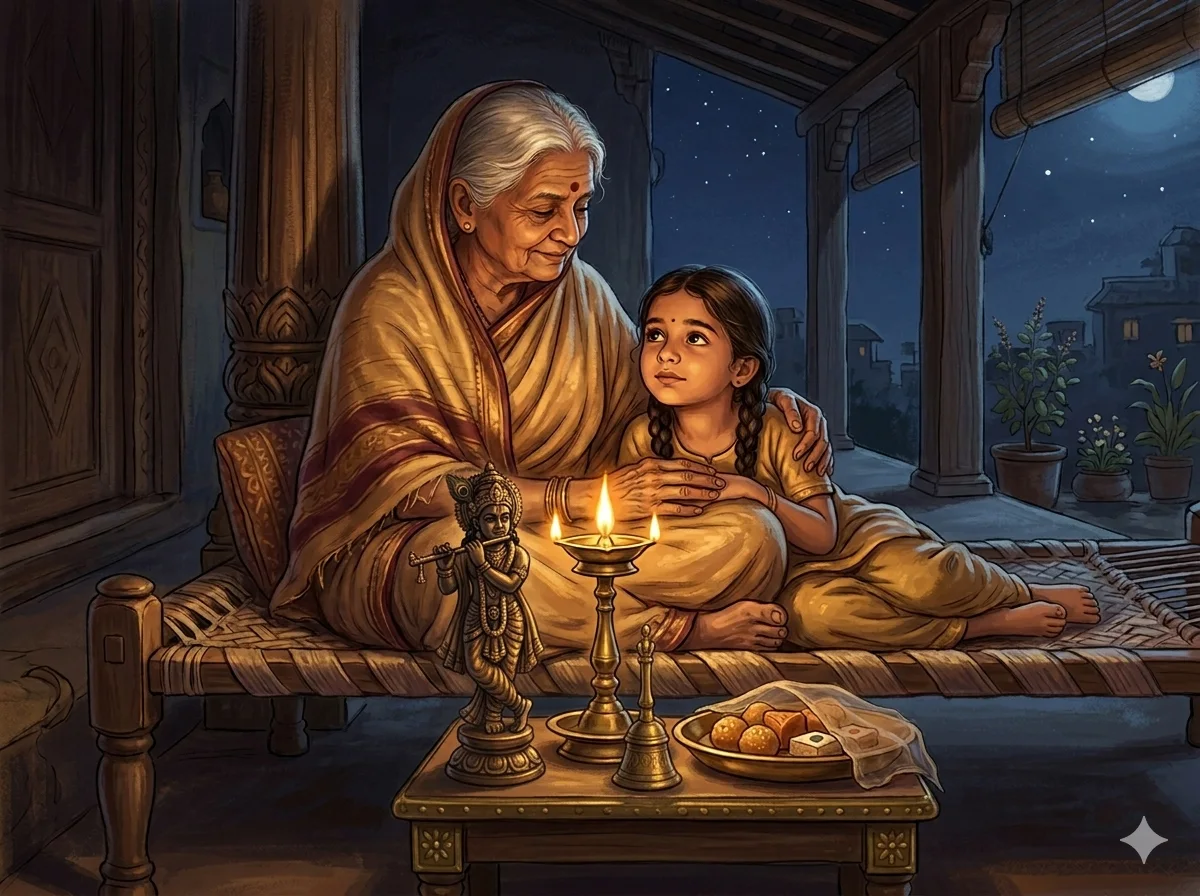
Stop eyeing those biscuits, beta. Not today. Today we wait.
You’re making that face again, the one you make when you think I’m being unfair. Sit, I’ll tell you why.
When I was your age, my own grandmother used to fast the whole day on Janmashtami — no rice, no roti, nothing but water and maybe one piece of fruit if her stomach complained too loudly. I asked her the same question you’re asking me now. “Dadi, why are you starving yourself for a baby who was born so long ago?”
She laughed at me. Not unkindly. Just the way you laugh when a child asks something that sounds simple but isn’t.
“We are not starving,” she said. “We are waiting. Like a mother waits.”
You see, Krishna wasn’t born in daylight, with everyone celebrating and sweets being passed around. He was born at midnight, in a prison cell, during a terrible storm, to parents who knew the moment he arrived that he might be in danger.
His mother Devaki had already lost six children before him, taken by her own brother Kamsa, who feared a prophecy that one of her sons would end his cruel rule.
So when Krishna finally arrived, there was no celebration in that cell. No sweets, no lights, no songs. Just his father Vasudev, wrapping him quickly in cloth, slipping past sleeping guards in pouring rain, crossing a flooding river at midnight to carry him somewhere safe.
That is what we are remembering when we fast, beta. Not punishment. Not denial.
We are sitting with the waiting. The not-knowing. The way Devaki must have sat in that cell, hungry and frightened, not eating properly for days before, wondering if this child too would be taken from her.
We fast through the day, the same hours she waited, and then at midnight — exactly midnight, no earlier — we break it. Sweets first. Always sweets first, because that is the moment the waiting ended for her, the moment her son was finally, truly, safely born.
Your grandfather used to stay awake with me till midnight every year, half-asleep on the swing outside, swatting mosquitoes, complaining his stomach was growling louder than the temple bells.
I told him the same thing I’m telling you. The hunger is not the point.
The waiting is the point.
And when the bell finally rings at midnight, and we put that first piece of sweet in our mouths, beta — that taste means something different than it would have meant at noon.
Now go wash your hands. Midnight is still far. But I’ll let you ring the bell when it comes.
NOTE
This story is inspired by the traditional account of Krishna’s birth found in the Bhagavata Purana, Book 10. The grandmother’s narration is an original storytelling style, not a scriptural quotation.
📄 Free printable worksheet available below.
Complete the learning activities and download it at the end of this lesson.
✨ Words Worth Keeping
🌱 Phrases to Remember
📚 Quick Glossary
🎬 See It in Action
The family decided to fast throughout the day in honour of the festival.
She remained frightened through the storm, unsure if help would arrive in time.
A joy that is earned through patience often feels different from one given too easily.


