
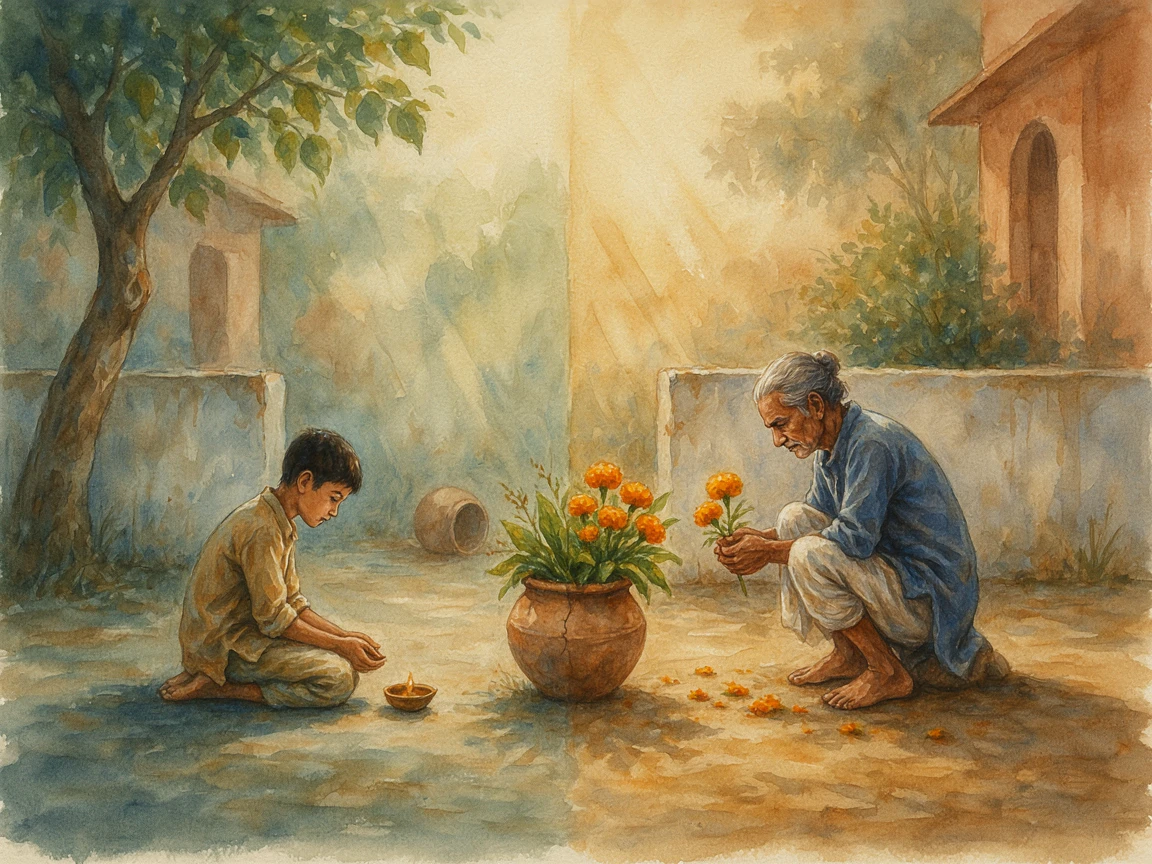
Ishaan hated the new town before he’d even unpacked his last box. The building had peeling paint. The boys at his new school spoke fast, laughed at jokes he couldn’t follow, and looked at him like he’d walked in wearing the wrong uniform.
Nothing about the last two weeks looked good to him — not because it was, but because of the way he’d started seeing things.
Behind the house sat a small courtyard nobody used, choked with weeds around a crooked peepal tree. One evening, avoiding the noise of unpacked boxes, Ishaan wandered out and kicked a loose stone across the cracked floor.
“Careful,” said a voice. “That’s where the rainwater collects.”
An old man knelt near the tree, his hands dark with soil, a tin of seeds rattling beside him.
“There’s nothing here to be careful about,” Ishaan said. “It’s just weeds and a broken wall.”
“Funny,” the old man said, not looking up. “I see turmeric leaf there, and wild basil by the gate. That wall keeps the December wind off my seedbeds.”
Ishaan looked at the same patch of green he’d already dismissed. It still looked like nothing much to him.
He came back the next evening anyway — mostly because the courtyard was quieter than the house. The old man, whom the neighbours called Gopal Kaka, was crouched by a cracked clay pot, working a marigold cutting into the damp soil inside it.
“That pot’s broken,” Ishaan said.
“Only halfway,” Gopal Kaka said. “The other half holds water fine. I’ve grown three seasons of marigolds in worse.”
Ishaan almost said something sharp about old men with nothing better to do than find beauty in broken pots. Instead, an uncomfortable thought stopped him: the courtyard hadn’t changed between yesterday and today. He had just kept looking at it the same way he’d been looking at everything since the move — for what was wrong with it.
“How do you decide what to see?” he asked.
Gopal Kaka sat back on his heels, turning the question over. “I don’t decide on the first glance,” he said. “First glance, I see what anyone would — broken pot, dead season. It’s the second glance I trust. That’s the one where I look for what I can still use.”
He held up the marigold cutting. “Same courtyard. Different crop, depending on which glance you believe.”
Ishaan didn’t answer. But walking through the school gate the next morning, he noticed — almost against his will — a boy from his class crouched alone by the cycle stand, fighting with a jammed chain. The same boy who’d laughed loudest at a joke two days ago.
His first glance wanted to walk past. His second glance noticed nobody else had stopped either.
“Chain’s stuck on the sprocket,” Ishaan said, crouching down before he could change his mind. “Happens on my old cycle all the time.”
The boy — Rohan — looked up, surprised, and moved over to make room.
By the time the chain clicked back into place, Ishaan had a name to go with a face he’d only ever dismissed before. The school hadn’t grown any friendlier overnight. He had simply started trusting his second glance.
That evening, back in the courtyard, he crouched beside Gopal Kaka without being asked and started clearing weeds from around the turmeric leaf. Neither of them mentioned the wall, or the pot, or what had changed between one evening and the next. There was nothing left that needed explaining.
Scripture/Source: यथा दृष्टिः तथा सृष्टिः (Yatha Drishti Tatha Srishti) — “As is the vision, so is the world.” A widely quoted Vedantic teaching, closely associated with the Yoga Vasistha tradition of Indian philosophy
📄 Free printable worksheet available below.
Complete the learning activities and download it at the end of this lesson.
✨ Words Worth Keeping
🌱 Phrases to Remember
📚 Quick Glossary
🎬 See It in Action
The workers cleared a small courtyard behind the factory for their lunch breaks.
The old gate hung crooked on its hinges after the storm.
My uncle keeps a seedbed of tomatoes ready every March.
He planted a cutting from the neighbour's hibiscus and it took root within weeks.
The delivery boy stopped to fix his sprocket before continuing his rounds.


