
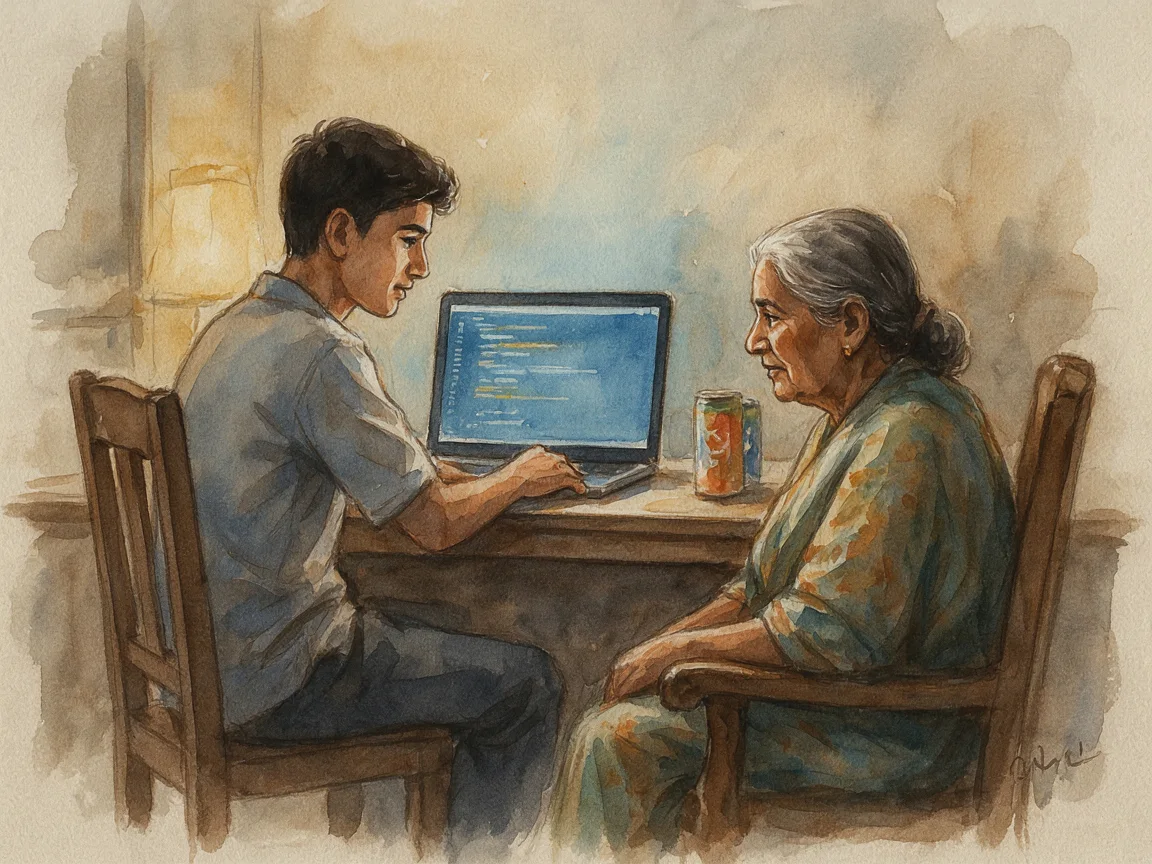
Aarav hadn’t slept properly in eleven days, and it showed — in the shadows under his eyes, in the way his hand shook slightly over the trackpad, in the three energy drink cans lined up like small soldiers beside his laptop.
The Bengaluru Regional AI Coding Challenge was in four days. First prize: a trophy, a scholarship, and — more than either of those — the right to walk into school on Monday and finally be the kid who’d beaten Vihaan Rao, who’d taken first place two years running and never once let Aarav forget it.
He’d been using Nirmaan, the new AI coding assistant everyone in his batch had installed the moment it launched, to practice for weeks — feeding it problems, studying its solutions, trying to absorb its patterns the way you might memorize someone else’s handwriting. Somewhere in those weeks, the practice had stopped feeling like learning and started feeling like a countdown.
His grandmother found him at 1 am, hunched over the glow of his screen, his dinner plate untouched on the desk beside him.
“You haven’t eaten,” she said, not really a question.
“I can’t, Ajji. If I lose this, I don’t know what I’ll—” He stopped himself, unsure how to finish a sentence he’d never actually let himself complete before.
She pulled the desk chair over — the old wooden one from the balcony, the one that always wobbled slightly on its back leg — and sat beside him without asking permission.
“Your grandfather taught computer science for thirty-one years at the polytechnic,” she said. “Did you know he once told a very anxious student almost the exact thing you’re feeling right now?”
“What did he say?”
“He asked the boy a question first. He asked, ‘When you’re actually writing the code — not thinking about the trophy, not thinking about the other students — when you’re just solving the problem in front of you — how does that feel?'”
Aarav thought about it, really thought, for the first time in eleven days. “It feels good. It’s the only part of this whole thing that still feels good.”
“And when you think about the trophy?”
His stomach tightened, just from the question. “Like I might throw up.”
Ajji nodded slowly, like she’d expected exactly that answer. “There’s an old story — you’ve heard it, I’m sure, some version of it — about a warrior on a battlefield who freezes completely, unable to fight, because all he can see is what he might lose. Someone has to remind him that his job was never to control how the battle ends. His only job was to fight well, fully, with everything he had — and let the rest arrange itself.”
“That’s easy to say when it’s not your trophy on the line.”
“It’s easier to say,” Ajji agreed. “It was never easy to do. Even that warrior needed convincing.” She glanced at the screen, at lines of code Aarav had barely looked at in twenty minutes, too busy spiraling to actually work. “Tell me — when Nirmaan writes a solution for you, do you feel anything when you look at it? Any of that good feeling you just described?”
“No. It’s just… there. Finished. I didn’t do anything.”
“Then maybe that’s your answer, more than mine.” She stood, chair creaking. “The tool can win you a trophy, perhaps. It cannot give you the only part of this that was ever actually going to be yours.”
She left him with that, and the wobbly chair, and his dinner going properly cold now.
Aarav closed Nirmaan’s window without deciding to, exactly — it just felt like the obvious next thing to do. He opened a blank file instead, and started on the same problem from scratch, badly at first, deleting more than he kept.
Somewhere around 2 am, four days out from a contest whose outcome he no longer had any real control over, he noticed he was actually enjoying himself again — not despite the mess of half-broken code in front of him, but because of it, because it was entirely his.
He didn’t win the regional challenge that Saturday. Vihaan Rao did, for the third year running.
But walking off stage, Aarav found he didn’t feel the sick drop in his stomach he’d been bracing for all week. He felt, instead, something closer to satisfaction — the particular, quiet kind that comes from knowing exactly what you built, and exactly how you built it, trophy or no trophy.
Scripture/Source: Inspired by the Bhagavad Gita, Chapter 2, Verse 47 — Krishna’s teaching that we have a right to our actions, but never to the fruits of those actions, and that true focus comes from the doing, not the outcome. Not a direct verse translation; adapted as an original story.
Continue Reading
Beyond the Target — a different contest, a different kind of freezing before the moment that matters most, and the same discovery underneath it.
The Girl Who Counted Likes — another young mind pulled toward outside validation, and what happens when the pulling finally eases.
📄 Free printable worksheet available below.
Complete the learning activities and download it at the end of this lesson.
✨ Words Worth Keeping
🌱 Phrases to Remember
📚 Quick Glossary
🎬 See It in Action
Spiraling — He felt himself spiraling after reading the harsh feedback on his essay.
Absorb — It takes time to absorb a new language fully, beyond just memorizing words.
Countdown — The countdown to exam results left the whole class on edge.
Satisfaction — There was quiet satisfaction in finally fixing the stubborn bug in her code.


