
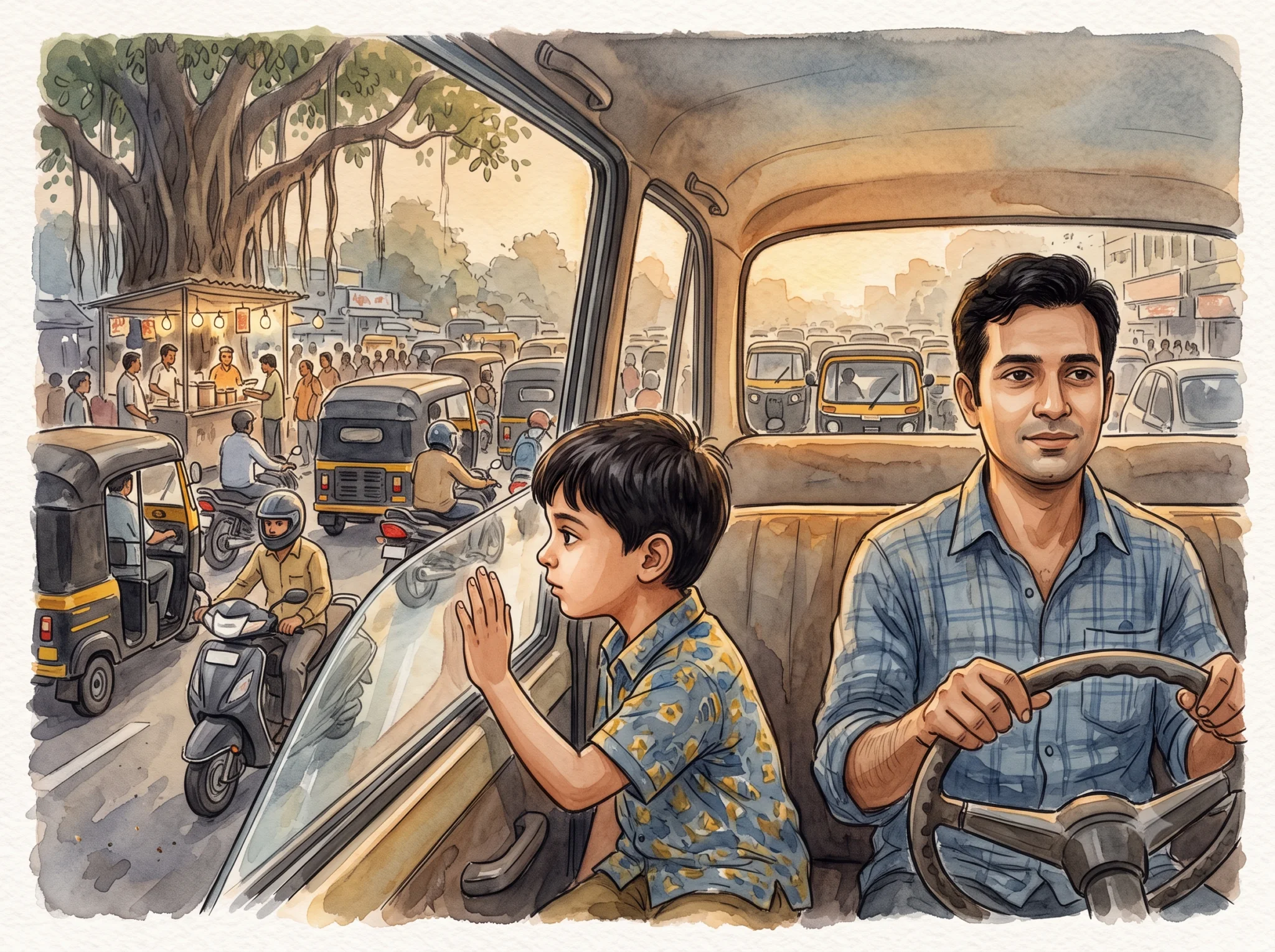
The Kalanagar signal had turned red for the fourth time that morning, and Vikram Deshmukh had stopped counting the minutes.
Behind him, a truck driver leaned on his horn like it owed him money. Autos squeezed into gaps that weren’t gaps. Someone’s bumper kissed someone else’s mirror, and the shouting started before the horn even stopped.
Ten-year-old Arjun sat beside his father, forehead against the window, watching a delivery boy on a scooter cut across three lanes without slowing down.
“Papa, why don’t you also cut the lane? Everyone else is.”
Vikram didn’t answer right away. He watched a Swift wedge itself between two buses, missing a mirror by inches.
“You know the story of Arjuna, on the battlefield of Kurukshetra?”
Arjun rolled his eyes — he’d heard this before, at bedtime, at temple, once even during a cricket match when he’d wanted to throw his bat. “The one with Krishna.”
“That one. Arjuna stood there with his bow lowered, looking at his own cousins on the other side, and he told Krishna — I can’t do this. Just tell me what’s right, quickly, so I can do it.”
“And Krishna told him?”
“He told him something Arjuna didn’t want to hear. He said — your work is the doing, not deciding what comes of it. Not what your cousins choose. Not what the outcome will be. Just what is right, done properly, whether or not anyone is watching.”
The signal was still red. A rickshaw driver had given up on his lane entirely and was now diagonal across two of them, staring at his phone.
“So Krishna didn’t care that Arjuna’s cousins were also fighting dirty?”
“He cared. But he told Arjuna — that’s their dharma to carry, not yours. If you start driving your chariot by watching what the other side is doing, you’ve already lost something. Even if you win the war.”
Arjun went quiet, watching a woman on a scooter balance a tiffin bag, a school bag, and a toddler between her knees, somehow still managing her indicator.
“So we just — sit here? While everyone else gets ahead?”
“We do what’s ours to do. Stay in the lane. Signal before we turn. That’s it.”
The light changed to green.
What happened next was the kind of thing Arjun would remember for years without knowing exactly why. The cars that had spent four minutes fighting for position lurched forward eight feet and stopped again, boxed in by each other, horns rising into one long unbroken note. The truck that had muscled into the wrong lane couldn’t turn out of it. The Swift that had cut off two buses was now wedged between them, going nowhere.
Vikram’s car, in its own lane the whole time, rolled forward smoothly and cleared the junction in one motion.
He glanced at the mirror. The lane-cutters were still there, exactly where they’d started, some of them already reaching for their horns again.
Arjun turned around in his seat to watch the tangle shrink behind them.
“Papa. We’re ahead of them now. All of them.”
“We’re not trying to be ahead, beta.” Vikram kept his eyes on the road, the flyover opening up clean and grey in front of them. “Doing the right thing doesn’t always make you faster.”
He slowed at the next signal, even though it was green, checking the pedestrian crossing before he moved.
“It helps you reach peacefully.”
Arjun didn’t say anything for a while. He watched the city go by — a chai stall setting up under a banyan tree, a school bus with its shutters half open, a boy about his own age selling garlands at the signal with the ease of someone who’d been doing it since he could walk.
When they reached the school gate, Arjun picked up his bag but didn’t get out right away.
“Papa. If I see everyone cutting the line for the school bus tomorrow — should I also—”
“What do you think?”
Arjun considered this with the seriousness of someone deciding something important for the first time.
“I think… I’ll just stay in my line.”
Vikram didn’t say anything. He didn’t need to. He watched his son walk through the gate, not first, not last, just steady — and somehow that felt like enough.
Scripture/Source: Inspired by the Bhagavad Gita, Chapter 2 (Arjuna’s despair on the battlefield and Krishna’s teaching on action without attachment to outcome — Nishkama Karma).
📄 Free printable worksheet available below.
Complete the learning activities and download it at the end of this lesson.
✨ Words Worth Keeping
🌱 Phrases to Remember
📚 Quick Glossary
🎬 See It in Action
Wedge — The cyclist tried to wedge his way between two cars stopped at the signal.
Steady — Even when the exam results came out badly, she kept a steady voice while calling her parents.
Diagonal — He walked diagonally across the empty parking lot to save a few minutes.
Unbroken — The old temple bell has rung unbroken every morning for fifty years.
Lurched — The bus lurched forward without warning, and everyone standing grabbed a handle.


