
English Short Stories

The Man Who Sold the Sky

The Man Who Sold the Sky

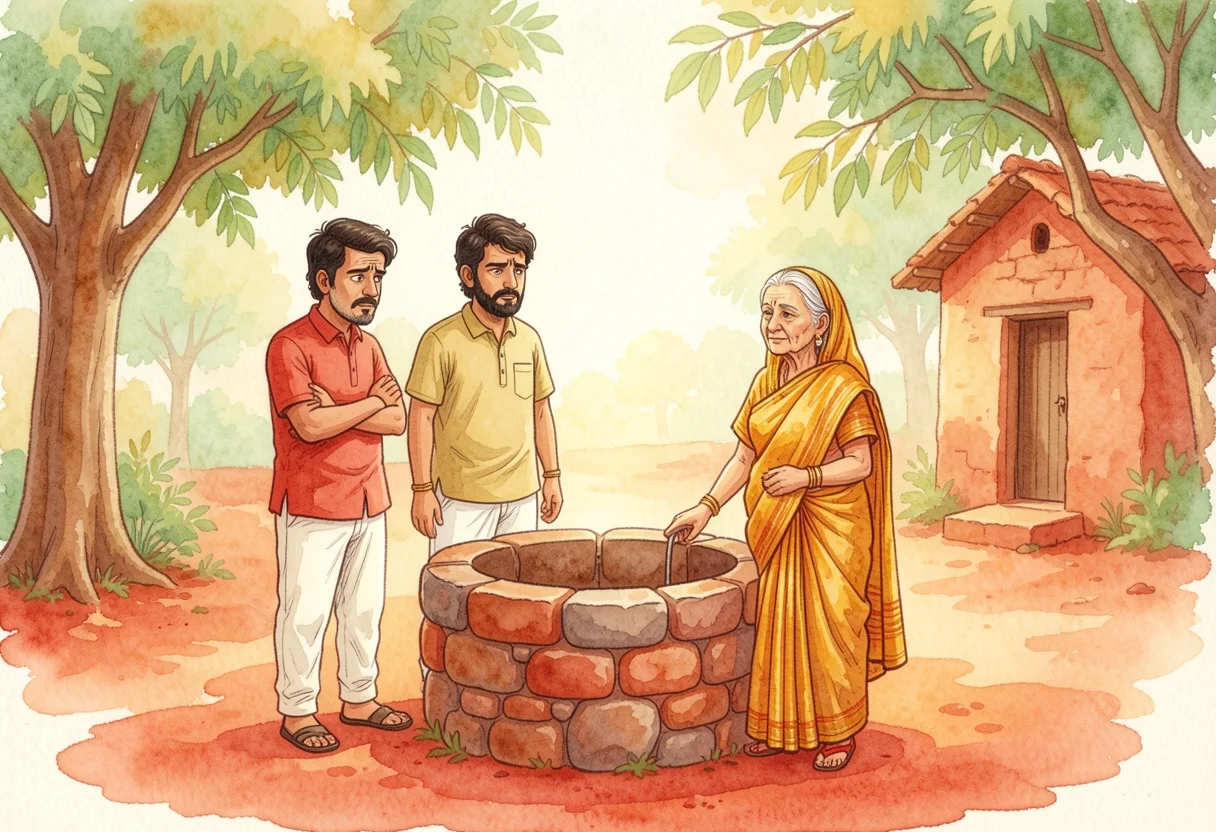
A farmer and an elder woman beside a stone well in a Gujarat village — kids moral story about greed and fairness
Reading Time: 2 minutes

In a village near the Gir forest, where the earth was red and the afternoons smelled of warm grass, there lived a farmer named Bhavesh.

Bhavesh had a well.

It sat right in the middle of his land — round, deep, and cold even in May. The whole village knew that well. Children would run to it after school. Women would fill their pots there before dawn. Old men would sit beside it in the evenings, talking about rain.

One dry summer, Bhavesh decided he needed more money.

He went to his neighbour Mohan, who had no well on his land.

“I will sell you my well,” said Bhavesh. “Five hundred rupees. It is yours.”

Mohan counted his savings carefully. He paid the five hundred rupees. He shook Bhavesh’s hand. He went home happy.

The next morning, Mohan came to draw water.

Bhavesh was standing by the well with his arms crossed.

“Stop,” said Bhavesh. “You cannot take this water.”

Mohan blinked. “But I bought the well.”

“You bought the well,” said Bhavesh, with a sly smile. “But not the water inside it. The water is still mine. If you want the water, pay me again.”

Mohan stood very still.

He did not shout. He did not argue.

He walked quietly to the village sarpanch — the head of the village — an old woman named Kamla Ben, who had seen everything in her eighty years and could not be fooled by anything.

Mohan explained the situation. Bhavesh explained his clever logic.

Kamla Ben listened to both of them without interrupting.

Then she looked at Bhavesh.

“So,” she said slowly. “You sold the well. But not the water inside it.”

“Correct,” said Bhavesh, feeling very smart.

“Then,” said Kamla Ben, “the water still belongs to you.”

“Yes,” said Bhavesh.

“And the well belongs to Mohan.”

“Yes.”

“Then,” she said, “you must remove your water from Mohan’s well immediately. Since the well is not yours, you have no right to store your water in it. Take every drop out by sunset — or pay Mohan rent for keeping your water in his well.”

The village went very quiet.

Bhavesh opened his mouth. Then closed it.

There was nothing to say.

He had been so busy being clever that he had trapped himself inside his own trick.

He paid Mohan back every rupee that afternoon. He also paid him extra — fifty rupees — for the trouble. Kamla Ben had suggested it. Very firmly.

That evening, Mohan drew cool water from the well and brought a pot of it to Kamla Ben’s door without being asked.

She accepted it with a small nod.

Some kindnesses do not need words.

And some lessons — the ones that sting a little — are the ones you never forget.

📖 Story in Brief
A greedy farmer in a Gujarat village sells his well but tries to keep the water, thinking he has found a clever loophole. The wise sarpanch turns his own trick back on him in front of the whole village. Being unfair does not make you clever — it makes you the one who loses.
💡 The Lesson Inside
Bhavesh thought he could be clever with words and walk away richer. But Kamla Ben showed him that a trick works both ways. When we try to take more than is fair, we do not outsmart others — we outsmart ourselves.
✨ Words Worth Keeping
Logic
using clear thinking to work out what is right or true, step by step, like solving a puzzle with your mind.
You might say: The teacher asked us to use our logic to figure out which answer made the most sense.
Sly
trying to get something in a sneaky, clever way that is not quite honest.
You might say: The sly boy hid the last ladoo behind his back and pretended he had not seen it.
Rent
money you pay to use something that belongs to someone else.
You might say: We pay rent every month to live in this house because it belongs to our landlord.
🌱 Phrases to Remember
Trapped in your own trick
when a plan you made to fool someone ends up hurting you instead.
In real life you might say: He told one lie to avoid trouble, then another to cover it, until he was trapped in his own trick.
Walk away richer
to leave a situation having gained more than you came with, sometimes unfairly.
In real life you might say: He tried to walk away richer by charging extra, but the shopkeeper noticed.
Works both ways
something that affects both people equally, not just one side.
In real life you might say: Sharing works both ways
if you share your tiffin today, your friend will share tomorrow.
📚 Quick Glossary
Sarpanch
the elected head of a village council in India, responsible for settling disputes and making local decisions. A sarpanch is often one of the most respected people in any village.
Gir forest
a real forest in Gujarat, famous for being the last home of the Asiatic lion. Villages near Gir are surrounded by dry golden land and warm red soil.
🎬 See It in Action
1

The shopkeeper tried to be sly, but everyone in the market already knew the real price.

2

She used her logic to figure out who had eaten the last piece of cake — the crumbs were a clue.

3

He thought his plan was perfect, but he had trapped himself in his own trick.

4

Fair is not always equal — sometimes fair means giving more to the one who needs it most.

🗣️ Say It Right
Logic
/LOJ-ik/
Sarpanch
/SAR-panch/

🎯 Complete the Story Challenges

🧩 Vocabulary Explorer ✏️ Context Architect Timeline Master ✍️ Creative Novelist
Game 1: Word Match ✨ Reward: +10 XP

Vocabulary Matcher

Match the vocabulary word on the left with its correct meaning on the right.

Logic
Rent
Sly
using clear thinking to work out what is right or true, step by step, like solving a puzzle with your mind.
money you pay to use something that belongs to someone else.
trying to get something in a sneaky, clever way that is not quite honest.

One more story before you go...

A father and son sit calmly in traffic — a Krishna story about not comparing yourself to others.

The Lane Arjun Didn’t Take

Reading Time: 3 minutesThe Kalanagar signal had turned red for the fourth time that morning, and Vikram Deshmukh had stopped counting the minutes. Behind him, a truck driver leaned on his horn like

Read More »
A grandmother and grandson sharing roti at an Indian family dinner table — moral story about sacrifice

Dadi’s Last Piece of Roti

Reading Time: 2 minutesEvery night, the same thing happened at the Sharma family table, and every night, nobody but Vihaan seemed to notice. Dadi would take one roti fewer than everyone else. Nine

Read More »

Stories you may like...

A father and son sit calmly in traffic — a Krishna story about not comparing yourself to others.

Reading Time: 3 minutesThe Kalanagar signal had turned red for the fourth time that morning, and Vikram Deshmukh had stopped counting the minutes.

Read More »
A husband discovers his wife's smaller plate in the kitchen — a short moral story about sacrifice in marriage.

Reading Time: 2 minutesRamesh worked in a small accounts office near Dadar station. Every morning at eight, his wife Sunita packed his tiffin

Read More »
Two sparrows on a winter branch — bedtime story about courage and staying with a friend.

Reading Time: < 1 minuteHigh above the mango tree, every bird was getting ready to fly south for the winter. “Everyone goes,” chirped the

Read More »

Readers Also Enjoyed

📖 Finding your next story...

Learn something new

Featured Vocabulary
Strikers
players whose job is to attack and score goals
Literary Term
Kansa
the cruel king of Mathura and Krishna's maternal uncle, who imprisoned Devaki and Vasudeva after a prophecy told…
Idiomatic Expression
Go still
to suddenly stop moving, often from surprise or worry. In real life you might say: He went still…
Speech & Pronunciation
Shankarji
Phonetic: SHUN-kar-jee

Sign up to my newsletter

A story for every mood: