English Short Stories

The Umbrella That Came Back

The Umbrella That Came Back

An auto driver gives his umbrella to a teen in the rain — a short spiritual story about karma
Reading Time: 3 minutes

Manoj Kadam had driven the same black-and-yellow auto-rickshaw through the streets of Nashik for eleven years. The seat had two mismatched patches — one green, one the colour of weak tea — sewn on by his wife the year their daughter was born. Everyone in the Panchavati lane knew that auto by its patched seat before they ever looked at the driver’s face.

Under that seat, rain or shine, sat an old black umbrella with a bent rib on one side. Manoj kept it there the way other men kept a spare tyre.

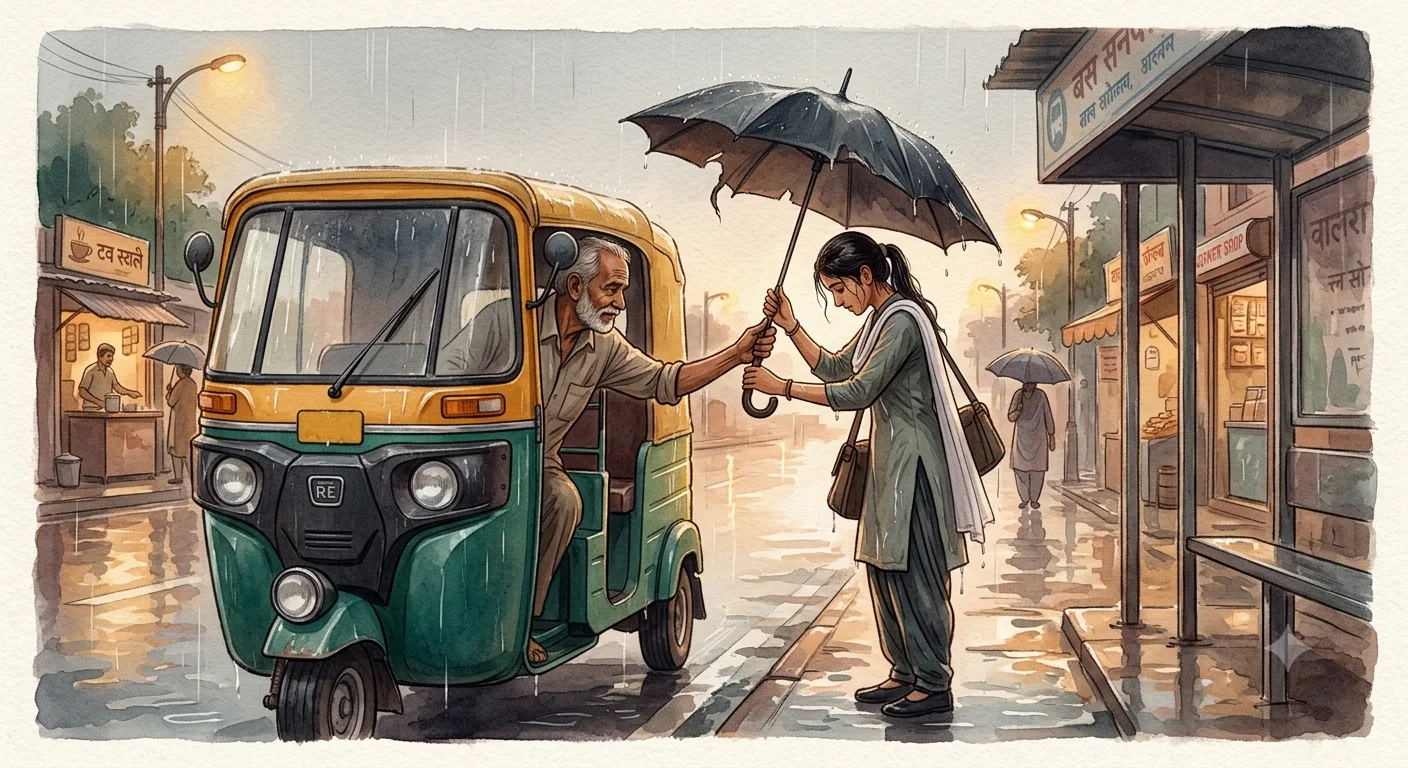
One July evening, the sky over Nashik turned the colour of wet ash. Manoj was driving home, tired, his day’s earnings barely enough to cover the petrol and a plate of misal for dinner. At the bus stop near Ramkund, a girl in a Class 12 uniform stood pressed against the shelter’s pillar, soaked through, her school bag hugged to her chest like something that might drown.

He stopped the auto without deciding to.

Beta, no bus is coming in this rain. Get in, I will drop you.”

She hesitated the way children are taught to hesitate with strangers. Then the rain answered for her, and she climbed in.

Halfway to her house, she was still shivering. Manoj reached under the seat, pulled out the old umbrella, and pushed it into her hands.

“Keep it. I have a raincoat at home.”

He didn’t. But a lie that keeps a child dry is not really a lie.

She tried to pay him. He waved the ten-rupee note away like it was a fly. “Go, your mother will be waiting.”

He never saw her again. Or so he thought.

Eleven years is a long time in a small city, and Manoj’s own daughter, Payal, grew from a girl who rode on the auto’s footboard to a girl who studied late for her Class 12 boards. On the night of her final chemistry exam, the sky over Nashik turned that same colour of wet ash.

Payal’s college was on the other side of the river, and Manoj was three hours away in Igatpuri, his auto’s clutch cable snapped on a job he couldn’t refuse. He called every number he had. No one could reach her before the exam hall closed its gates.

Payal stood outside the gate with no umbrella, no rickshaw, and fifteen minutes on the clock, when a car pulled up beside her. A young woman rolled down the window.

“You’re going to be late. Get in — I’ll drop you first, we can talk after.”

In the car, dry and breathless, Payal noticed a black umbrella with a bent rib lying on the back seat, next to a stethoscope case.

“That’s an old umbrella for a doctor to be carrying,” Payal said, more to fill the silence than anything else.

The woman glanced at it in the mirror. “It’s not really mine. Someone gave it to me a long time ago, when I was about your age, standing in the rain exactly like you were. An auto driver. I never got his name. I just never had the heart to throw it away.”

Payal went quiet — the kind of quiet that has nothing to do with having no words and everything to do with having too many at once.

“My father drives an auto,” she said finally. “Yellow and black. The seat has two patches — one green and one that used to be red. My mother sewed them.”

The woman’s hands tightened slightly on the wheel.

Neither of them said anything else about it. They didn’t need to. Payal sat her exam with three minutes to spare. Ananya — that was the doctor’s name — waited outside the whole time, the old umbrella resting across her lap like something she’d been keeping for exactly this evening, without ever knowing why.

📄 Free printable worksheet available below.
Complete the learning activities and download it at the end of this lesson.

📖 Story in Brief
An auto-rickshaw driver in Nashik gives his umbrella to a drenched, unknown schoolgirl on a rainy evening, expecting nothing back. Eleven years later, his own daughter is stranded in a storm before her final exam, and a stranger's car — and the very same umbrella — arrives to carry her through. What goes out quietly into the world has a way of finding its way home, though rarely by the door you expected.
💡 The Lesson Inside
Karma isn't a debt that gets collected with interest, and it doesn't keep a ledger. It's simply this: kindness, once let loose into the world, doesn't disappear — it moves through other hands, other rainy evenings, other frightened children, until it finds its way back to someone who needs it. Manoj never asked what happened to his umbrella. He just kept another one under the seat, in case.
✨ Words Worth Keeping
Hesitate
to pause before doing something because you're unsure or a little afraid.
You might say: She hesitated at the door, unsure whether to knock or just walk in.
Shelter
a place that protects you from rain, wind, or danger.
You might say: We ran for shelter under the banyan tree when the storm hit.
Breathless
so out of breath or excited that you can barely speak.
You might say: He arrived breathless at the station, just as the train doors were closing.
Debt
something you owe someone, whether it's money or a kindness.
You might say: She felt she owed her old teacher a debt she could never fully repay.
Stranded
left somewhere with no way to move forward or get help.
You might say: We were stranded at the airport for six hours because of the fog.
🌱 Phrases to Remember
Pressed against
to stand or lean very close to something, often for safety or comfort.
In real life you might say: The children pressed against their mother as the thunder rolled.
Waved away
to refuse something with a small dismissive gesture, often kindness or an offer.
In real life you might say: He waved away her apology, saying it was nothing at all.
Went quiet
to suddenly stop talking, usually because of a strong emotion.
In real life you might say: The room went quiet the moment she mentioned his name.
Have the heart to
to be willing or able to do something difficult, usually said in the negative.
In real life you might say: I didn't have the heart to tell him the shop had closed for good.
Three minutes to spare
arriving just in time, with very little margin left.
In real life you might say: We caught the flight with three minutes to spare.
📚 Quick Glossary
Auto-rickshaw
a small three-wheeled taxi common across Indian cities, often yellow and black, used for short local rides.
Misal
a spicy Maharashtrian street dish of sprouted lentils topped with onions, farsan, and lime, usually eaten with bread rolls.
Beta
a warm, affectionate way of addressing a child or younger person, meaning roughly "dear one" or "child."
Class 12 boards
the final school-leaving exams in India, taken at the end of Class 12, which strongly influence college admissions.
🎬 See It in Action
1

Hesitate — The waiter hesitated before bringing the bad news to the table.

2

Shelter — She pressed against the wall, taking shelter from the sudden downpour.

3

Breathless — He arrived breathless at the platform just as the train pulled in.

4

Debt — She always felt a quiet debt to the teacher who believed in her first.

5

Stranded — They were stranded at the station for hours after the last bus left.

🗣️ Say It Right
Hesitate
/say it like: HEZ-ih-tayt/
Stranded
/say it like: STRAN-ded/
Breathless
/say it like: BRETH-less/

🎯 Complete the Story Challenges

🧩 Vocabulary Explorer ✏️ Context Architect Timeline Master ✍️ Creative Novelist
Game 1: Word Match ✨ Reward: +10 XP

Vocabulary Matcher

Match the vocabulary word on the left with its correct meaning on the right.

Shelter
Breathless
Hesitate
Debt
a place that protects you from rain, wind, or danger.
to pause before doing something because you're unsure or a little afraid.
something you owe someone, whether it's money or a kindness.
so out of breath or excited that you can barely speak.
Free Reading Comprehension Worksheet

Strengthen your English skills with a printable worksheet based on this story.

Vocabulary Practice Reading Comprehension Critical Thinking Writing Skills
Download & Print Worksheet

Free for students, parents, teachers and ESL learners.

One more story before you go...

An Indian sculptor holding a hammer over an unbroken stone in a dimly lit workshop — moral story about never giving up

The Strike He Never Took

Reading Time: 2 minutesNarayan had been a sculptor for thirty-one years. His hands knew stone the way a mother knows her child’s cry — by feel, by instinct, by something that could not

Read More »
Elephant tied with a small rope at an Indian mela, symbolizing limiting beliefs.

The Belief That Held Him Down

Reading Time: 3 minutesThe late afternoon sun hung low above the dusty grounds of a small village mela. Stalls lined the open field—colorful bangles, sweets dripping with syrup, toys that spun in the

Read More »

Stories you may like...

An elderly man waiting at a small-town bus stop — short story about kindness and promise

Reading Time: 4 minutesIn Devgarh, the highway had stopped sending its buses down the old lane years ago, but the bus stop was

Read More »
A shy schoolgirl in a crowded Indian classroom — moral story about a teacher who remembers names

Reading Time: 2 minutesIn Class 5-C of the Zilla Parishad school in Latur, forty-six children sat elbow to elbow, three to a bench

Read More »
A girl kneels over a smudged peacock rangoli at dawn — a story about failure and trying again.

Reading Time: 2 minutesMeera had been drawing rangoli since she was four, tracing chalk circles on the cool marble of their veranda while

Read More »

Readers Also Enjoyed

📖 Finding your next story...

Learn something new

Featured Vocabulary
You might say: He arrived breathless at the station, just as the train doors were closing.
Literary Term
Faith
Trust and belief in something good
Idiomatic Expression
In and out
to complete something quickly without getting involved or staying long. In real life you might say: I just…
Speech & Pronunciation
Particular
Phonetic: say it like: par-TIK-yoo-ler

Sign up to my newsletter

A story for every mood: