In a village near the Gir forest, where the earth was red and the afternoons smelled of warm grass, there lived a farmer named Bhavesh.
Bhavesh had a well.
It sat right in the middle of his land — round, deep, and cold even in May. The whole village knew that well. Children would run to it after school. Women would fill their pots there before dawn. Old men would sit beside it in the evenings, talking about rain.
One dry summer, Bhavesh decided he needed more money.
He went to his neighbour Mohan, who had no well on his land.
“I will sell you my well,” said Bhavesh. “Five hundred rupees. It is yours.”
Mohan counted his savings carefully. He paid the five hundred rupees. He shook Bhavesh’s hand. He went home happy.
The next morning, Mohan came to draw water.
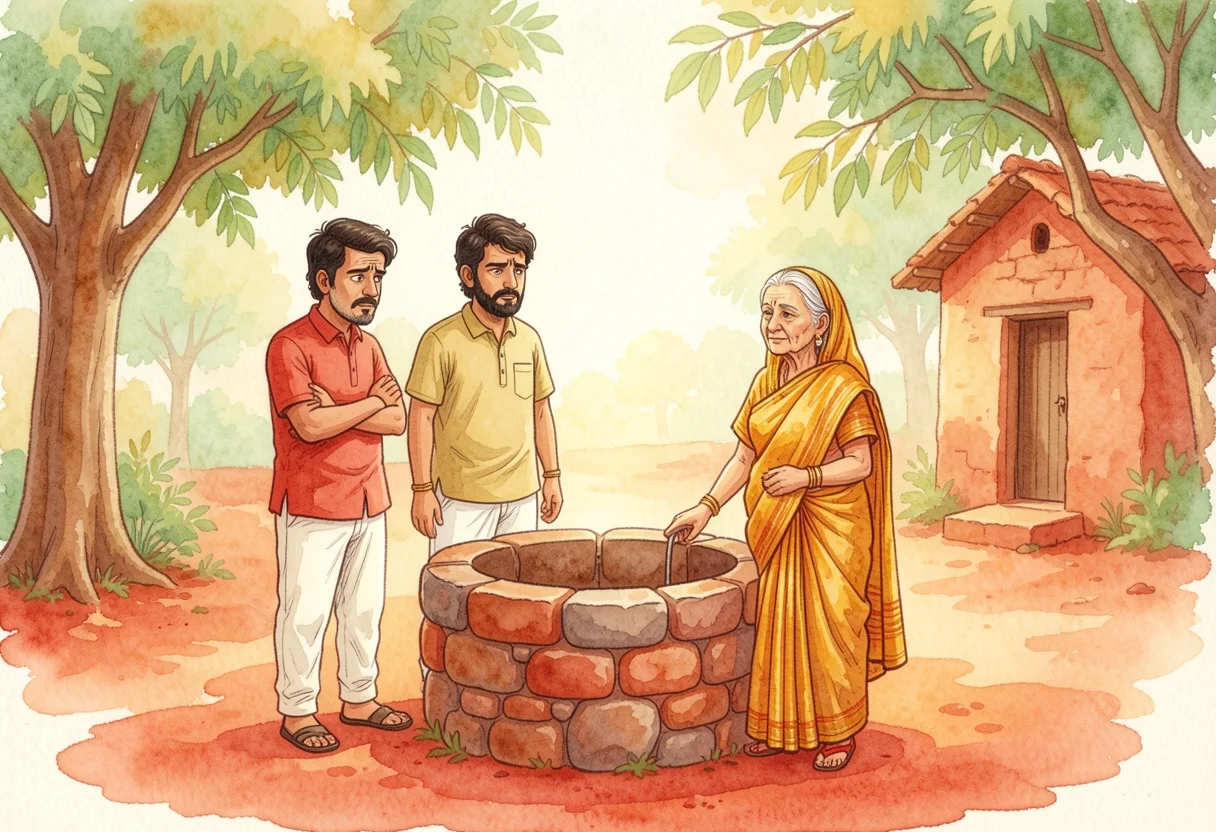
Bhavesh was standing by the well with his arms crossed.
“Stop,” said Bhavesh. “You cannot take this water.”
Mohan blinked. “But I bought the well.”
“You bought the well,” said Bhavesh, with a sly smile. “But not the water inside it. The water is still mine. If you want the water, pay me again.”
Mohan stood very still.
He did not shout. He did not argue.
He walked quietly to the village sarpanch — the head of the village — an old woman named Kamla Ben, who had seen everything in her eighty years and could not be fooled by anything.
Mohan explained the situation. Bhavesh explained his clever logic.
Kamla Ben listened to both of them without interrupting.
Then she looked at Bhavesh.
“So,” she said slowly. “You sold the well. But not the water inside it.”
“Correct,” said Bhavesh, feeling very smart.
“Then,” said Kamla Ben, “the water still belongs to you.”
“Yes,” said Bhavesh.
“And the well belongs to Mohan.”
“Yes.”
“Then,” she said, “you must remove your water from Mohan’s well immediately. Since the well is not yours, you have no right to store your water in it. Take every drop out by sunset — or pay Mohan rent for keeping your water in his well.”
The village went very quiet.
Bhavesh opened his mouth. Then closed it.
There was nothing to say.
He had been so busy being clever that he had trapped himself inside his own trick.
He paid Mohan back every rupee that afternoon. He also paid him extra — fifty rupees — for the trouble. Kamla Ben had suggested it. Very firmly.
That evening, Mohan drew cool water from the well and brought a pot of it to Kamla Ben’s door without being asked.
She accepted it with a small nod.
Some kindnesses do not need words.
And some lessons — the ones that sting a little — are the ones you never forget.
✨ Words Worth Keeping
🌱 Phrases to Remember
📚 Quick Glossary
🎬 See It in Action
The shopkeeper tried to be sly, but everyone in the market already knew the real price.
She used her logic to figure out who had eaten the last piece of cake — the crumbs were a clue.
He thought his plan was perfect, but he had trapped himself in his own trick.
Fair is not always equal — sometimes fair means giving more to the one who needs it most.