English Short Stories

What the Gods Forgot Before They Won

What the Gods Forgot Before They Won

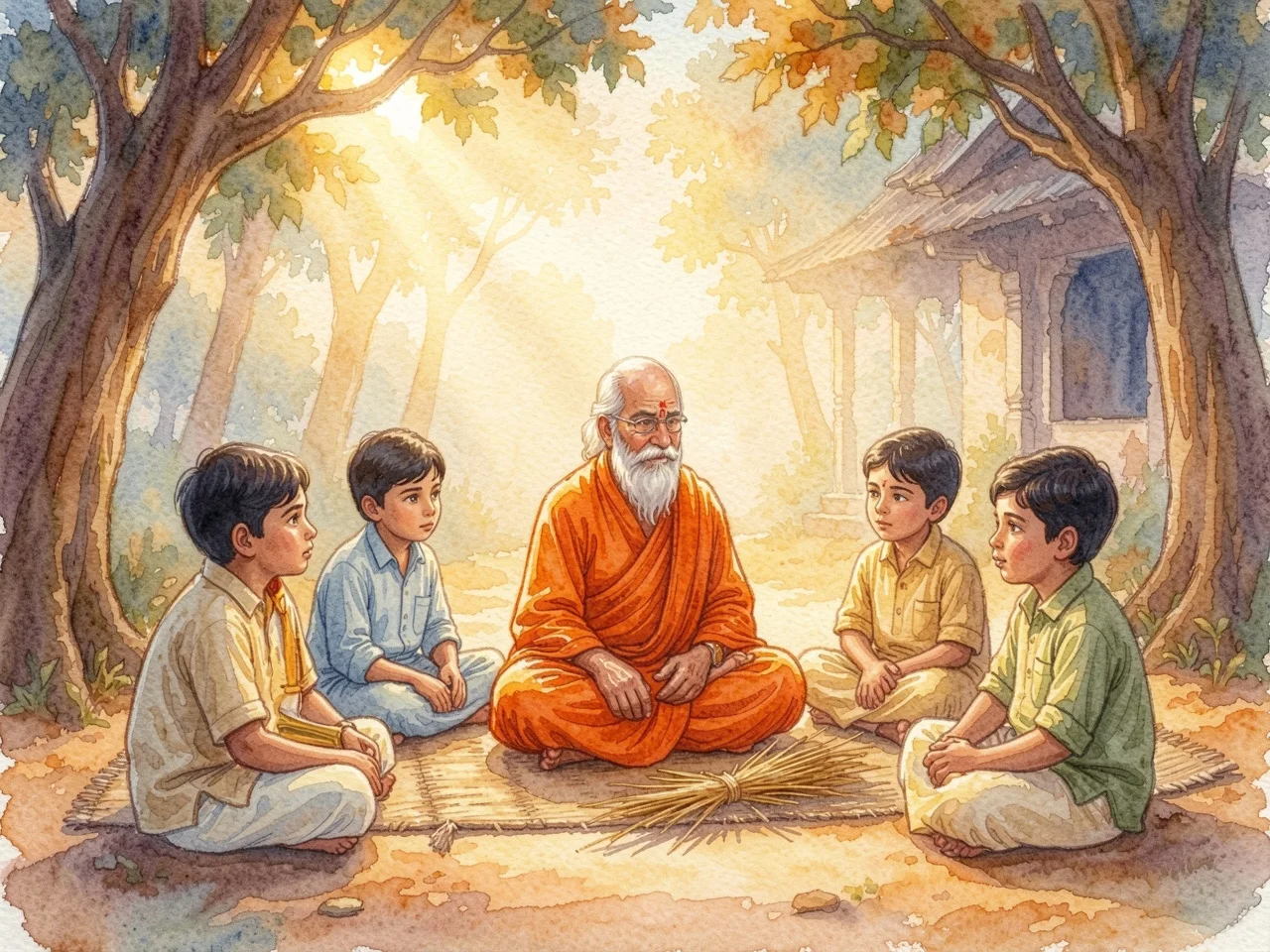
Guru in traditional attire teaches attentive children at a gurukul at dawn — spiritual story about the gods
Reading Time: 3 minutes

The evening prayers had ended, and the gurukul courtyard smelled of the last of the incense sticks. The children sat cross-legged around their guru, waiting, the way they always did, for someone brave enough to ask the first question.

It was Nachiketa’s grandson, a boy no older than ten, who finally spoke.

“Guruji, when I close my eyes, who is it that sees the darkness? When I speak, who moves my tongue? There must be someone behind all of this. Who is it?”

The guru did not answer right away. He picked up a dry straw from the ground beside him and turned it over in his fingers before setting it down.

“That,” he said, “is the very question the gods themselves once asked. Would you like to hear what happened to them?”

The children leaned forward.

“Long, long ago,” the guru began, “there was a great battle between the gods and the demons. It went on for many seasons, and finally the gods were victorious.”

“They celebrated on the field of battle, banging their drums and shouting, ‘We have won! Look at our strength! The demons could not stand against us!'”

“But their victory had not come from their own strength alone. It had come from something behind them, something they had forgotten to thank.”

Brahman — the truth behind all things — decided the gods needed a lesson in humility. So Brahman appeared before them in a strange, glowing form, one they did not recognise.”

Agni, the god of fire, stepped forward first, puffed up with pride. ‘Who are you, to stand in our midst?’ he demanded. ‘I am Agni. There is nothing in this world I cannot burn to ash.'”

“Brahman said nothing. Instead, this being placed a single dry straw on the ground before him and said, ‘Burn this, then.'”

“Agni laughed and summoned every bit of his fire. He roared, he blazed, he scorched the air around him. But the straw did not so much as curl at the edges. Agni’s flame grew smaller and smaller until he stepped back, confused and silent, and returned to the other gods without a word.”

“Next came Vayu, the god of wind, certain he would succeed where fire had failed. ‘I am Vayu. I can lift mountains and empty oceans. Watch me clear this straw from the earth.'”

“He blew with the full force of every storm he had ever made. Trees elsewhere bent nearly to breaking. But the straw stayed exactly where it was, still as a stone.”

“Vayu, too, went back to the others, saying nothing.”

“Finally Indra, king of the gods, walked forward himself, certain that a king would not be humbled the way his servants had been. But the moment Indra arrived, the strange glowing being vanished.”

“In its place stood a woman of extraordinary radiance — Uma, daughter of the mountains.”

“‘Devi,’ Indra asked her, ‘who was that, standing here a moment ago?'”

“Uma looked at him gently. ‘That was Brahman. The very power that let you win your battle. Not your strength, Indra. Not Agni’s fire or Vayu’s wind. All of it borrowed, all of it Brahman’s.'”

“Indra stood very still. Then, for the first time since the war had ended, he bowed his head — not to another god, but to the truth itself.”

The guru looked around at the children’s faces, catching the firelight.

“That same power,” he said quietly, “is what lets your eyes see this fire tonight. It is what lets your ears hear my voice. It cannot be seen, cannot be held, cannot be burned by any flame or carried off by any wind. And yet without it, nothing else in you would work at all.”

Nachiketa’s grandson looked down at the straw still lying near the guru’s feet.

“So it was never really about the fire and the wind, was it?”

“No,” said the guru, smiling. “It never is.”

Source Note: This story is inspired by the traditional account found in the Kena Upanishad. The narration and dialogue are an original storytelling style, not a scriptural quotation.

📄 Free printable worksheet available below.
Complete the learning activities and download it at the end of this lesson.

📖 Story in Brief
In an ancient gurukul, a guru answers a child's question about the unseen power behind sight, speech, and thought with a story of the gods' pride after battle. Agni and Vayu discover their strength means nothing before a single straw, until Indra alone learns the truth through the goddess Uma. Power, the story quietly insists, is only ever borrowed.
💡 The Lesson Inside
Strength likes to speak first and loudest, but it rarely knows where it came from. Agni and Vayu were certain of their own power right up until a single dry straw proved otherwise. The quietest presence in the story — the one nobody could name — turned out to be the one holding everything else up.
✨ Words Worth Keeping
Humility
the quality of not thinking too highly of your own importance or power. You might say: Losing that match taught him humility he never had before.
Radiance
a glow or brightness that seems to come from within, often used for someone's presence. You might say: There was a quiet radiance about her that made people trust her instantly.
Puffed up
feeling proud or self-important, often more than is deserved. You might say: He got a little puffed up after winning just one game.
Humbled
made to feel less important or proud, usually after realising a limit to your own power. You might say: The old teacher's simple question left the scientist humbled.
Borrowed (power)
something used or held temporarily, not truly your own. You might say: All the confidence he showed on stage felt borrowed, like it belonged to someone else.
🌱 Phrases to Remember
Stand very still
to pause completely, often out of shock, respect, or sudden realisation. In real life you might say: He stood very still when he heard his name announced as the winner.
Bow one's head
to lower your head, usually as a sign of respect or acceptance. In real life you might say: She bowed her head quietly when her grandmother corrected her.
Without a word
done in complete silence, often after being surprised or humbled. In real life you might say: He left the meeting without a word after hearing the decision.
Lean forward
to move your body toward something out of interest or attention. In real life you might say: The whole class leaned forward when the teacher began the story.
Curl at the edges
to begin changing shape slightly, often used literally for paper or leaves, but here for something resisting fire. In real life you might say: The old photograph had begun to curl at the edges from age.
📚 Quick Glossary
Gurukul
a traditional Indian school where students lived with their teacher, learning through daily life and conversation rather than only textbooks.
Brahman
in Hindu philosophy, the ultimate, formless truth or reality believed to be the source of all existence.
Agni
the Hindu god associated with fire, often invoked in rituals and offerings.
Vayu
the Hindu god associated with wind and breath.
Indra
the king of the gods in Hindu tradition, associated with thunder, rain, and rulership over the heavens.
🎬 See It in Action
1

Humility - After the argument, he apologised with real humility, admitting he had been wrong.

2

Radiance - The old temple had a quiet radiance to it, even in the fading evening light.

3

Puffed up - Winning the first round left the young player a little puffed up, until the final match brought him back down to earth.

4

Humbled - Losing to a much younger opponent left the champion humbled.

5

Borrowed - She realised her confidence on stage felt oddly borrowed, as if it belonged to someone braver.

🗣️ Say It Right
Brahman
/say it like: BRAH-mun/
Humility
/say it like: hyoo-MIL-i-tee/
Radiance
/say it like: RAY-dee-uns/

🎯 Complete the Story Challenges

🧩 Vocabulary Explorer ✏️ Context Architect Timeline Master ✍️ Creative Novelist
Game 1: Word Match ✨ Reward: +10 XP

Vocabulary Matcher

Match the vocabulary word on the left with its correct meaning on the right.

Puffed up
Radiance
Humbled
Humility
made to feel less important or proud, usually after realising a limit to your own power. You might say: The old teacher's simple question left the scientist humbled.
the quality of not thinking too highly of your own importance or power. You might say: Losing that match taught him humility he never had before.
a glow or brightness that seems to come from within, often used for someone's presence. You might say: There was a quiet radiance about her that made people trust her instantly.
feeling proud or self-important, often more than is deserved. You might say: He got a little puffed up after winning just one game.
Free Reading Comprehension Worksheet

Strengthen your English skills with a printable worksheet based on this story.

Vocabulary Practice Reading Comprehension Critical Thinking Writing Skills
Download & Print Worksheet

Free for students, parents, teachers and ESL learners.

One more story before you go...

An elderly man planting seeds in a small field in rural Maharashtra — Indian family story about selfless service

The Weight of One Seed

Reading Time: 2 minutesArjun had not been back to Wai in three years. The village sat tucked between two hills in the Satara district of Maharashtra, the kind of place that smelled of

Read More »

Stories you may like...

Bhoomi and Diya serve food to the poor at a temple — story about God as our true friend

Reading Time: 2 minutesDiya hadn’t touched her dinner. “Meera’s moving to Bangalore,” she said, pushing rice around her plate. “Next month. Forever.” Bhoomi,

Read More »
A young boy lying on a rooftop looking up at a starry sky - story about curiosity over worry

Reading Time: 2 minutesKabir hated Sunday nights the most, though he could never explain why to anyone. Monday meant a spelling test. Monday

Read More »
Milo the mouse curled up in a warm cosy hole — a calming bedtime story about stopping worry.

Reading Time: < 1 minuteMilo the mouse sat inside his cosy little hole in the skirting board, wrapped in a soft scrap of cotton

Read More »

Readers Also Enjoyed

📖 Finding your next story...

Learn something new

Featured Vocabulary
You might say: The old woman was humming to herself as she folded the clothes.
Literary Term
Garam
Hindi word meaning "hot"
Idiomatic Expression
Loosen
to become less tight, less held — like a knot that slowly comes undone, or the feeling in…
Speech & Pronunciation
Kanha
Phonetic: KAA-nhaa

Sign up to my newsletter

A story for every mood: