
I have read the invitation to her exhibition three times tonight, and I still don’t know if I’m happy for her or just tired of pretending I am.
I locked up the press at seven, same as every evening for the last nine years, and the card was already going soft in my shirt pocket by the time I reached the embankment.
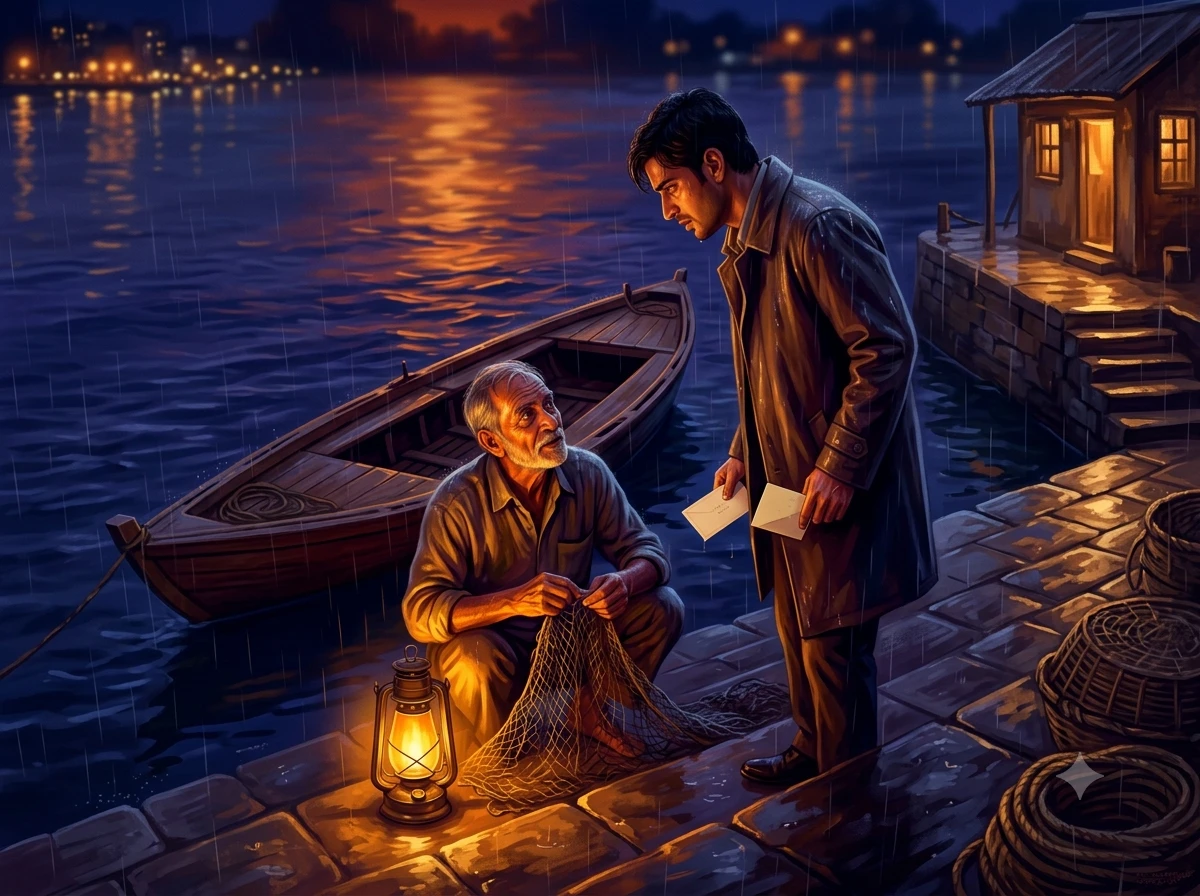
The rain had turned the river high and brown, pushing hard against the concrete steps where the fishing boats usually sat pulled up for the night. Tonight only one remained, half in the water, an old man crouched beside it with a lantern, mending a tear in the net by hand.
I’d meant to walk straight past. The path was flooded further on, so I stopped instead, not to watch him, just because there was nowhere else to stand.
“Her show opens Friday,” he said, without looking up, as if we’d already been talking for an hour. “You’ve read that card enough times to have it memorised.”
I hadn’t shown him the card. I hadn’t shown anyone the card.
“It’s just an invitation.”
“It’s an invitation you’re deciding whether you’re allowed to be jealous of.” He turned the net over, checking the tear from the other side. “Nine years since she left for the scholarship you both applied for. Nine years since you stayed to keep your father’s press running.”
“He had a stroke. Someone had to keep the shop open.”
“I’m not asking why you stayed.” He threaded the needle again, unhurried, rain darkening his shoulders through his shirt. “I’m asking why you’ve spent nine years running that press like a sentence, instead of like something that’s actually yours now.”
“It was never supposed to be mine. It was supposed to be his, until I could finally leave.”
“And now?”
I didn’t answer that. The current pushed against the boat’s hull hard enough to rock it, even pulled half onto the steps.
“You keep measuring the press against her studio,” he said, “as if there’s a scale somewhere that says which life is the better one. There isn’t. There’s only the question of which one your hands were actually built for.”
“That’s easy to say when your hands aren’t the ones stuck here.”
He didn’t flinch at that. “I’ve watched you rebind broken spines for customers who could have bought a new copy cheaper elsewhere. Nobody asks you to care whether the old ones survive. You do it anyway, every time.”
I hadn’t thought about that in years — the rebinding, the ones nobody paid extra for, the hour I’d spend matching thread colour to a cover no one else would notice.
“That doesn’t mean I chose this life.”
“No,” he agreed, “it means somewhere in nine years, you started doing it like you had, without ever letting yourself notice you’d changed your mind.” He held the mended net up to the lantern light, checking the seam had held. “That is a very different problem than the one you’ve been carrying tonight.”
Rain kept falling into the river, disappearing the moment it landed, no trace anywhere of where each drop had been.
“Then what have I been carrying?” I asked.
He set the net down slowly and didn’t answer right away, long enough that the question seemed to belong to the river now, not just to me.
“Are you mourning the road you didn’t take,” he finally said, pushing the boat the rest of the way into the current, “or grieving that this one was never allowed to feel like a choice?”
Krishna’s Question to you
“Are you mourning the road you didn’t take, or grieving that this one was never allowed to feel like a choice?”
📄 Free printable worksheet available below.
Complete the learning activities and download it at the end of this lesson.
✨ Words Worth Keeping
🌱 Phrases to Remember
📚 Quick Glossary
🎬 See It in Action
She kept glancing at the embankment path, hoping the rain would let up before dark.
He answered every hard question in that same unhurried way, like the clock didn't apply to him.
Nobody offers a scholarship for staying — that's a choice you make for free.
The boat's hull groaned against the dock all through the storm.
It took me years to mend things with my father, and even longer to admit I wanted to.


