Baburao Deshmukh reached platform two hours before the train was due. He always did.
The station master, Prakash, had stopped asking why years ago. He simply nodded from his little glass office and let the old man take his usual bench — the one with blue paint peeling in the shape of a map, near the tea stall that had been selling the same over-sweet chai since before either of them could remember.
Twelve years. That was how long it had been since his son Vijay boarded a train from this very platform, suitcase in one hand, a job letter from Dubai in the other. Baburao had stood right here, on this concrete, and watched the train pull his only son into a life he could not picture.
Phone calls came every Sunday, six-thirty sharp. Photos arrived sometimes — Vijay in front of tall glass buildings, Vijay at a wedding, Vijay holding a baby that grew, over the years, into a boy Baburao had never touched.
Today, for the first time, Vijay was bringing that boy home.
Baburao took the folded photograph from his shirt pocket — Vijay at seven, missing a front tooth, grinning at the camera his own father had borrowed for one afternoon. The edges had gone soft from handling, the way cloth goes soft after enough washing.
“Twenty minutes late,” Prakash called out, checking the board. “Signal problem near Karad.”
Baburao nodded and kept sitting. Twenty minutes was nothing against twelve years.
When the train finally groaned into the station, he stood so fast his knees complained. Doors opened. Bodies spilled out — office bags, trunks, a woman balancing two children on one hip.
Then Vijay. Greyer at the temples than his photographs let on, but the same walk, hurried and slightly pigeon-toed, exactly like his mother’s had been.
Behind him, holding tight to his father’s shirt, was a boy of about eight, eyes darting across the crowd like he was counting exits.
“Papa.” Vijay’s voice cracked on the single word.
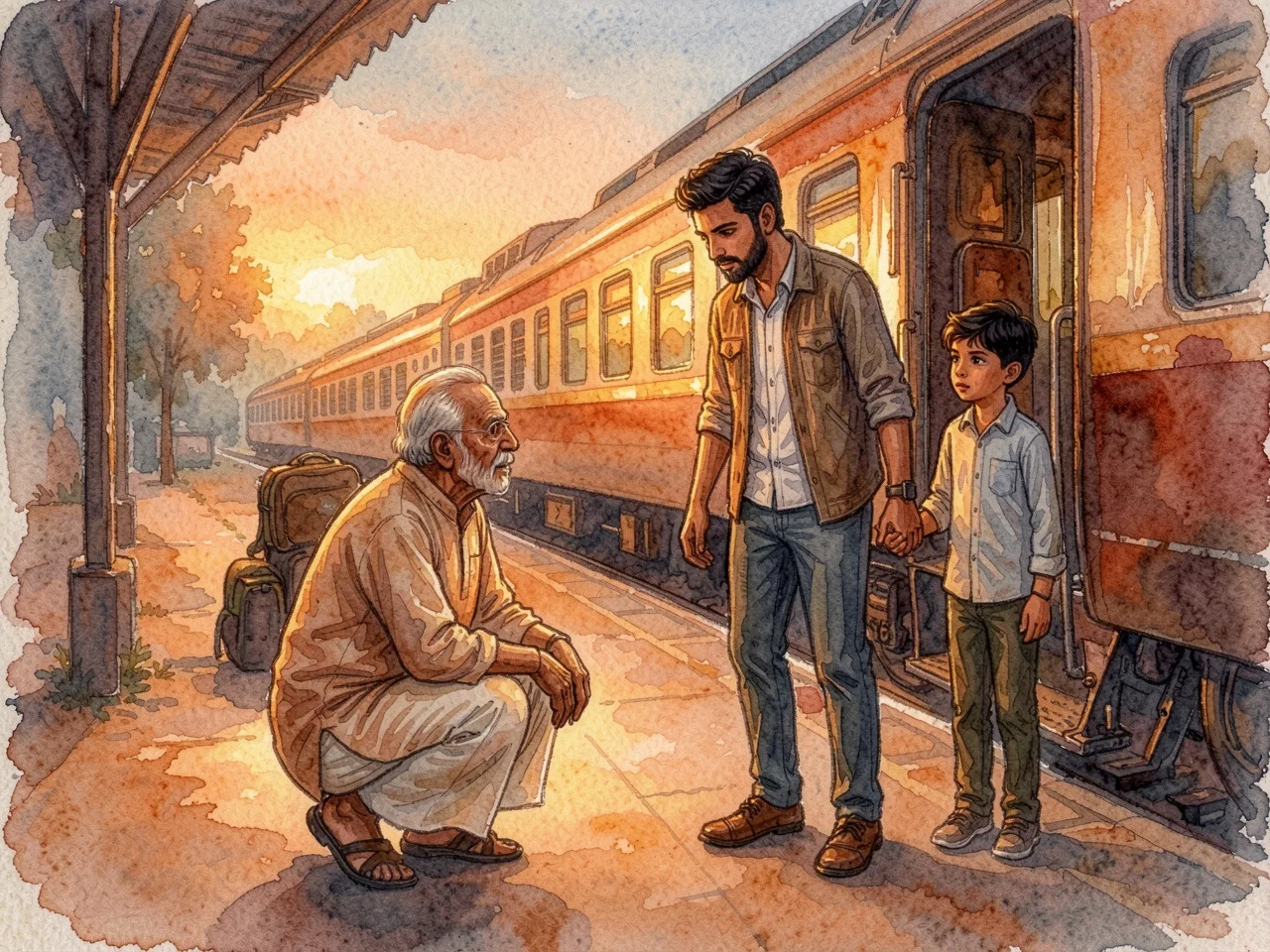
They did not embrace immediately. Vijay first turned to the boy and crouched to his level.
“Arjun, this is your Dada.”
The boy studied Baburao with the frank suspicion only children manage without cruelty. Baburao crouched too — his knees protesting louder this time — until he was eye to eye with a grandson he was meeting for the first time at age seventy-one.
He held out the old photograph.
“This was your father,” he said, “when he was not much older than you. He lost that tooth falling off my bicycle, showing off for the neighbourhood girls.”
Arjun’s suspicion cracked slightly at the corners. “He fell off a bicycle?”
“Face first. Cried for an hour. Then asked to try again.”
The boy looked up at his father, who was rubbing his eyes with the back of his hand and pretending it was dust from the train.
“Dada,” Arjun said, testing the word like a new shoe, “can I see the bicycle?”
“It rusted years ago. But I still have the bell.”
Arjun’s hand slipped into his grandfather’s, uninvited and unhesitating, the way children’s hands do when they’ve decided something adults are still deciding.
Baburao stood, folded the photograph back into his pocket, and led his son and grandson off the platform where he had waited every year for a train that had, at last, brought everyone back.
📄 Free printable worksheet available below.
Complete the learning activities and download it at the end of this lesson.
✨ Words Worth Keeping
🌱 Phrases to Remember
📚 Quick Glossary
🎬 See It in Action
She felt a wave of nostalgic longing every time she smelled her grandmother's kitchen.
He approached the new colleague with quiet suspicion until she proved herself trustworthy.
Without a second thought, he gave an unhesitating promise to help his brother move house.
The child had to crouch low to see under the bed for his lost toy.
Her frank honesty during the meeting surprised everyone, but they respected her for it.