Arjun arrived in Varanasi on a Tuesday evening with two suitcases, a new comic book, and absolutely no intention of waking up early.
He was eleven. It was summer holidays. That combination, he felt, earned him the right to sleep until nine.
His Dada disagreed.
The old man was up every morning before five. Arjun had heard him the first day — the creak of the wooden door, the soft sound of the latch, then silence. By the time Arjun rolled over and went back to sleep, his grandfather had already been to the Ganga and back.
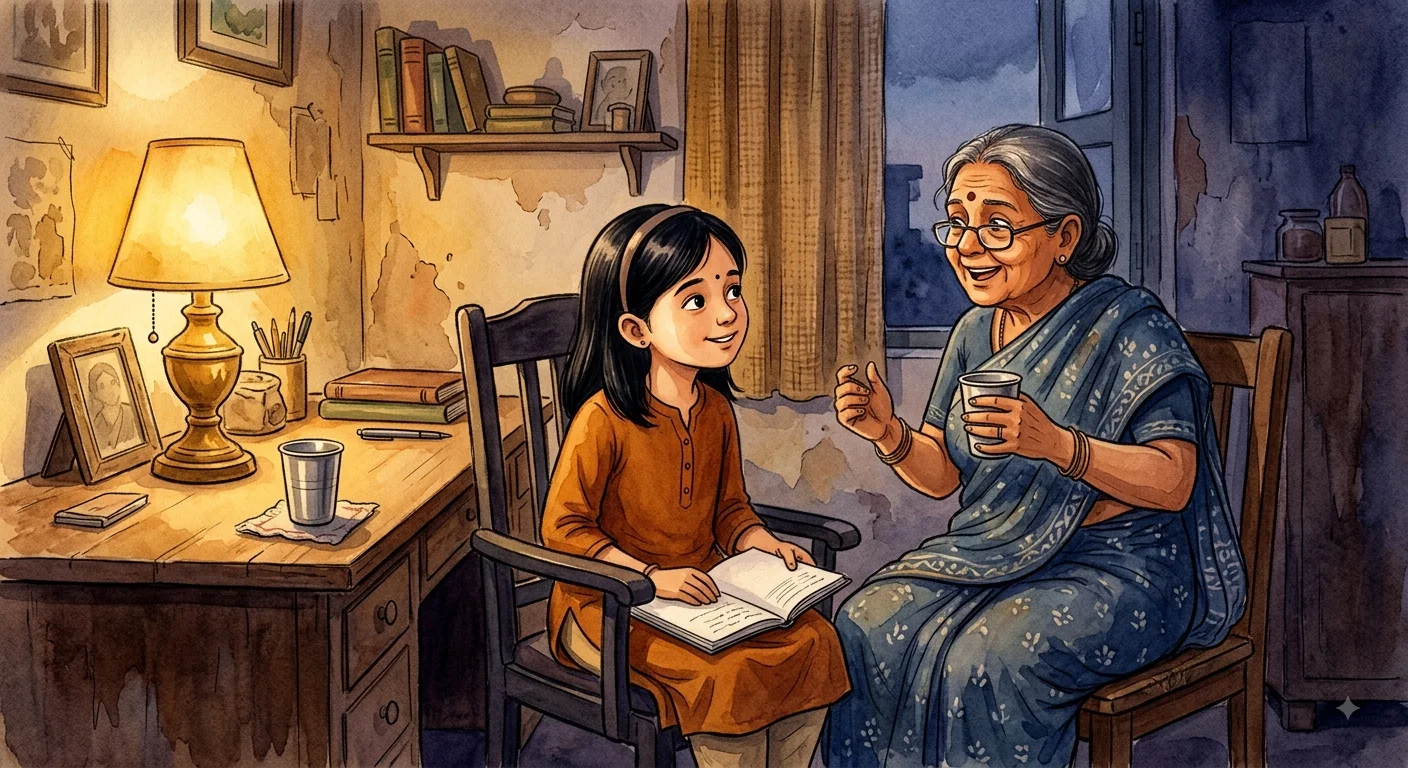
“Come tomorrow,” Dada said that first night, setting a steel glass of warm milk on the table beside Arjun’s comic book. “The temple bell rings at five-fifteen. You have never heard anything like it.”
“I’ll come,” Arjun said. He meant it. Mostly.
The next morning the alarm went off at four-fifty. Arjun silenced it without opening his eyes.
He woke up at seven to find a small marigold on his pillow — the kind they put on the temple steps — and his grandfather sitting in the courtyard reading a newspaper, saying nothing.
Arjun felt something he couldn’t name. Not guilt, exactly. Something quieter.
“I’ll come tomorrow,” he said.
“You keep saying that,” Dada replied, without looking up.
He missed it again the next day. And the day after. Each morning the alarm, each morning the darkness outside the small window, each morning the decision that five more minutes would not hurt anyone.
On the fifth day, something changed.
He heard the bell in his sleep — deep, resonant, rolling across the water like it was looking for something. It pulled him out of a dream about nothing in particular and planted him upright in his bed before he had decided to wake up.
Four forty-eight. The room was still dark.
He found his slippers. He found his grandfather already at the door with a shawl over his shoulders and no particular expression on his face — not surprise, not pleasure. Just a man ready to walk.
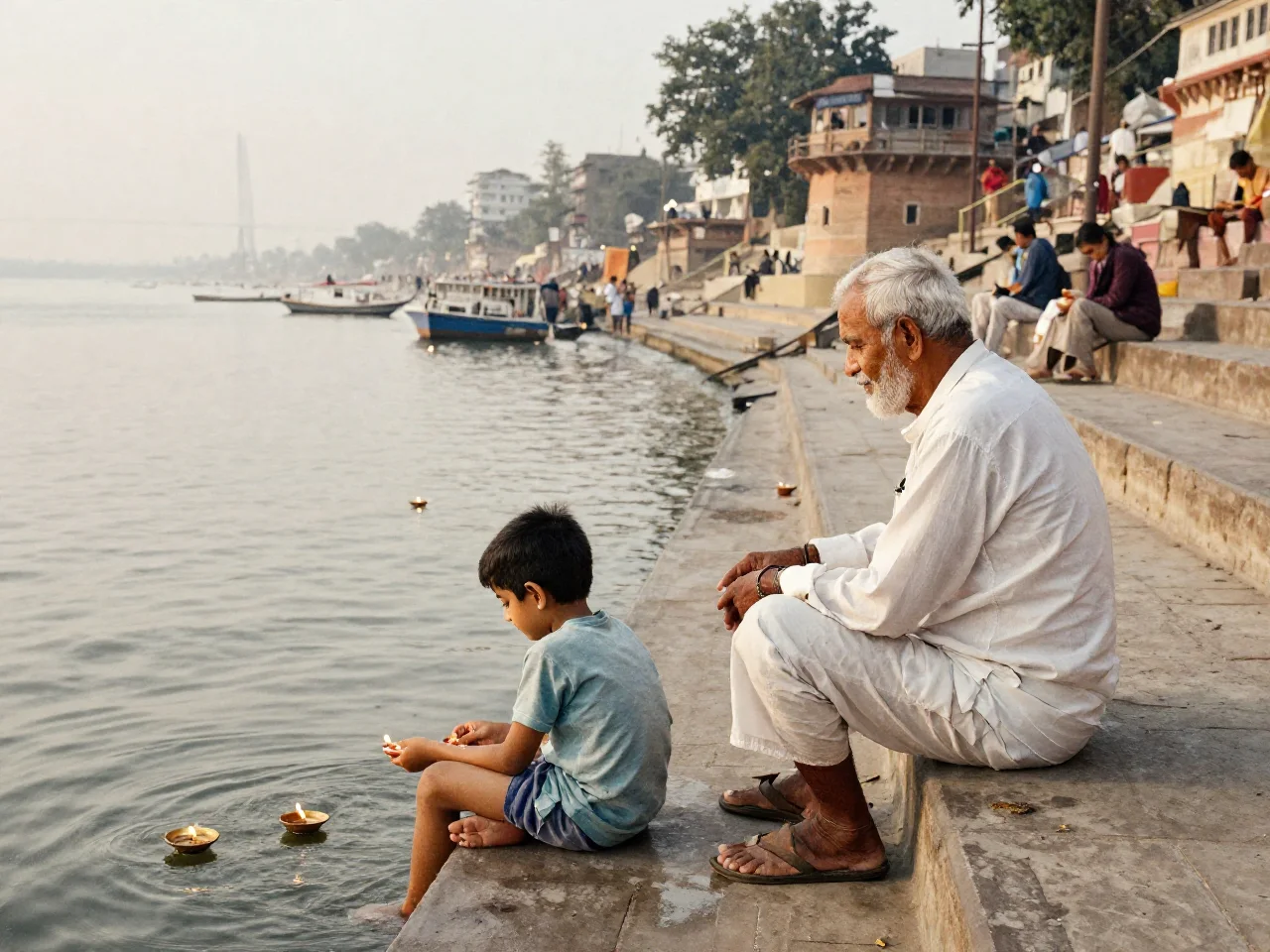
They went together through the narrow galis of the old city, the stone lanes still damp from the previous night. Stray dogs slept in doorways. A chai wallah was lighting his first fire of the morning. The air smelled of river water and incense and something Arjun had no word for — something ancient, like the city had been exhaling since before anyone could remember.
Arjun had seen photographs. He thought he knew what it would look like. He did not know what it would feel like — the Ganga in the hour before sunrise, still and pewter-grey, the oil lamps floating like small brave fires across the current, the temple bell ringing a second time across the water, so deep it seemed to come from somewhere inside his own chest.
He stood very still.
His grandfather stood beside him, not speaking. There was nothing to explain.
On the walk back, Arjun asked: “How long have you been doing this?”
“Forty-three years,” Dada said.
“Every day?”
“Every day.”
Arjun turned this over in his mind. Forty-three years. Not when he felt like it. Not when the alarm was kind. Every day, before the city woke, before anyone was watching, before there was any reason to except the one he had made for himself.
“Didn’t you want to stop sometimes?” Arjun asked.
Dada thought about this in the way he thought about most things — without hurry.
“The first time I went,” he said, “I went because my father took me. The second time, I went because I didn’t want to miss it again. The third time, I went because it had become mine.” He paused. “After that, the wanting and the not-wanting — it stopped mattering. I simply went.”
Arjun woke up at four-forty-eight for the rest of the holidays.
Not because the bell made him. Not because his grandfather was watching. But because somewhere in that dark walk through the old city, he had discovered that discipline is not a cage you are locked into. It is a door you learn to open yourself — and what waits on the other side is yours alone.
📖 Story in Brief
Eleven-year-old Arjun visits his grandparents in Varanasi during summer holidays and keeps failing to wake up for the dawn temple ritual his grandfather has kept for forty-three years. When the bell finally pulls him out of sleep on its own and he walks to the ghats in the dark, what he sees changes his understanding of what discipline actually means. A practice becomes yours not when someone forces it, but when you stop needing a reason to keep it.
💡 The Lesson Inside
We often think of discipline as something done to us — an alarm, a rule, a parent's voice. But Arjun's grandfather had been walking to the Ganga for forty-three years not because anyone was keeping count, but because the practice had become his. That is the quiet truth at the heart of every real routine: the first time you go for someone else, the second time you go because you don't want to miss it, and after that — it becomes yours. Discipline does not shrink life. In Varanasi, in the dark, before the city woke, it opened one boy's life wide.
✨ Words Worth Keeping
Discipline
the steady practice of doing something consistently, not because you feel like it every time, but because you have decided it matters.
You might say
It was not talent that got her to the final round - it was discipline, the kind that shows up even on the days no one is watching.
Resonant
a sound that is deep, full, and seems to vibrate through the air long after it is made.
You might say
The speaker had a resonant voice that made even ordinary words feel worth hearing.
Routine
a sequence of actions done regularly, at the same time, in the same way, until it becomes part of who you are.
You might say
His morning routine was simple : tea, twenty minutes of reading, a short walk, but it kept him steady through difficult weeks.
Ancient
very old, older than memory, carrying the weight of centuries in its presence.
You might say
The tree at the centre of the village was ancient, its roots wider than any door in the town.
Pewter-grey
a dull, quiet silver colour, like old metal or the sky just before the sun decides to arrive.
You might say
The sea that morning was pewter-grey and completely calm, the kind of calm that feels like it is waiting for something.
🌱 Phrases to Remember
Turn something over in one's mind
to think about something carefully and slowly, looking at it from different sides before arriving at a conclusion.
In real life you might say: She turned the offer over in her mind for two days before she finally said yes.
Without hurry
in a pace that is calm and deliberate, without any urgency or pressure.
In real life you might say: He answered every question without hurry, as if time were something he had made peace with.
Before anyone was watching
when there is no audience, no reward, no one to notice — the truest test of character and commitment.
In real life you might say: She practised her speech before anyone was watching, in an empty room, a hundred times.
Stop mattering
when a concern or feeling that once felt important loses its grip over you because something deeper has taken its place.
In real life you might say: After years of worrying about what others thought, it simply stopped mattering.
Come into one's own
to grow into your full self, to find your footing and begin to belong to something.
In real life you might say: He had always been a quiet student, but in his final year he truly came into his own.
📚 Quick Glossary
Ganga
the River Ganges, one of the most sacred rivers in the world, flowing through the heart of Varanasi. For millions of Hindus, the Ganga is not just a river — it is a living presence. Bathing in or simply sitting beside it at dawn is considered a deeply spiritual act.
Ghats
the wide stone staircases that descend from the city of Varanasi directly into the Ganga. Each ghat has its own history and character. At dawn, the ghats come alive with prayer, ritual, and the soft light of floating oil lamps. There are over eighty ghats in Varanasi.
Galis
the narrow winding lanes of old Indian cities, particularly Varanasi, where the streets are barely wide enough for two people to pass. The galis of Varanasi are famous for their maze-like character and their feeling of stepping backward in time.
Chai wallah
a person who prepares and sells tea, usually from a small roadside stall or cart. In Varanasi, the first chai wallah lighting his stove before sunrise is as much a part of the morning as the temple bell itself.
Marigold
a bright orange or yellow flower used extensively in Hindu worship, festivals, and temple offerings across India. Finding a marigold on your pillow in a Varanasi household is a small, specific kind of message.
🎬 See It in Action
1
She had never thought of herself as a disciplined person until she realised she had not missed her morning walk in four months.
2
The routine was small — just twenty minutes — but it was hers, and that made it feel unbreakable.
3
He went the first time because his father insisted, the second time out of curiosity, and after that he simply never stopped.
4
There is a particular silence in a city before it wakes that you can only find if you are already up to meet it.
5
The bell did not ask anything of him. It only rang. He was the one who chose to answer.
🗣️ Say It Right
Discipline
/DIS-i-plin/
Resonant
/REZ-o-nant/
Ancient
/AYN-shent/
Pewter
/PYOO-ter/
Routine
/roo-TEEN/
💬 Reflection Corner
What good habit would you like to start — and what is the one small step that could begin it tomorrow?
Why do you think doing something every day, even when you don't feel like it, can make you stronger?
Match the vocabulary word on the left with its correct meaning on the right.
You might say
Resonant
You might say
Discipline
the steady practice of doing something consistently, not because you feel like it every time, but because you have decided it matters.
It was not talent that got her to the final round - it was discipline, the kind that shows up even on the days no one is watching.
The speaker had a resonant voice that made even ordinary words feel worth hearing.
a sound that is deep, full, and seems to vibrate through the air long after it is made.
Game 2: Context Solver✨ Reward: +15 XP
Story Context Solver
Analyze the story clues below and tap the vocabulary term that matches perfectly.
1. 📖 Meaning: "the steady practice of doing something consistently, not because you feel like it every time, but because you have decided it matters."
2. 📖 Meaning: "It was not talent that got her to the final round - it was discipline, the kind that shows up even on the days no one is watching."
3. 📖 Meaning: "a sound that is deep, full, and seems to vibrate through the air long after it is made."
Game 4: Story Sequencer✨ Reward: +20 XP
Timeline Sorting
The story paragraphs got jumbled up! Click the 🔼 and 🔽 buttons on each card to arrange them back into the correct chronological order.
The old man was up every morning before five. Arjun had heard him the first day — the creak of the wooden door, the soft sound of the latch, then silence. By the time Arjun rolled over and went back to sleep, his grandfather had already been to the Ganga and back.
"Come tomorrow," Dada said that first night, setting a steel glass of warm milk on the table beside Arjun's comic book. "The temple bell rings at five-fifteen. You have never heard anything like it."
He was eleven. It was summer holidays. That combination, he felt, earned him the right to sleep until nine.
Arjun arrived in Varanasi on a Tuesday evening with two suitcases, a new comic book, and absolutely no intention of waking up early.
Game 7: Story Builder✨ Reward: +30 XP
Creative Author Lab
Become the author! Write a short story or paragraph below. To unlock your reward points, you must write between 25 and 250 words and include at least two words from your vocabulary bank.
Reading Time: 2minutesLittle Tara was the smallest star in the whole sky, tucked right at the edge where the dark just begins. Every evening, the same worry crept in. “What if the