Vasudeva knew this because he had counted the stones in the wall so many times he could close his eyes and see every one. One hundred and forty-three stones. He had memorised each crack, each dark stain, each place where the mortar had crumbled slightly at the edges.
He had been in this cell for eight years.
Outside, Mathura slept. Kansa’s guards slept. The whole frightened city slept the uneasy sleep of people who live under a cruel king and have learned not to ask questions about the sounds they hear at night.
Inside the cell, something was happening.
Devaki had stopped crying an hour ago. She sat against the far wall with her eyes closed and her hands folded in her lap. Her breathing was slow and steady — the breathing of someone who has moved beyond fear into a place that fear cannot reach.
The child had arrived just after midnight.
He did not cry. That was the first thing Vasudeva noticed. Every child he had ever known announced itself to the world with noise. This one simply opened his eyes — dark, bottomless, completely calm — and looked at Vasudeva as though he had been expecting him.
Vasudeva looked back.
He felt something shift in his chest. Not fear. Not joy exactly. Something larger than both. The feeling of standing at the edge of something infinite and realising the edge goes on forever.
He pulled the child close.
The chains on his wrists fell open.
He had not touched them. He had not even looked at them. They simply fell — the way things fall when they are no longer needed — and lay on the stone floor without a sound.
The cell door was open.
Vasudeva stood in the doorway for a moment. The corridor beyond was dark. The guards were asleep at their posts — not slumped, not fallen, but sitting upright with their eyes closed and their spears still in their hands, as though someone had simply pressed pause on the ordinary world.
He wrapped the child against his chest. He walked past the guards. Past the outer gate. Past the second gate and the third.
Every door opened before he reached it.
He did not run. Running belongs to fear. He walked — steadily, unhurried — the way a man walks when he knows exactly where he is going and trusts completely that the way will be made clear.
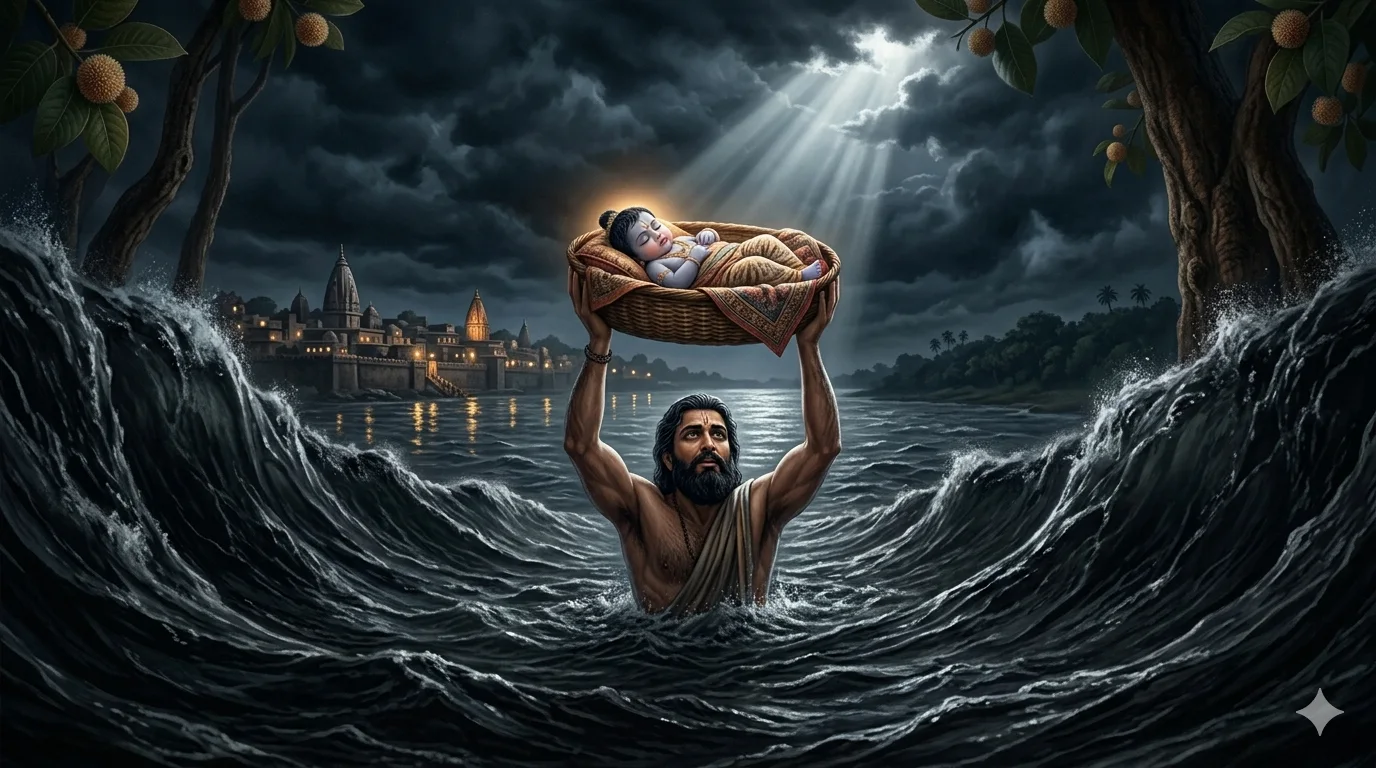
The Yamuna was in flood.
Vasudeva stood at the bank and looked at what was in front of him. The river was enormous in the darkness — black and fast and loud, pulling everything it had collected from a hundred miles upstream. Broken branches. Uprooted grass. The debris of a monsoon that had not yet finished with the land.
There was no boat. No bridge. No shallow crossing.
He looked at the river. He looked at the child in his arms.
Then he stepped in.
The water rose to his knees. To his waist. He kept walking. The current pushed hard against him — the particular violence of a flooded river that has forgotten its own banks. He planted each foot carefully before lifting the other.
The child above his head stayed dry. Stayed silent. Stayed completely, impossibly calm.
The water reached his chest.
Then his shoulders.
Then — and Vasudeva would spend the rest of his life trying to find words for this moment and never quite managing — the river changed.
Not all at once. Not dramatically. Simply and completely, the way a door opens when the right hand is on it.
The water pulled back. Not far. Just enough. A path opened — narrow, dark-edged, the riverbed slick and cold under his feet — and Vasudeva walked through the Yamuna the way you walk through a room where everyone has stepped aside to let you pass.
On the other bank he turned and looked back.
The river had closed behind him. It moved as it had always moved. Black, fast, indifferent to what had just happened or what it had just done.
He held the child tighter and walked toward Gokul.
Behind him, in the prison cell in Mathura, a baby girl began to cry. The guards woke. Kansa was summoned.
On the night of Krishna's birth, Vasudeva carries his newborn son out of Kansa's prison through doors that open without being touched and guards who sleep without being silenced. At the bank of the Yamuna — swollen with monsoon rain and impossible to cross — he steps into the water anyway, holding the child above his head. The river makes way. He reaches the other bank and walks toward Gokul. A story about what faith looks like when it stops being a thought and becomes a step taken in the dark.
💡 The Lesson Inside
Vasudeva did not pray on the bank of the Yamuna. He did not ask the river's permission. He did not wait for a sign that it was safe to enter. He simply stepped in — carrying the most precious thing he had ever held — and trusted that the way would open. That is what faith looks like when it is stripped of ceremony and sentiment. Not a feeling. Not a belief. A step. Taken in the dark. Into a flooded river. With no guarantee except the child in your arms and the direction you are walking.
✨ Words Worth Keeping
Debris
the broken scattered remains of things destroyed or carried away, the material evidence of something that has passed through. The morning after the storm the street was covered in debris, branches, roof tiles, a child's red bicycle lying on its side.
Indifferent
showing no interest or concern in either direction, neither for nor against, the particular quality of nature when it continues regardless of what humans need from it. The sea was indifferent to the small boat, moving as it always moved, neither helping nor hindering.
Immense
so large that its full size is difficult to take in at once, the kind of large that makes ordinary scale feel temporary. She stood at the base of the Himalayas and understood for the first time what immense actually meant.
Bottomless
so deep it appears to have no end, used both literally for very deep water and figuratively for eyes or feelings that seem to contain everything. He had the bottomless patience of someone who has learned that most things resolve themselves if you simply wait.
Corridor
a long narrow passage connecting rooms or sections of a building, the kind that feels longer when you are walking it in darkness or fear. The hospital corridor at two in the morning had a particular quality of silence that felt different from ordinary quiet.
🌱 Phrases to Remember
Pressed pause on the ordinary world
stopped everything from moving or happening in the normal way, as though a remote control had frozen the scene. Walking into her childhood home after ten years felt like someone had pressed pause on the ordinary world, everything exactly where she had left it.
The way will be made clear
a phrase expressing deep trust that the path forward will reveal itself at the right moment, even when it is not visible yet. She did not know how she would manage the next six months but she walked into them believing the way would be made clear.
Step aside
to move out of someone's path to allow them to pass, used both literally and to describe anything that yields to allow something important through. The crowd stepped aside as the ambulance forced its way through the narrow street.
Stripped of ceremony
reduced to its essential nature by removing all the formal or decorative elements that usually surround it. When you strip friendship of ceremony what remains is simply this, someone who shows up when things are difficult.
The story had already moved on
a way of saying that events have progressed past the point of interference or reversal, that what needed to happen has already happened and cannot be undone. By the time they realised what had occurred the story had already moved on, the decision was made and the consequences already in motion.
📚 Quick Glossary
Mathura
an ancient city in Uttar Pradesh, North India, considered the birthplace of Krishna. It was ruled by the tyrant king Kansa at the time of Krishna's birth, a city that lived under fear and waited without knowing it was waiting for the night everything would change.
Kansa
the cruel king of Mathura and Krishna's maternal uncle, who imprisoned Devaki and Vasudeva after a prophecy told him that Devaki's eighth child would bring about his end. Kansa ordered every child born to Devaki to be killed, which is why Vasudeva's crossing of the Yamuna with Krishna was an act of both love and survival.
Gokul
a small village across the Yamuna from Mathura where Nanda and Yashoda lived. This is where Vasudeva carried Krishna on the night of his birth, away from the prison and the cruel king, toward the family that would raise him as their own son.
Monsoon
the seasonal heavy rainfall that arrives across India between June and September, filling rivers to their banks and beyond. The Yamuna in monsoon is an entirely different river from the one that flows in winter, wider, faster, darker, and completely transformed by the weight of everything it carries.
🎬 See It in Action
1
The debris from the flood took three days to clear from the lower streets of the town.
2
She stood in the corridor outside the examination hall and could not remember a single thing she had studied.
3
He had the bottomless generosity of someone who genuinely does not keep count of what they give.
4
The board stepped aside when it became clear that the founder's vision was the only one worth following.
5
After the apology was made the story had already moved on — there was nothing left to argue about.
🗣️ Say It Right
Vasudeva
/say it like: vaa-soo-DAY-vuh/
Indifferent
/say it like: in-DIF-er-unt/
Corridor
/say it like: KOR-ih-dor/
Debris
/say it like: deh-BREE/
💬 Reflection Corner
Vasudeva does not pray or ask for a sign before stepping into the flooded river — he simply steps in. What does this tell us about the difference between faith as a feeling and faith as an action?
Have you ever had to take a step into something unknown without any guarantee that the way would open? What made you take it?
The story says the river was indifferent to what had just happened. Why do you think nature in this story does not celebrate or acknowledge the miracle it has just performed?
Every door in the prison opens before Vasudeva reaches it. What does this image suggest about what happens when a person is moving in the right direction?
The last line says the story had already moved on. What does it mean for a story — or a life — to move on before anyone has had time to understand what just happened?
Match the vocabulary word on the left with its correct meaning on the right.
Indifferent
Immense
Debris
Bottomless
showing no interest or concern in either direction, neither for nor against, the particular quality of nature when it continues regardless of what humans need from it. The sea was indifferent to the small boat, moving as it always moved, neither helping nor hindering.
the broken scattered remains of things destroyed or carried away, the material evidence of something that has passed through. The morning after the storm the street was covered in debris, branches, roof tiles, a child's red bicycle lying on its side.
so deep it appears to have no end, used both literally for very deep water and figuratively for eyes or feelings that seem to contain everything. He had the bottomless patience of someone who has learned that most things resolve themselves if you simply wait.
so large that its full size is difficult to take in at once, the kind of large that makes ordinary scale feel temporary. She stood at the base of the Himalayas and understood for the first time what immense actually meant.
Game 2: Context Solver✨ Reward: +15 XP
Story Context Solver
Analyze the story clues below and tap the vocabulary term that matches perfectly.
1. 📖 Meaning: "the broken scattered remains of things destroyed or carried away, the material evidence of something that has passed through. The morning after the storm the street was covered in debris, branches, roof tiles, a child's red bicycle lying on its side."
2. 📖 Meaning: "showing no interest or concern in either direction, neither for nor against, the particular quality of nature when it continues regardless of what humans need from it. The sea was indifferent to the small boat, moving as it always moved, neither helping nor hindering."
3. 📖 Meaning: "so large that its full size is difficult to take in at once, the kind of large that makes ordinary scale feel temporary. She stood at the base of the Himalayas and understood for the first time what immense actually meant."
Game 4: Story Sequencer✨ Reward: +20 XP
Timeline Sorting
The story paragraphs got jumbled up! Click the 🔼 and 🔽 buttons on each card to arrange them back into the correct chronological order.
He had been in this cell for eight years.
Vasudeva knew this because he had counted the stones in the wall so many times he could close his eyes and see every one. One hundred and forty-three stones. He had memorised each crack, each dark stain, each place where the mortar had crumbled slightly at the edges.
Inside the cell, something was happening.
Outside, Mathura slept. Kansa's guards slept. The whole frightened city slept the uneasy sleep of people who live under a cruel king and have learned not to ask questions about the sounds they hear at night.
Game 7: Story Builder✨ Reward: +30 XP
Creative Author Lab
Become the author! Write a short story or paragraph below. To unlock your reward points, you must write between 25 and 250 words and include at least two words from your vocabulary bank.
Reading Time: 2minutesOne morning in Kailash, the home of Lord Shiva and Goddess Parvati, two brothers — Kartikeya and Ganesha — sat before their parents.Parvati smiled and said, “My sons, today I
Reading Time: 3minutesBy late afternoon, the old Kashyap house had stopped feeling old. Its courtyard had chappals scattered everywhere. Somebody had left half-cut marigold strings near the gate. Pressure cooker whistles came