By late afternoon, the old Kashyap house had stopped feeling old.
Its courtyard had chappals scattered everywhere. Somebody had left half-cut marigold strings near the gate. Pressure cooker whistles came from the kitchen every few minutes, followed by Dadi shouting, “Meera, watch the kheer!”
For the first time in years, the house sounded like itself again.
Rajiv had come from Mumbai. Meera arrived from Pune with her six-year-old daughter Pari. Cousins who once raced across this same courtyard now stood in corners discussing office calls and school admissions.
Only Dadi looked untouched by time.
Eighty-two. Small frame. Cream shawl. Sharp eyes that still missed nothing.
She sat near the veranda while everyone rushed around.
“Rajiv,” she called suddenly, “bring me the old clay lamp.”
Rajiv looked up from hanging lights.
“Dadi, we bought twenty-four diyas today.”
“The old one.”
“The cracked one?” he asked.
“Yes.”
He sighed.
Not because he disagreed.
Because every Diwali Dadi remembered things nobody else remembered.
Aarav walked past holding his phone.
“Maybe it’s some secret magical diya,” he said without looking up. “Ancient family technology.”
Nobody reacted.
Teenagers hated when jokes failed.
He kept scrolling.
After a few minutes he found the lamp inside an old cupboard, wrapped in yellow cloth.
“This?” he asked.
The thing looked tired.
Its edges were chipped. Faded patches covered one side. Compared to the bright painted diyas outside, it looked like it had retired years ago.
Dadi smiled immediately.
“Yes.”
She took it from his hand carefully.
Too carefully.
Like people do with old photographs.
Evening arrived slowly.
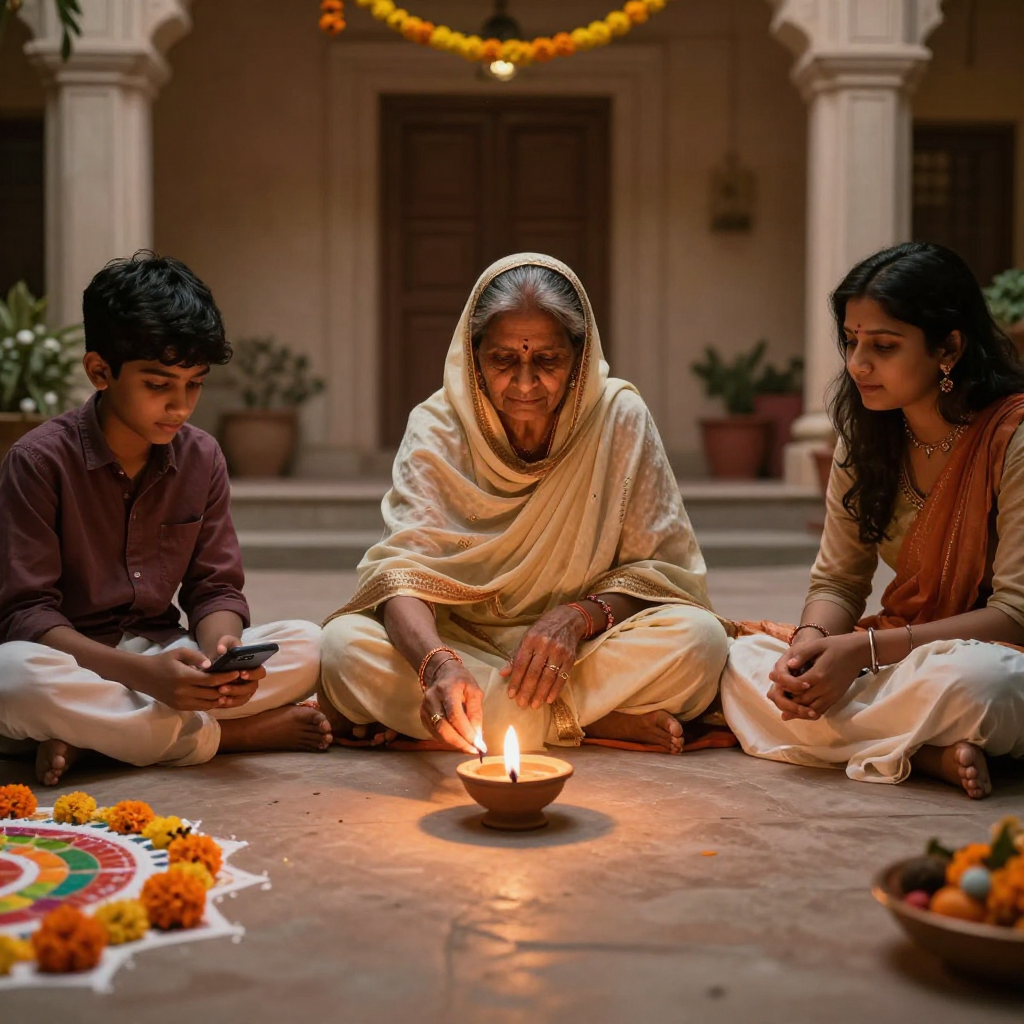
The rangoli in the courtyard was finished. Someone had already smudged one corner by accident. Fairy lights blinked across the balcony.
From the kitchen came the smell of hot ghee and cardamom.
Pari ran around carrying sparklers she wasn’t allowed to light yet.
Then prayers began.
Rows of lamps flickered around the house.
And Dadi lit the old clay lamp first.
Just first.
No explanation.
For a few moments she simply watched it.
Then—
Darkness.
The power disappeared so suddenly that little Pari squealed.
“Oh no!”
Rajiv looked upward immediately.
“Perfect timing,” he muttered.
Phones appeared almost automatically.
Including Aarav’s.
His face glowed blue from the screen.
“No network either,” he sighed dramatically.
The decorative lights outside had gone dark.
The television inside stopped.
The noise disappeared.
Only one thing remained.
That small cracked lamp.
Its flame moved gently in the middle of the courtyard.
Dadi looked around.
“Come sit.”
Nobody argued.
Maybe because there was nothing else to do.
Maybe because darkness makes people listen differently.
Everyone gathered around the lamp.
A tray of chai sat nearby.
Five minutes later nobody remembered to drink it.
Dadi looked at the flame.
“Your Dadaji bought this lamp forty years ago.”
Aarav glanced up.
“This one?”
She nodded.
“The year we moved into this house, we had almost nothing.”
Silence.
No one had heard this before.
“No decorations,” Dadi said. “No sweets. Barely enough money after repairing the roof.”
She laughed softly.
“And your grandfather came home carrying one tiny diya.”
Meera smiled.
“Oh no.”
“Oh yes,” Dadi said immediately. “I became angry.”
Rajiv looked shocked.
“You? Angry?”
“Very.”
Everyone laughed.
“I told him, ‘One lamp? One? People will think we forgot Diwali completely.’”
Pari giggled.
“What did Dadaji say?”
For a moment Dadi looked somewhere beyond the courtyard.
Past the lights.
Past the years.
Then she smiled.
“He said, ‘Let’s light this one first. If the house feels full after that, we have enough.’”
Nobody spoke.
Firecrackers burst somewhere far away.
Softly.
Dadi adjusted the shawl around her shoulders.
“Then every year before lighting anything else, we sat together for a few minutes.”
She looked around.
“No guests. No rushing. No discussing bills or school marks.”
Rajiv laughed.
“That rule was definitely Dadaji.”
She smiled.
“Just sitting.”
The courtyard stayed quiet.
Aarav looked down at his phone.
The battery symbol flashed red.
He stared at it for a second.
Then quietly turned it face down beside him.
Nobody noticed.
Or maybe Dadi did.
After a while she said, “Tell me something good from this year.”
Not thankful.
Not blessings.
Just something good.
Meera spoke first.
“Pari finally stopped drawing on my walls.”
“Not true!” Pari protested immediately.
Laughter.
Rajiv shook his head.
“My blood pressure report was normal.”
“Now that’s a real Diwali miracle,” Meera said.
More laughter.
Even Dadi wiped tears from her eyes.
Then everyone looked toward Aarav.
He shrugged.
For a second it seemed he would say nothing.
“Honestly?” he said.
Silence.
“I thought this trip would be boring.”
Rajiv looked offended immediately.
“Very nice.”
“No, listen.”
Aarav looked toward the lamp.
Then toward the dark house around them.
“I forgot this place sounds different.”
Nobody interrupted.
“The city is always noisy. Here…” he paused.
“…you can actually hear people.”
No one spoke after that.
Not immediately.
Somewhere beside them, the chai had gone cold.
A few moments later electricity returned.
Lights blinked back.
The house became bright again.
But nobody got up.
Nobody reached for phones.
They sat there a little longer.
Around one old clay lamp.
Years later, Aarav would still remember that night.
Not the rangoli.
Not the sweets.
Not even the firecrackers.
Just a small flame.
And a house that somehow felt fuller in the dark.
Story in brief
An old grandmother gathers her family in their ancestral home during Diwali and insists on lighting one cracked clay lamp first. A sudden power cut turns an ordinary evening into a quiet circle of memories, laughter, and unexpected honesty. Sometimes people return home before they realize they were missing it.
The lesson inside
Funny thing about family traditions — most of us think we remember them because of rituals. The sweets, the lights, the photos. But sometimes what stays isn't the big thing at all. It's one small habit, repeated every year, quietly keeping a seat warm for everyone.