
In the village of Vrindavan, everyone loved Gopal.
He was named Krishna when he was small. When he was still the boy who ran through the village barefoot, stealing butter from clay pots, making the cows follow him just by playing his flute.
Every family in Vrindavan knew him. Every grandmother had fed him. Every child had run with him through the mustard fields in the golden afternoon light.
He was theirs. That is how they felt. Our Gopal.
One year, the rains came angrily
The sky turned the colour of a bruise. Thunder rolled down from the hills like something enormous turning over in its sleep. The river rose above its banks and crept toward the village.
The children held their mothers’ hands. The cows pressed close together. The old grandmothers stood in their doorways and looked at the sky and said prayers they had learned as children themselves.
Nanda — Gopal’s father looked at his son.
Gopal was standing in the middle of the courtyard, looking up at the sky. His feet were bare on the wet earth. His flute was tucked into his patka. He was completely calm — the way the centre of something is always calm, no matter what is spinning around it.
“Gopal,” his father said.
Gopal turned. He looked at his father with those dark eyes that sometimes seemed to hold more than a child’s eyes should hold.
“Don’t be afraid, Baba,” he said. “Bring everyone to Govardhan hill. Bring the cows. Bring the children. Bring all of it.”
Nanda did not fully understand. But he trusted his son the way Vrindavan had always trusted Gopal — not because they could explain why, but because something in their hearts had always known.
He called the village together. They walked through the rain toward Govardhan hill — the great green hill that had stood at the edge of Vrindavan since before anyone’s grandfather’s grandfather could remember.
Gopal walked ahead. Small. Barefoot. Unhurried.
At the base of Govardhan Hill, he stopped. He turned to face the village. Every face he loved was looking back at him.
He turned to the hill.
He pressed one small hand against its ancient stone — the way you press your hand to the face of someone you love.
Then he lifted it.
Not with effort. Not with a great cry or a show of strength. He simply lifted it the way he did everything — lightly, completely, as though it were the most natural thing.
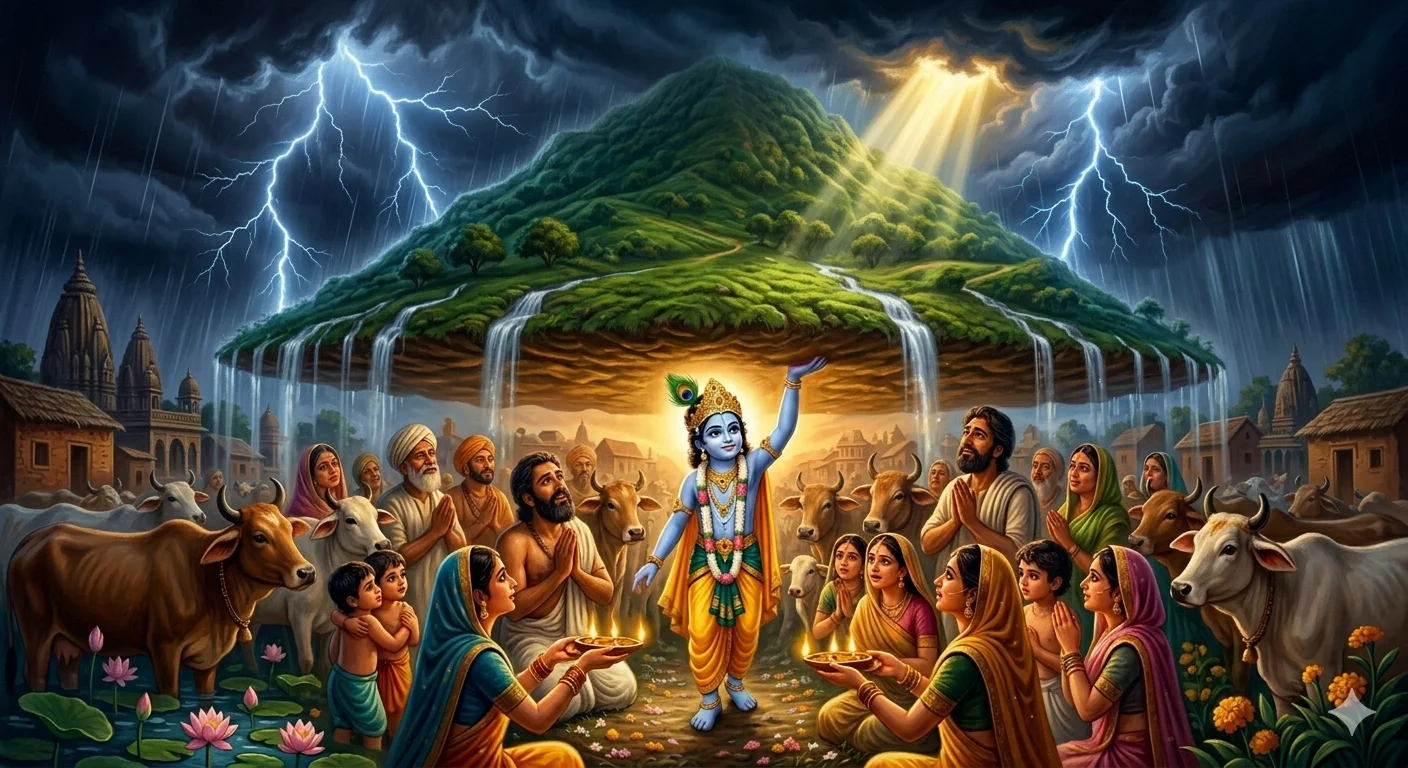
The hill rose above Vrindavan like the roof of the biggest home in the world.
The rain hammered above. The thunder shook the clouds. But underneath the hill — still. Dry. Safe. The smell of wet earth and marigolds and the warm breath of cows settling down to sleep.
The families sat together under their hill. Grandmothers held grandchildren. Mothers fed babies. Fathers sat close. The cows folded their legs beneath them. Someone, somewhere, began to hum an evening bhajan — softly, the way you hum when everything is all right.
Gopal stood at the edge and held the hill steady.
He held it for seven days.
He did not sit. He did not eat. He simply stood — that small, barefoot boy from Vrindavan — and held an entire mountain above the people he loved.
On the seventh morning, the storm was gone.
The sky was clean and gold. The river had settled. The birds had come back to the trees.
Gopal set Govardhan down exactly where it had always stood. He patted its side once — the way you pat the back of an old friend.
Then he turned to the village.
“Now,” he said, looking at all of them — the grandmothers and the children, the fathers and the cows — “shall we eat something? I am very hungry.”
The whole village laughed. And in that laughter was everything — relief and love and the particular joy of people who have just understood, fully and completely, that they are cared for.
✨ Words Worth Keeping
🌱 Phrases to Remember
📚 Quick Glossary
🎬 See It in Action
Devotion — say it like: deh-VOH-shun
Ancient — say it like: AYN-shunt


