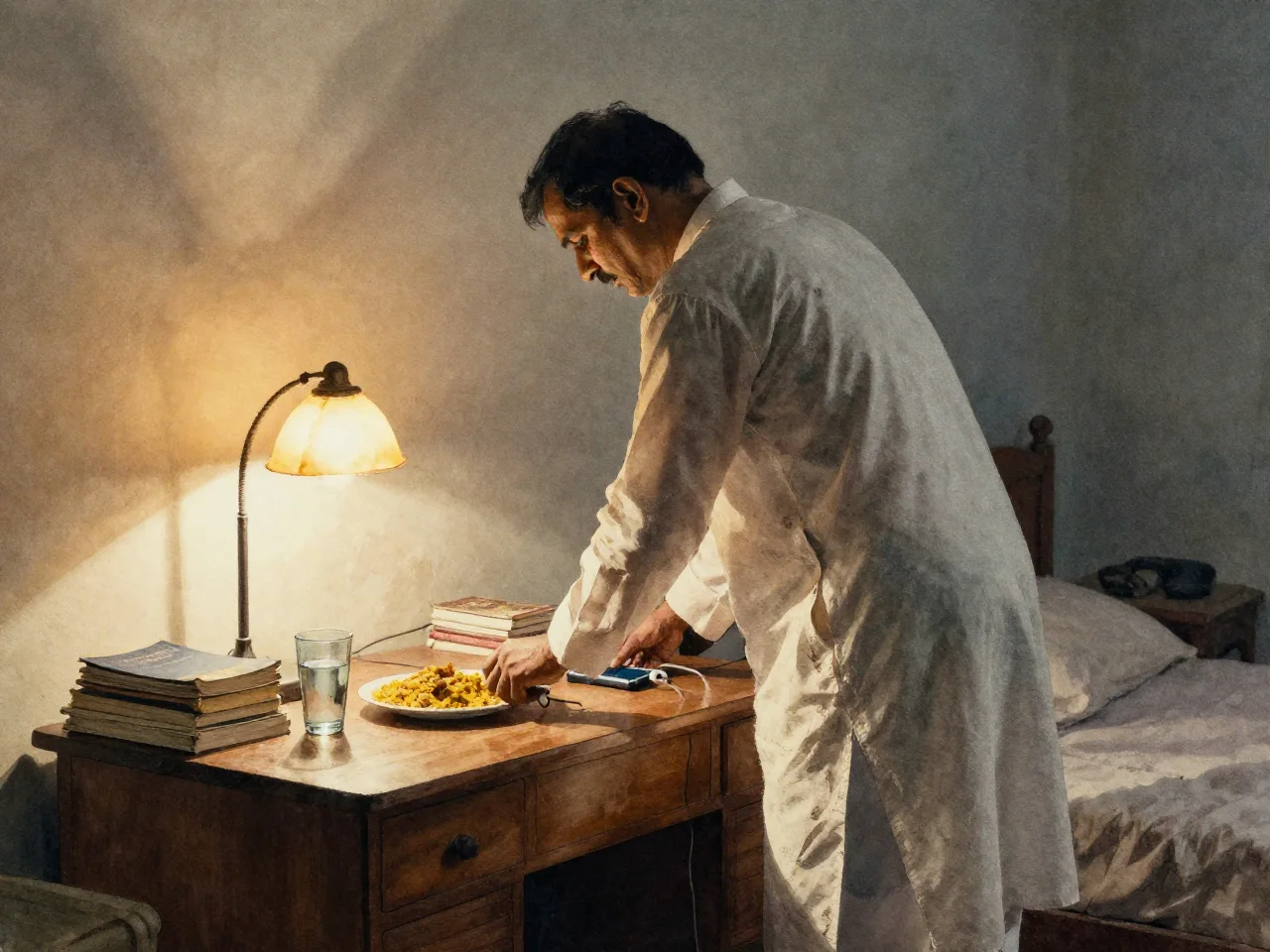
Rohan had left every light on in his room, the fan running, his laptop plugged in, and gone to college. Vikram noticed at seven in the morning before his first Teams call. He sent a message. Rohan didn’t reply. By evening, when Rohan came home dropping his bag on the sofa like it had personally offended him, Vikram was ready.
“Do you think money comes from the wall?” Vikram said, not looking up from his laptop.
“It was one fan, Papa.”
“It is never one fan. It is one fan, one light, one charger, one month, every month.”
Rohan picked up his bag, went to his room, and closed the door. Not a slam. Worse — a controlled, deliberate click that said everything a slam would have said, but with more dignity.
Vikram stared at his screen. A Jira ticket he had been ignoring all afternoon. He didn’t read a word of it.
Inside his room, Rohan sat on the bed and pulled up his notes. He had a unit test tomorrow. Economics. Supply, demand, cost curves. He read the same paragraph four times.
At nine-thirty, his mother knocked.
“Come eat.”
“Not hungry.”
She opened the door anyway, the way mothers do when they’ve already decided hunger is not the point. She left a plate of dal-chawal on his desk, said nothing, and walked out.
At ten-fifteen, Rohan heard his father’s chair scrape against the floor. The sound of the kitchen tap. The refrigerator opening. The usual sounds of his father’s late-night ritual — one glass of cold water before bed, every night, for as long as Rohan could remember.
Then. Silence.
Then, a soft knock. His door opened two inches.
“Your charger,” Vikram said. Just that. He placed Rohan’s phone charger on the desk beside the plate — the one Rohan had left in the drawing room — and walked back out without waiting for a response.
Rohan looked at the charger for a long time.
His phone was at four percent. He had not gone out to get the charger himself because that would have meant walking past his father, and neither of them was ready for that yet. His father had known. His father had brought it anyway.
He plugged in his phone. Pulled the plate of dal-chawal closer. Started eating.
The economics notes stopped making sense at midnight. He typed a message to his father: Cost curve chapter — can you explain the logic tomorrow morning?
He put the phone down and didn’t wait to see if Vikram would reply at that hour.
The reply came in forty seconds.
Yes. Wake me up.
Rohan lay back on his pillow and looked at the ceiling fan — switched off, for once — and the corner of his mouth did something that was not quite a smile and not quite not one either.
The argument was not resolved. It would come back, probably next week, probably about something equally small. But the charger was on the desk. The reply had come in forty seconds. Some things did not need to be said to be understood.
Match the vocabulary word on the left with its correct meaning on the right.
Deliberate
Resolved
Ritual
Dignity
the quality of behaving with composure and self-respect, especially in a tense moment — choosing control over reaction.
fully settled or concluded — when something is resolved, the disagreement or problem is genuinely finished, not just paused.
a repeated action done regularly, almost without thinking — not religious necessarily, but personal and habitual, something that marks routine and belonging.
done with full intention and awareness — not accidental, not impulsive, but chosen. Used here to describe the kind of action that carries a silent message.
Game 2: Context Solver✨ Reward: +15 XP
Story Context Solver
Analyze the story clues below and tap the vocabulary term that matches perfectly.
1. 📖 Meaning: "done with full intention and awareness — not accidental, not impulsive, but chosen. Used here to describe the kind of action that carries a silent message."
2. 📖 Meaning: "a repeated action done regularly, almost without thinking — not religious necessarily, but personal and habitual, something that marks routine and belonging."
3. 📖 Meaning: "fully settled or concluded — when something is resolved, the disagreement or problem is genuinely finished, not just paused."
Game 4: Story Sequencer✨ Reward: +20 XP
Timeline Sorting
The story paragraphs got jumbled up! Click the 🔼 and 🔽 buttons on each card to arrange them back into the correct chronological order.
"It is never one fan. It is one fan, one light, one charger, one month, every month."
"Do you think money comes from the wall?" Vikram said, not looking up from his laptop.
Rohan had left every light on in his room, the fan running, his laptop plugged in, and gone to college. Vikram noticed at seven in the morning before his first Teams call. He sent a message. Rohan didn't reply. By evening, when Rohan came home dropping his bag on the sofa like it had personally offended him, Vikram was ready.
The fight was about the electricity bill. Again.
Game 7: Story Builder✨ Reward: +30 XP
Creative Author Lab
Become the author! Write a short story or paragraph below. To unlock your reward points, you must write between 25 and 250 words and include at least two words from your vocabulary bank.
Your Vocabulary Word Bank:
❌Deliberate❌Ritual❌Resolved❌Dignity❌Impulsive
Words: 0 / 25Vocabulary Used: 0 / 2
📖 Story in Brief
A routine argument about electricity costs drives a wedge of silence between Rohan, a college student, and his IT professional father Vikram.
Neither apologises, but that night Vikram brings Rohan's forgotten phone charger to his room — and when Rohan texts about an economics chapter at ten-fifteen, the reply comes in forty seconds.
The story shows that between fathers and sons, love does not always speak first — sometimes it just places a charger on the desk and walks away.
💡 The Lesson Inside
Between fathers and sons, love rarely travels in straight lines. It arrives as a charger left on a desk, as a reply sent at midnight, as a question asked about economics when what is really being asked is — are we okay? The ego between them is real. So is everything underneath it. The two have always existed together, and most of the time, the second one wins — just without announcing itself.
✨ Words Worth Keeping
Deliberate
done with full intention and awareness — not accidental, not impulsive, but chosen. Used here to describe the kind of action that carries a silent message.
Ritual
a repeated action done regularly, almost without thinking — not religious necessarily, but personal and habitual, something that marks routine and belonging.
Resolved
fully settled or concluded — when something is resolved, the disagreement or problem is genuinely finished, not just paused.
Dignity
the quality of behaving with composure and self-respect, especially in a tense moment — choosing control over reaction.
Impulsive
acting quickly on feeling without thinking it through first — the opposite of deliberate; often used to describe arguments that begin before either person is ready.
🌱 Phrases to Remember
Not looking up
continuing to focus on something in front of you while speaking — a way of showing emotional distance or controlled irritation without confrontation.
Adding fuel to it
making a conflict or bad situation worse by saying or doing something that intensifies it — from the image of throwing fuel onto a fire.
Not ready for that yet
a phrase used when two people are in conflict and neither has emotionally cooled down enough to face each other directly — a pause before reconciliation.
Without waiting for a response
doing something kind or necessary and leaving before the other person can react — a gesture that asks for nothing in return.
Did not need to be said to be understood
describing communication that happens without words — through action, timing, or presence — and is fully felt by both people.
📚 Quick Glossary
Dal
chawal - lentil curry served over steamed rice — the most common comfort meal in Indian households, often made when someone is unwell, upset, or simply needs feeding without fuss.
Jira ticket
a task or bug assigned in Jira, a project management tool used widely in IT companies — a very specific detail of the Indian IT professional's daily life.
Teams call
a video or audio meeting on Microsoft Teams — standard in Indian IT offices, often starting early in the morning to align with global time zones.
Unit test
a scheduled class test in Indian colleges covering one unit or chapter of the syllabus — smaller than a semester exam but taken seriously by students.
🎬 See It in Action
1
He left without a word, closing the door with deliberate care — the kind that hurts more than a slam.
2
Their evening chai together had become a ritual neither of them talked about but both of them protected.
3
The argument was not resolved but they had both stopped adding fuel to it, and that was enough for tonight.
4
She placed his lunch on the desk without waiting for a response and walked back to the kitchen.
5
Some things between them did not need to be said to be understood — his presence at the hospital at two in the morning was one of them.
Match the vocabulary word on the left with its correct meaning on the right.
Dignity
Resolved
Deliberate
Ritual
fully settled or concluded — when something is resolved, the disagreement or problem is genuinely finished, not just paused.
done with full intention and awareness — not accidental, not impulsive, but chosen. Used here to describe the kind of action that carries a silent message.
the quality of behaving with composure and self-respect, especially in a tense moment — choosing control over reaction.
a repeated action done regularly, almost without thinking — not religious necessarily, but personal and habitual, something that marks routine and belonging.
Game 2: Context Solver✨ Reward: +15 XP
Story Context Solver
Analyze the story clues below and tap the vocabulary term that matches perfectly.
1. 📖 Meaning: "done with full intention and awareness — not accidental, not impulsive, but chosen. Used here to describe the kind of action that carries a silent message."
2. 📖 Meaning: "a repeated action done regularly, almost without thinking — not religious necessarily, but personal and habitual, something that marks routine and belonging."
3. 📖 Meaning: "fully settled or concluded — when something is resolved, the disagreement or problem is genuinely finished, not just paused."
Game 4: Story Sequencer✨ Reward: +20 XP
Timeline Sorting
The story paragraphs got jumbled up! Click the 🔼 and 🔽 buttons on each card to arrange them back into the correct chronological order.
"Do you think money comes from the wall?" Vikram said, not looking up from his laptop.
Rohan had left every light on in his room, the fan running, his laptop plugged in, and gone to college. Vikram noticed at seven in the morning before his first Teams call. He sent a message. Rohan didn't reply. By evening, when Rohan came home dropping his bag on the sofa like it had personally offended him, Vikram was ready.
The fight was about the electricity bill. Again.
"It is never one fan. It is one fan, one light, one charger, one month, every month."
Game 7: Story Builder✨ Reward: +30 XP
Creative Author Lab
Become the author! Write a short story or paragraph below. To unlock your reward points, you must write between 25 and 250 words and include at least two words from your vocabulary bank.
Reading Time: < 1minute“You’re wasting ten minutes every day,” the station master said. “One day you’ll realize it.” Aarav only smiled. Every evening, before catching his train home, he spent ten minutes arranging
Reading Time: < 1minuteHigh above the clouds, the Moon yawned.He looked at his sky full of stars and said softly, “It’s almost bedtime, little ones. Let’s shine gently so the world can sleep.”