
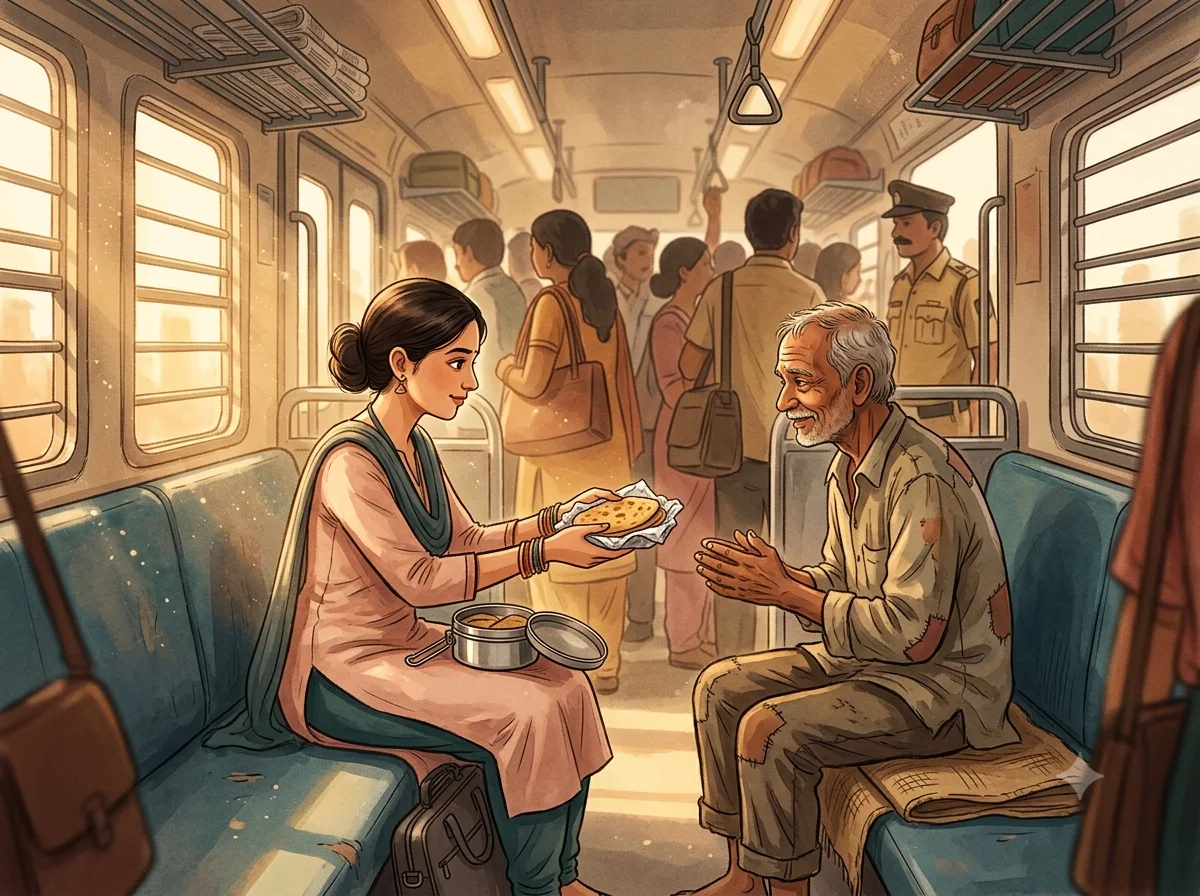
The 6:47 fast local from Andheri emptied out around Bhagwan Das every single day. He sat near the door on a folded jute sack, and the blue vinyl seat beside him stayed empty long after the compartment filled to bursting.
Ananya Kulkarni had watched this happen for six years without once looking twice. Today, her feet carried her straight to that seat, and she sat down before she could talk herself out of it.
The ticket checker in his khaki uniform pushed through the crowd two stations later. He stopped in front of Bhagwan Das, tapping his ticket punch against his palm.
“Ticket,” he said.
Bhagwan Das reached slowly for the folded newspapers on his lap, as if pretending to search would buy him a few more seconds on the train.
“He’s with me,” Ananya said, before she had decided to say it. She held up two fingers along with her own pass. “I’m paying for both.”
The checker looked between them, shrugged, and punched a ticket into her hand.
Bhagwan Das didn’t say anything for a while. Then: “Why?”
“You looked like you needed someone to say it,” Ananya said. “That’s all.”
He laughed — short, surprised, like the sound had been sitting unused for years. “Madam, in twelve years on this train, you are the first person who has said anything to me at all.”
She opened her tiffin box and passed him a paratha wrapped in foil, still faintly warm. He took it with both hands, the way you take something you weren’t expecting to be offered twice in one morning.
They talked between Jogeshwari and Borivali — about the garment factory in Bhiwandi that had closed on him, about the newspapers he now sold outside Andheri station, folded with more care than most people give their own clothes.
“You have a good job?” he asked.
“I manage accounts for a shipping company. Twelve people report to me.”
“That is a big job.”
“Some days I don’t feel big at all,” she admitted.
He nodded like this made complete sense. “Success,” he said, “is being able to look at someone — and have them look back.”
At Borivali, Ananya stood to leave. She held out her hand. He hesitated, then shook it, firm and brief, his palm rough against hers.
“Same time tomorrow?”
“I am always here, madam.”
She stepped off the train. Behind her, through the closing doors, she saw a schoolboy slide into the seat beside Bhagwan Das without a second thought — the way children do, before anyone has taught them who not to sit beside.


