English Short Stories

The Empty Chair at the Table

The Empty Chair at the Table

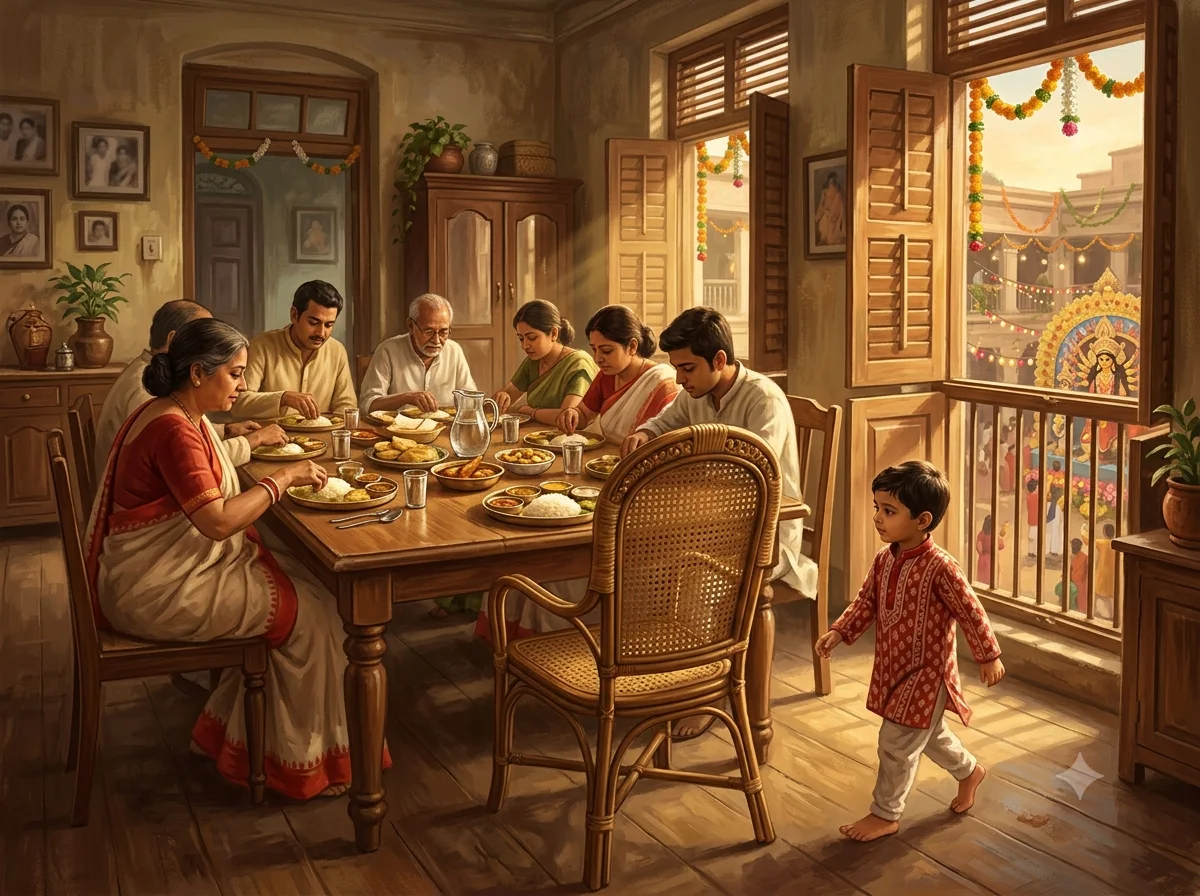
An empty cane chair at a Bengali family's Durga Puja table — Krishna story about grief and loss.
Reading Time: 3 minutes

The cane chair at the head of the table had been empty for four months, but nobody had said so out loud until Ishaan, seven years old and unaware of the rule nobody had written down, pulled it out and climbed onto it during the Ashtami lunch.

“Ishaan, not there,” his mother Sharmila said quickly, already half out of her own seat.

The boy froze, one knee still on the cane seat, waiting to find out what he’d done wrong.

“He’s just a child,” Dida said from her corner of the room — quietly enough that it wasn’t really an argument. Ishaan slid back down onto the floor mat anyway and wandered off toward the courtyard, where the dhak drums from the pandal two streets away rattled the window glass.

Ananya watched all this from across the table, a plate of khichuri and labra going cold in front of her. Four months since Dadu’s chair had become the chair nobody used, and the whole house still organized itself around the shape of his absence, the way a room rearranges itself around a piece of furniture that’s been moved.

She hadn’t meant to go up to his study that afternoon. She’d gone looking for a spare fan for the guest room, and instead found the door slightly open, the smell of old paper and mustard-oil hair tonic still faintly there, four months on, in a way that undid something in her chest before she’d even stepped inside.

His reading glasses were still on the desk, folded, waiting for a face that would never come back to reclaim them. Beside them, his old Gita — not the ornamental one from the puja shelf downstairs, but this one, cloth-bound, spine cracked white from being opened at the same pages for forty years.

She sat down in his chair, the actual chair, not the one downstairs that had quietly become a monument, and opened the book without really deciding to.

It fell open on its own to a page worn soft at the corner, the way pages go when a hand returns to them again and again. Pencil in the margin, his handwriting, small and slanted the way it always was on birthday cards and grocery lists — “Not born. Cannot die. Only the coat changes.”

Underneath, in a different, later ink, like he’d added it years after the first note: “Read this the year Baba died. Read it again the year I turned seventy. Still true both times, which surprised me.”

Ananya read it twice, then a third time, and found she wasn’t crying the way she’d been bracing herself to, downstairs, every time someone mentioned him. It was something quieter than that — more like the feeling of finding a letter addressed, unexpectedly, to exactly the person she happened to be that day.

She heard Ishaan’s feet on the stairs before she saw him, chasing something invisible, the particular thunder that only a seven-year-old produces on a wooden staircase. He stopped in the doorway when he saw her.

“Am I in trouble?”

“No.” She closed the book carefully, keeping a finger at the page. “Come here a second.”

He came and stood at her knee, unbothered by dust or old-paper smell, in the way only children are.

“Dadu used to sit exactly like that,” Ananya said, “with a book open and his glasses pushed up on his forehead, forgetting he wasn’t wearing them.”

Ishaan considered the glasses on the desk with new interest. “Can I wear them?”

“They won’t help you see anything. He was very shortsighted.” She smiled, surprising herself with it. “But you can hold them if you want.”

Downstairs, lunch had mostly finished by the time they came back down, plates cleared to the kitchen, Dida dozing in her chair by the window, the dhak still going somewhere outside, low and constant under everything else, the way it had been all week.

The cane chair sat empty at the head of the table, same as it had for four months.

Ishaan walked past it, hesitated, glanced at his mother, who this time said nothing at all, and climbed up into it — not with the same uncertain scramble as before, but simply, the way a child sits down anywhere there’s room.

Nobody moved to stop him.

Ananya, watching from the doorway, found she didn’t want them to.

Scripture/Source: Inspired by the Bhagavad Gita, Chapter 2, Verses 20 and 27 — Krishna’s teaching that the soul is never born and never dies, and that grieving the inevitable brings no lasting peace. Not a direct verse translation; adapted as an original story.

Continue Reading

Faith in Krishna — a different kind of hardship, and the same quiet trust that carries a person through what can’t be controlled.

📄 Free printable worksheet available below.
Complete the learning activities and download it at the end of this lesson.

📖 Story in Brief
Four months after her grandfather's death, Ananya finds his old, well-worn Gita in his empty study, its most-read page marked in his own handwriting about the soul's permanence. Downstairs, his chair sits empty at the family table until her young cousin finally, simply, sits down in it.
💡 The Lesson Inside
Grief doesn't ask us to stop missing someone. It only asks, eventually, for the chair to be sat in again — ordinary life quietly continuing, without that being a betrayal of what was lost.
✨ Words Worth Keeping
Rattled
shook or vibrated, usually from noise or sudden movement.
You might say: The passing train rattled every window in the old house.
Undid
loosened, disturbed, or unraveled something that had felt firmly held together.
You might say: One phone call undid the calm she'd worked all morning to build.
Slanted
leaning or sloped at an angle rather than straight.
You might say: His signature was slanted so far right it was barely legible.
Shortsighted
unable to see distant things clearly without help.
You might say: My grandmother was so shortsighted she read the newspaper an inch from her nose.
Monument
something kept or built specifically to honor a memory.
You might say: The old cricket bat in the hallway had become a kind of monument to her father's youth.
🌱 Phrases to Remember
Organize itself around someone's absence
the way daily life quietly reshapes around a person who is gone.
In real life you might say: The whole office still organizes itself around the empty desk where he used to sit.
Worn soft
smoothed or softened by being touched or used again and again.
In real life you might say: The stair rail was worn soft in the middle from decades of hands.
Half out of her seat
already moving to react, before fully deciding to.
In real life you might say: She was half out of her seat the moment she heard the crash in the kitchen.
Without really deciding to
doing something automatically, before consciously choosing it.
In real life you might say: He found himself dialing her number without really deciding to.
Only the coat changes
the idea that the outer form may end, while what's essential continues.
In real life you might say: My father used to say only the coat changes, whenever someone at the funeral needed comfort.
📚 Quick Glossary
Dadu
a Bengali word for grandfather, used with warmth across Bengali households.
Dida
a Bengali word for grandmother, equally affectionate and common at home.
Ashtami
the eighth and one of the most important days of Durga Puja, marked by special rituals and family gatherings.
Khichuri
a comforting rice-and-lentil dish, often cooked and shared during Durga Puja in Bengali homes.
Dhak
a traditional drum played during Durga Puja processions, its rhythm considered inseparable from the festival itself.
🎬 See It in Action
1

Rattled — The old ceiling fan rattled every time it was switched on.

2

Undid — A single kind word undid the tension that had built up all week.

3

Slanted — The old photograph hung slightly slanted on the wall.

4

Shortsighted — Without his glasses, he was too shortsighted to read the menu.

5

Monument — The trophy shelf had become a quiet monument to her college years.

🗣️ Say It Right
Ashtami
//osh-TOH-mee//
Khichuri
//kih-CHOO-ree//
Dhak
//DHAK/ (soft "d," rhymes with "hut")/

🎯 Complete the Story Challenges

🧩 Vocabulary Explorer ✏️ Context Architect Timeline Master ✍️ Creative Novelist
Game 1: Word Match ✨ Reward: +10 XP

Vocabulary Matcher

Match the vocabulary word on the left with its correct meaning on the right.

Rattled
Shortsighted
Undid
Slanted
loosened, disturbed, or unraveled something that had felt firmly held together.
leaning or sloped at an angle rather than straight.
shook or vibrated, usually from noise or sudden movement.
unable to see distant things clearly without help.
Free Reading Comprehension Worksheet

Strengthen your English skills with a printable worksheet based on this story.

Vocabulary Practice Reading Comprehension Critical Thinking Writing Skills
Download & Print Worksheet

Free for students, parents, teachers and ESL learners.

One more story before you go...

A husband discovers his wife's smaller plate in the kitchen — a short moral story about sacrifice in marriage.

The Steel Tiffin

Reading Time: 2 minutesRamesh worked in a small accounts office near Dadar station. Every morning at eight, his wife Sunita packed his tiffin — the old steel one with a dent on the

Read More »

Stories you may like...

A worn white Santro parked beside a gleaming new Fortuner SUV in an Indian residential society — Krishna story about desire.

Reading Time: 4 minutesNinad had been driving the Santro for eight months now — errands mostly, his mother’s saree emergencies, his father’s files

Read More »
A young woman and an old flute player at Bandra Bandstand sunset — Krishna story about social media addiction.

Reading Time: 3 minutesAisha Deshmukh’s phone buzzed at 11:47 pm, and she was awake in a second, thumb already unlocking the screen before

Read More »
Father holding a brass Krishna statue while talking to his son in their garden, pothole visible outside.

Reading Time: 3 minutesThe rain had stopped an hour ago, but the road outside their house still remembered it — brown water sitting

Read More »

Readers Also Enjoyed

📖 Finding your next story...

Learn something new

Featured Vocabulary
Break free
Escape, liberate
Literary Term
Rangoli
colorful floor art made near entrances during festivals to welcome happiness and guests.
Idiomatic Expression
thought carefully
Considered deeply before deciding
Speech & Pronunciation
Routine
Phonetic: roo-TEEN

Sign up to my newsletter

A story for every mood: