Reading Time: 2 minutesYashoda heard it before she saw it.
The soft scrape of a wooden stool being dragged across the kitchen floor. Then silence — the particular silence of a child trying very hard not to exist.
She stood at the doorway and watched.
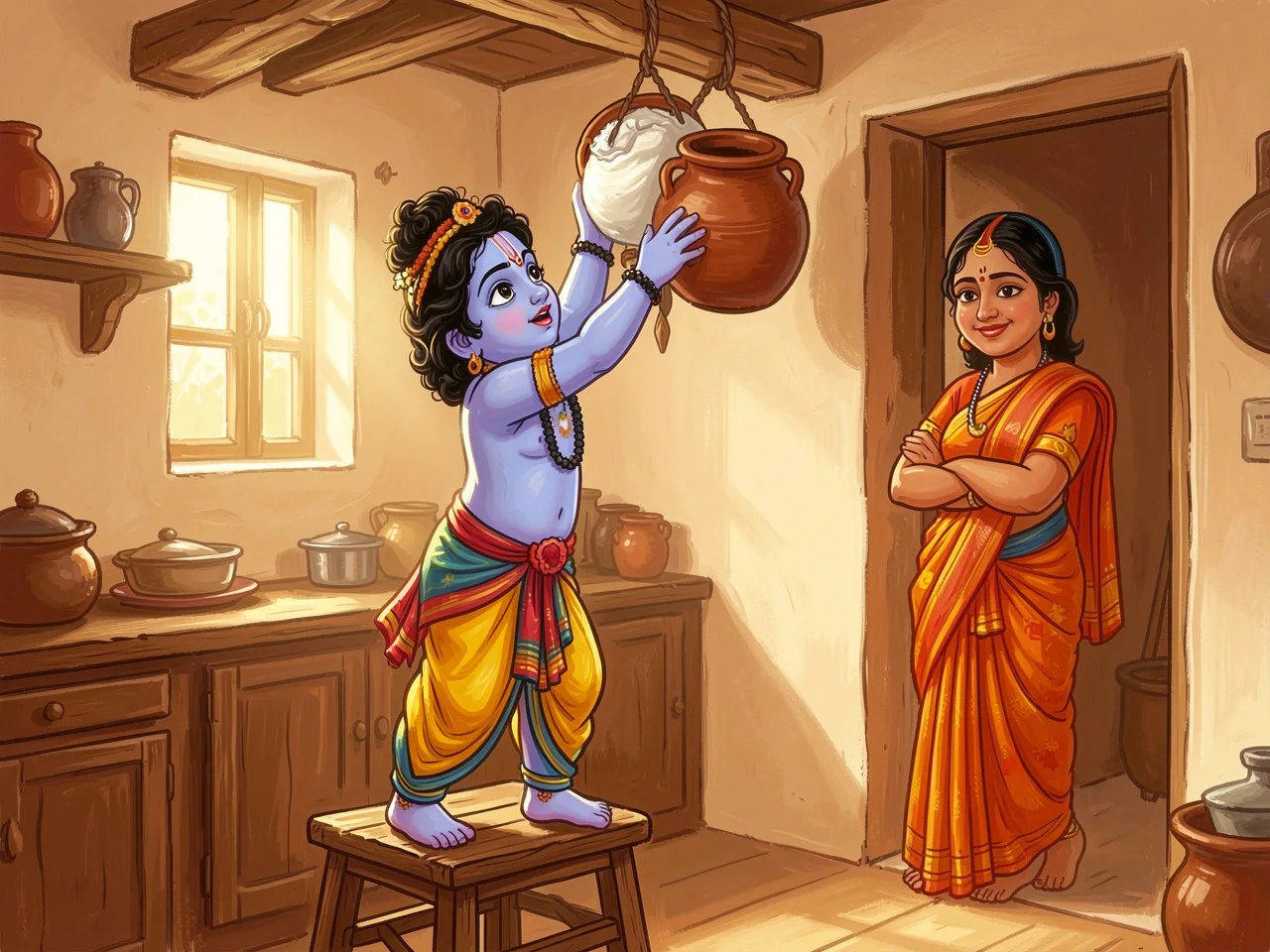
Krishna was seven years old and standing on his toes on the stool, both arms stretched toward the clay pot of fresh makhan she had hung from the ceiling beam that morning. His fingers were just — just — reaching the rim. His tongue was already out in concentration.
He had not heard her come in.
Yashoda folded her arms. She did not move. She did not speak.
The pot swayed. Krishna grabbed it with both hands, steadied it, then looked down.
He saw her.
For one full second neither of them moved. His eyes went wide — not guilty exactly, more the expression of someone who has been caught mid-sentence in a story they cannot now finish.
Then he smiled.
Not a sorry smile. Not a caught smile. The smile of someone who knows that the person watching them loves them too completely for this to end badly.
Yashoda pressed her lips together hard.
“Down,” she said. “Now.”
He climbed down from the stool with great dignity, the pot still in his hands, makhan on three fingers and one elbow. He held it out to her with the expression of someone presenting a gift.
“I was checking,” he said, “if it was fresh.”
“The makhan I churned at four this morning.”
“It could have turned.”
“It is ten o’clock, Kanha.”
He considered this seriously. “Quickly, sometimes.”
Yashoda took the pot from him. She set it on the shelf. She turned back around and looked at her son — at the butter on his cheek that he had not noticed, at the stool still sitting under the beam, at the small perfect chaos of him standing in her kitchen in the morning light.
She thought about what she had been planning to say. Something about respect. Something about the gopis whose pots he had broken last Tuesday, whose complaints she was still receiving. Something firm and clear that a mother was supposed to say.
Instead she tucked a strand of hair behind his ear.
“Go wash your hands,” she said. “Both of them. And your elbow.”
He was already running.
She stood in the kitchen alone for a moment, the morning quiet settling back around her. She picked up the churning rope. She looked at the pot on the shelf — fingerprints on the rim, lid slightly crooked.
Outside, she could hear him calling to Balaram. Already forgetting. Already onto the next thing.
Yashoda began to churn again. The rope moved in her hands with its old familiar rhythm — the same rhythm her mother had taught her, and her mother before that.
She was smiling. Just slightly. Just enough.
She would hang the pot higher tomorrow.
She would not hang it high enough.
📖 Story in Brief
Yashoda catches young Krishna stealing freshly churned butter from a clay pot she hung from the kitchen ceiling that morning. Krishna offers an excuse so cheerful and shameless that it is impossible to take seriously. Yashoda sends him away with a look softer than she intended — and hangs the pot in exactly the same place the next morning. A story about the secret mathematics of a mother's love.
💡 The Lesson Inside
There is a kind of love that lives in the space between what we say and what we feel. Yashoda had every reason to be firm. She had the words ready. But love — real love, the daily ordinary kind — sometimes expresses itself most honestly in the moment we choose not to use them. Every parent who has ever hidden a smile behind a serious face knows exactly what Yashoda felt standing in that kitchen. The pot was never really about the butter.
✨ Words Worth Keeping
Exasperationthe feeling of being thoroughly frustrated by someone, especially someone you love too much to stay angry at for long.
Churnto stir or beat something like cream or milk repeatedly until it changes form, the way butter is made by hand in traditional Indian homes.
Dignitya quality of calm self-respect, the way a person carries themselves when they refuse to be embarrassed.
Chaosa state of complete disorder and unpredictability, the kind that small children carry with them like weather.
Rhythma regular repeated pattern of movement or sound, the kind that lives in the body before it lives in the mind.
🌱 Phrases to Remember
Caught mid-sentenceto be discovered in the middle of doing or saying something you cannot now convincingly finish or explain. In real life
Example:He looked caught mid-sentence when his mother walked in — hand in the biscuit tin, explanation nowhere ready.
Pressed her lips togethera physical description of someone suppressing a smile, laugh, or sharp word — holding something in deliberately. In real life
Example:She pressed her lips together when her son explained why the cat was wearing a doll's hat.
Too completely for this to end badlythe quiet certainty that someone's love for you is large enough to absorb your mistake. In real life
Example:She knew her father was annoyed, but she also knew he loved her too completely for this to end badly.
Already onto the next thingthe particular quality of a child's attention that moves on before any adult emotion has finished processing. In real life
Example:He had already forgotten the argument — he was already onto the next thing, calling his friends from the gate.
Hide a smile behind a serious facethe universal parenting act of suppressing amusement in order to maintain necessary authority. In real life
Example:Every teacher learns early to hide a smile behind a serious face when a student's excuse is genuinely creative.
📚 Quick Glossary
Makhan
fresh white butter made at home by churning curd, softer and purer than commercial butter. In Vrindavan, makhan is Krishna's most beloved food — and the thing he is most famous for stealing from his mother's kitchen and every neighbour's pot within reach.
Gopis
the women of Vrindavan, the village where Krishna grew up. They are milkmaids and cowherd women, Krishna's neighbours, devotees, and the people most frequently robbed of their butter and curd by a cheerful seven-year-old god.
Balaram
Krishna's elder brother, his closest companion in childhood. Where Krishna went, Balaram followed — and where trouble went, both of them were usually nearby.
Kanha
one of the most beloved pet names for Krishna, used by his mother Yashoda and by devotees. Softer and more intimate than Krishna — the name a mother uses, not a temple.
Clay pot
an earthen vessel used in traditional Indian homes to store water, curd, and butter. Hung from ceiling beams to keep cool and — theoretically — out of reach of small children.
🗣️ Say It Right
Exasperation/ex-as-per-AY-shun/
Churn/CHURN (rhymes with learn)/