Ramesh Iyer adjusted his spectacles and cleared his throat—a sound that, in the Sharma household on the sixth floor, meant listen up, I am about to be correct.
It was Sunday morning, 9:47 AM. The annual general meeting of the Gokul Dham Co-operative Housing Society was running forty-two minutes behind schedule. The generator had been coughing like a sick goat for three months, the lift had developed a habit of stopping exactly between floors, and someone had painted a rather unflattering caricature of the secretary on the notice board.
“I will solve everything,” Ramesh announced to his wife, Meena, who was pouring tea into a steel tumbler. “They always need me.”
Meena said nothing. She had been saying nothing in this particular way for twenty-three years.
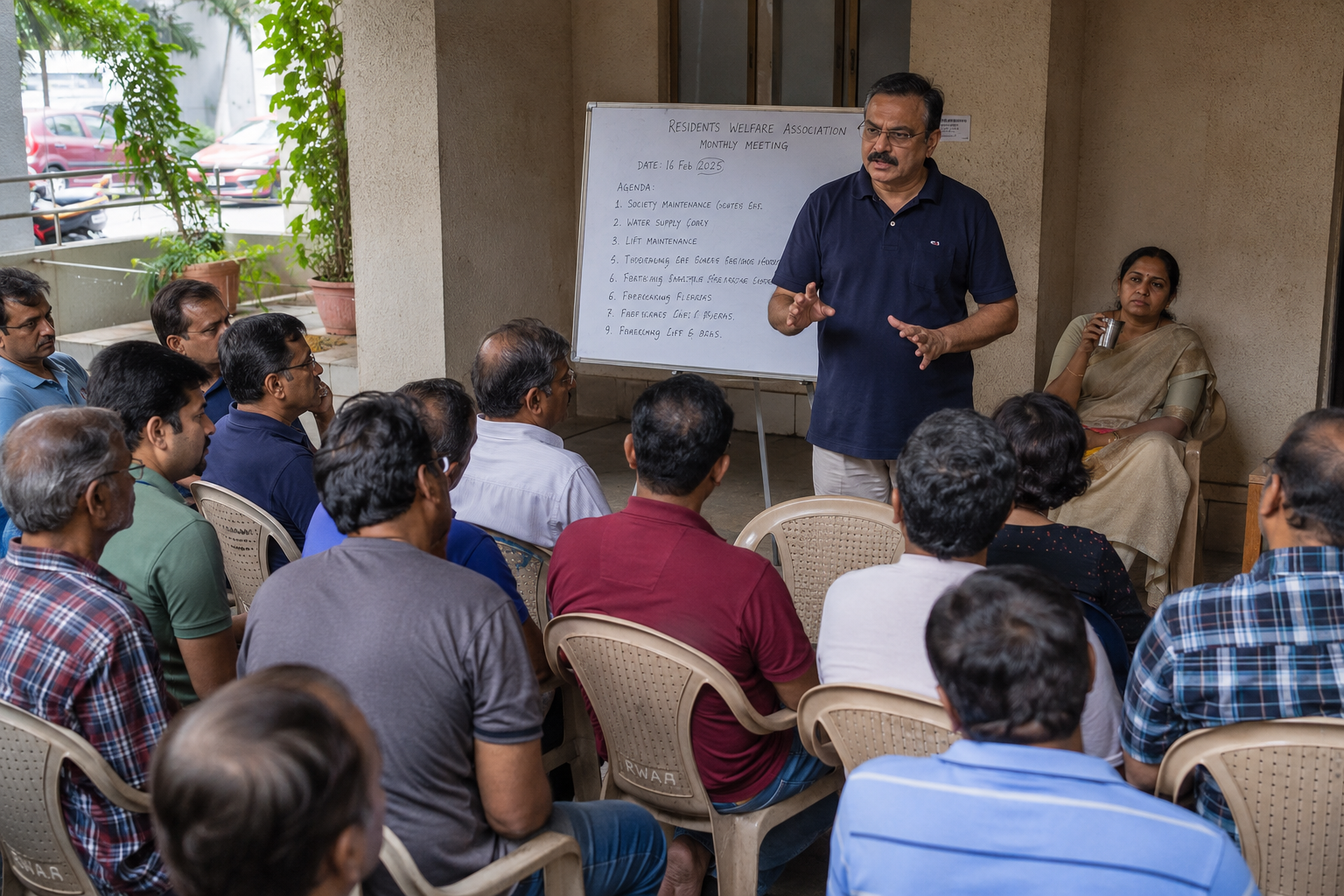
The meeting was held in the building courtyard, under a banyan tree that had seen better days—much like the generator, much like the lift, much like everyone’s patience. Thirty residents sat on plastic chairs. Mrs. Kulkarni had brought biscuits. Mr. D’Souza had brought a list of complaints written on both sides of an electricity bill.
Ramesh stood up before the secretary could call the meeting to order.
“The problem,” Ramesh announced, pointing at the generator with the authority of a man pointing at a map of a country he had never visited, “is that you idiots used the wrong grade of diesel.”
Silence. Then Mr. Mehta from the second floor said, “But we don’t have a generator. That’s the problem.”
“I know that,” Ramesh said quickly, because Ramesh always knew everything, including things that weren’t true. “I meant the backup battery system. Obviously.”
The secretary, a tired man named Suresh who had been trying to resign for four years, sighed. “Ramesh ji, we don’t have a backup battery system either. The building was built in 1987. We have a rusty inverter that runs on hope.”
Ramesh’s left eye twitched. This was the moment when most men would sit down. Ramesh was not most men.
“Then the lift problem,” he said, pivoting so fast his elbow hit Mrs. Kulkarni’s biscuit plate. “The lift stops between floors because—and I have researched this extensively on WhatsApp University—the cable tension is uneven by exactly 2.3 millimeters.”
Mrs. Kulkarni rescued her biscuits. “But Ramesh, I saw you last week standing outside the lift because it wouldn’t close. You stood there for twenty minutes pressing the button harder.”
“That was a different problem,” Ramesh said. “That was a button problem. Today I am talking about cable tension. Completely different department.”
Meena, from the back row, took a very slow sip of tea. She did not look up. She did not need to.
The meeting continued in this fashion for another forty-five minutes. Ramesh corrected everyone. The lift was not broken, it was misaligned. The water tank did not leak, it was redistributing moisture. The crack in the boundary wall was not a crack, it was a micro-fissure requiring complex geological analysis.
Then came the moment.
The building watchman, a gentle man named Bhaskar who had been working there since 1995, walked up to the whiteboard where someone had listed the agenda items. He picked up a marker and, with the careful handwriting of someone who had taught himself to read at age forty, wrote:
Item 7: Who painted the secretary on the notice board?
Everyone laughed. Bhaskar smiled.
Ramesh stood up again. “This is a waste of time. The culprit is obviously Mr. D’Souza. He has a grudge.”
Mr. D’Souza dropped his electricity bill. “I have a what? I named my dog after the secretary!”
“Exactly,” Ramesh said. “Classic misdirection. I read about this in a psychology book I saw on the internet.”
Meena put down her tea. She stood up. Everyone turned, because Meena never stood up at meetings. She barely spoke at meetings. She came for the biscuits.
“Ramesh,” she said quietly. “I painted the secretary.”
The courtyard went so silent you could hear the generator not working.
Ramesh laughed. “Darling, don’t joke. You don’t even know how to draw.”
“I know how to draw a moustache on a sleeping man,” Meena said. “Which I did. At 2 AM last Thursday. When you were snoring.”
Someone in the back coughed. Someone else choked on a biscuit. Mr. D’Souza looked like he wanted to hug Meena.
Ramesh opened his mouth. Closed it. Opened it again. His face cycled through seven colors, none of them flattering.
“You—but—the psychology—the internet said—”
“The internet also said you could charge your phone in the microwave,” Meena said. “You tried it. Remember? February 14th. Our anniversary.”
The courtyard erupted. Not angry erupt—happy erupt. The kind of laughter that makes your stomach hurt. Even the banyan tree seemed to shake.
For the first time in his life, Ramesh Iyer had nothing to say.
He sat down. He looked at his shoes. He looked at Meena. She smiled—not a victory smile, not an I-told-you-so smile. Just a gentle, tired, I-love-you-but-seriously smile.
“The generator needs a new spark plug,” Meena said to the secretary. “The lift needs a sensor cleaning. The water tank has a leak in the third joint from the left. Bhaskar can fix all of it by Tuesday.”
She sat back down. Everyone applauded. Including, after a long, long pause, Ramesh.
✨ Words Worth Keeping
🌱 Phrases to Remember
📚 Quick Glossary
🎬 See It in Action
The meeting started forty-two minutes late because the secretary forgot the keys to the community hall.
Mrs. Kulkarni brought two packets of Parle-G biscuits, which disappeared within ten minutes.
Mr. D'Souza named his Labrador "Suresh" after the secretary, which everyone found hilarious except Suresh.
The generator coughed exactly three times before giving up completely, as if it knew it was being discussed.
Ramesh's face cycled through seven colors, none of which matched his shirt.