Reading Time: 2 minutesIt started with a handful of mud.
Sita from next door came running before the afternoon had fully settled — breathless, indignant, her dupatta half-undone from running.
“Yashoda! Your son. Your Kanha. He has been eating mud again. Right there by the river bank. I saw him.”
Yashoda set down her vessel. She knew the look on Sita’s face. She had been receiving versions of this face her entire life — from neighbours, from the gopis, from her own mother-in-law. Your son. Your Kanha.
She found him by the peepal tree at the edge of the yard, sitting with the absolute stillness of a child who has heard footsteps and is now concentrating very hard on looking innocent.
His mouth was closed. His hands were behind his back.
“Kanha.”
He looked up. The picture of serenity.
“Open your mouth.”
A pause. The kind that contains an entire conversation happening entirely inside one small person.
Then he opened it.
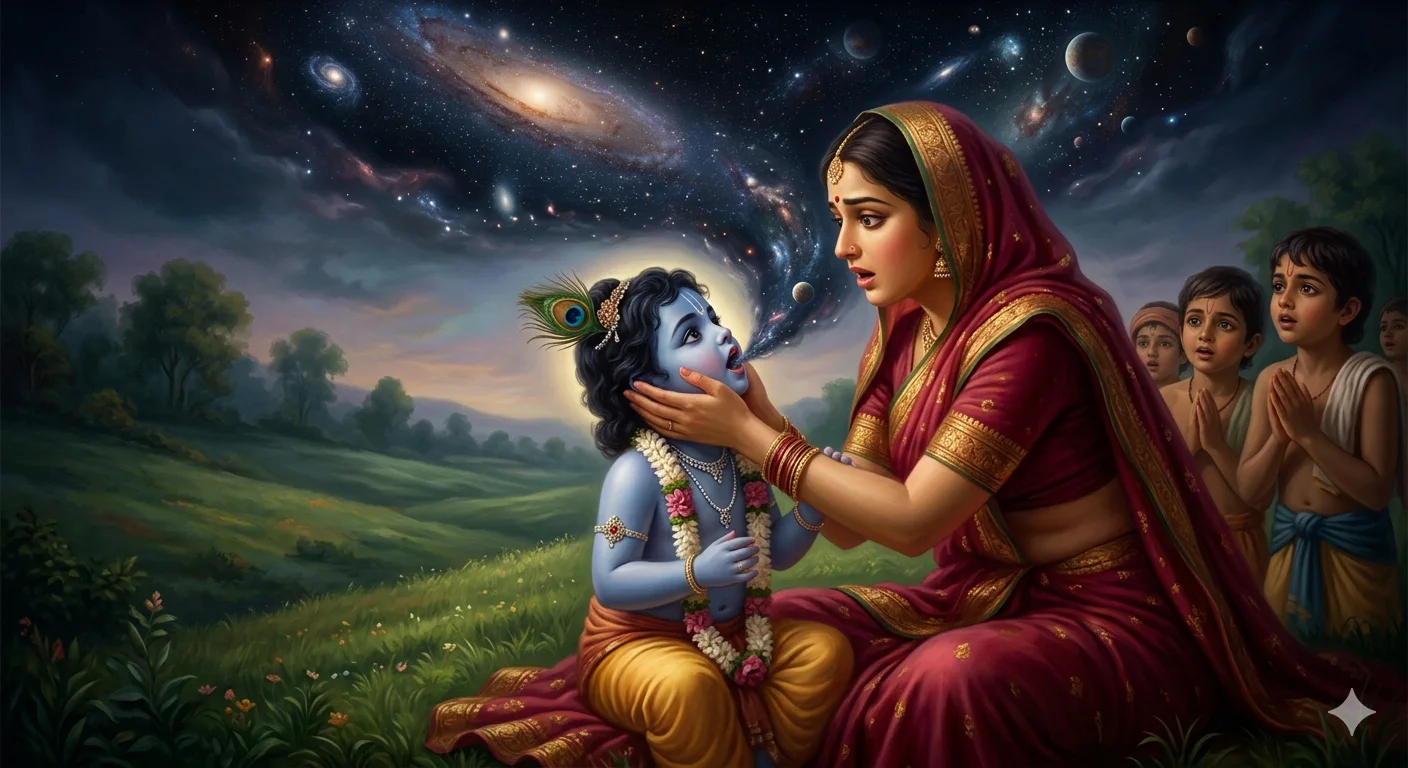
Yashoda leaned down to look — ready with her scolding, ready with the speech about mud and illness and what the vaidya had said last month — and stopped.
She could not move.
Inside her son’s open mouth she saw the river. The Yamuna, wide and silver in afternoon light. She saw the fields of Vrindavan stretching beyond it — green and gold and impossibly vast. She saw the sky above the fields and the stars inside the sky, and beyond the stars something she had no name for, something that kept going and going without ever finding a wall or an edge or a place where it ended.
She saw fire. She saw ocean. She saw forests she had never walked through and cities she had never heard of and faces of people who had not yet been born.
She saw all of it inside the open mouth of her seven-year-old son, who was watching her with dark eyes that held no expression she could read.
Then her mind — the part of her that churned butter and braided hair and counted how many rotis were left for dinner — her mind closed gently around the vision like a hand closing around water.
She forgot.
Not all at once. The way a dream forgets itself — from the edges inward. First the stars, then the ocean, then the fields.
By the time she was standing fully upright again she remembered only that she had looked and that something had been there and that it had felt like standing in a doorway of a house you have never entered but somehow already know.
She looked at her son.
He had closed his mouth. He was sitting exactly as before — small, unhurried, his hands still behind his back, mud at the corner of his lip.
She did not scold him.
She sat down on the ground beside him, which she had not done since he was small enough to carry. The earth was warm. The peepal tree made its quiet sound above them. Somewhere behind the house, Sita was still talking.
Yashoda put her hand on top of her son’s head the way she had done ten thousand times before. She felt the familiar warmth of him. The ordinary weight of his hair under her palm.
“Come inside,” she said. “Wash your hands before dinner.”
He stood. He took her hand. They walked back across the yard together in the late afternoon light — a mother and a small boy, unremarkable from any distance, the mud still on his lip, her heart still ringing with something she could no longer name.
📖 Story in Brief
Yashoda goes to scold Krishna for eating mud and instead finds the entire universe inside his open mouth — rivers, stars, forests, and faces of people not yet born. Her ordinary mind cannot hold what she has seen, and by the time she is standing upright the vision is already leaving her. She sits beside her son in the afternoon light and walks him home for dinner, her heart ringing with something she will spend the rest of her life almost remembering.
💡 The Lesson Inside
The infinite does not always announce itself. Sometimes it opens its mouth in the middle of an afternoon and shows you everything — and then closes again, and the world continues as it was, and you carry your dinner plate to the table and call the children in from outside. Yashoda forgot what she saw, but her hand on her son's head was never quite the same after. Some knowledge lives below the part of us that remembers. It changes how we hold things even when we cannot say why.
✨ Words Worth Keeping
Serenitya quality of deep calm that goes beyond just being relaxed — the stillness of someone who is completely at peace with where they are.
Vastso large that it goes beyond what the eye or mind can comfortably hold — the word for oceans, skies, and things that keep going past the point where you expect them to stop.
Indignantfeeling or showing strong displeasure at something that feels unfair or disrespectful — the particular offended energy of someone who wants it known that they have been wronged.
Unremarkablenot special or noticeable in any way — the quality of something that blends into ordinary life without drawing attention.
Vaidyaa traditional Indian physician who practices Ayurvedic medicine, the ancient system of healing using herbs, diet, and natural remedies. In village India, the vaidya was the first person a family called when a child fell ill.
🌱 Phrases to Remember
The picture of serenitya phrase used to describe someone who looks completely calm and untroubled, usually when you suspect they are hiding something. In real life
Example:He sat at the table the picture of serenity while everyone around him was trying to figure out who had eaten the last of the cake.
From the edges inwardthe way something disappears gradually, starting at the outside and moving toward the centre — the way dreams fade, the way grief loosens, the way light leaves a room. In real life
Example:The memory came apart from the edges inward, and by morning she could only recall that something important had happened.
Below the part of us that remembersthe deep unconscious place where experiences live even after our conscious mind has forgotten them — the place that changes how we feel without telling us why. In real life
Example:Some music lives below the part of us that remembers — you hear it and something shifts before you even know the song.
Almost rememberingthe state of being on the edge of a memory that will not fully surface — close enough to feel but not close enough to hold. In real life
Example:She spent the whole morning almost remembering a dream that had left behind only a colour and a feeling.
Never quite the same aftera phrase for the quiet permanent change that a significant experience leaves on a person — not dramatic, not announced, just different in some way that matters. In real life
Example:He had always been careful with his words, but after that conversation he was never quite the same after — slower to judge, quicker to listen.
📚 Quick Glossary
Dupatta
a long scarf worn by Indian women, draped over the shoulders or head. It is part of everyday dress across North India and carries both practical and cultural significance — a detail that tells a reader immediately they are in Indian life.
Peepal tree
a large sacred fig tree found across India, considered holy in Hindu, Buddhist, and Jain traditions. Village life in India is organised partly around peepal trees — they are gathering places, resting places, and the shade under which important conversations happen.
Vrindavan
the village in Uttar Pradesh, India, where Krishna spent his childhood. It sits on the banks of the Yamuna river and is considered one of the most sacred places in Hinduism — a town that has been defined entirely by one childhood.
Yamuna
one of India's most sacred rivers, flowing through North India past Vrindavan, Agra, and Delhi. In Krishna stories the Yamuna is almost a character in itself — the river the gopis crossed, the river Vasudeva waded through on the night of Krishna's birth.
Roti
a round flatbread made daily in Indian homes, cooked on a tawa over flame. It is the most ordinary food of Indian life — and that is exactly why Yashoda thinking about rotis in the middle of a cosmic vision is the most human detail in the story.
🗣️ Say It Right
Unremarkable/un-reh-MAR-kuh-bul/